Retro Explore — Discover classic retro games
Lumines II
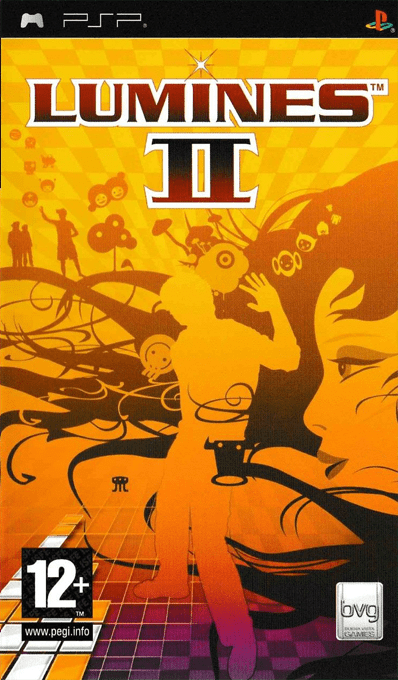
The sequel to the Lumines stays close the original puzzle game, but add some twists. The gameplay is identical: you arrange blocks, made of four smaller block pieces with two colours in total, to form shapes with an identical colour, as a square of four pieces or more. The blocks can be rotated and are stacked with the other blocks on the board. A vertical line crosses the screen and when it hits the right side, all combinations are removed, causing chain combos and clearing the board. You have to prevent the blocks from piling up and reaching the top of the screen. There are also special blocks you can use to remove many blocks at once. Games are played against colorful backgrounds and the speed of the timeline matches the music of the level, while the falling speed of the blocks increases as you get further in the game. The game modes are either new or have been remixed. In the single-player Challenge mode, there are three difficulty classes. By clearing levels you unlock new music, skins and game modes. One of these are the Endurance challenge runs, where you have to play through all skins in the game. Next to games with regular skins, some backgrounds now have 3D animations or show music videos of popular artists. The sound effects and the design of blocks is often adapted to fit the music. For levels with music video skins, you cannot play through them at a quicker pace to clear the level as you have to keep going until the song ends. The other single-player modes are Time Attack mode (get a high score with limited time, you can even record your session) and Puzzle mode where you need to create shapes. You can also challenge the computer in the VS CPU Mode. Here, you need to score more than your opponent to make his playing field smaller until he gets stuck. This game type is also available as the Duel mode against a human player through Wi-Fi. The order of the skins can be defined in the new Skin Edit mode. The Single Lap section allows you to make your own playlists for a set run, while the Endless Lap allows you to choose or exclude skins to keep playing as long as you like. There are 60 levels and 100 skins in total. Another new feature is the Mission mode where more strategy is required. You are given specific tasks to clear boards with a limited amount of blocks or time. In the new Sequencer mode, you can compose your own songs. The game provides options to define the speed and 8 separate music sheets to place notes and effects on. The high scores, playlists from the Skin Edit mode, songs from the Sequencer mode and replays of the Time Attack mode can be exchanged with other players through Wi-Fi. Your performance is tracked in the Database mode where statistics of your playing sessions are available. The game also includes a demo of Every Extend Extra, another puzzle game by Q ENTERTAINMENT, Inc.
God of War : Chains of Olympus
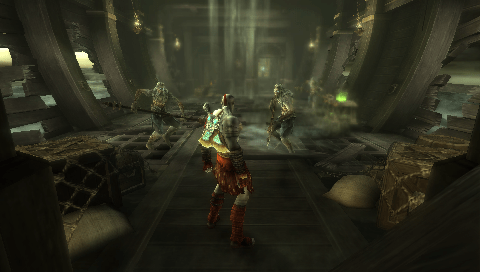
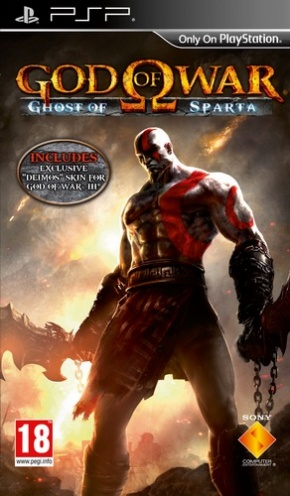
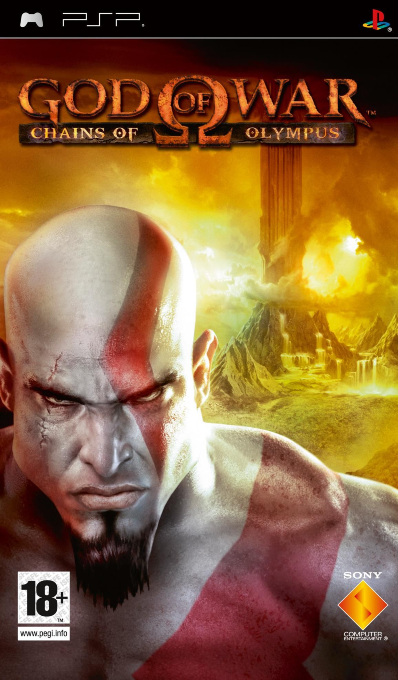
God of War: Chains of Olympus for PSP is a 2008 action-adventure game developed by Ready at Dawn in collaboration with Sony Computer Entertainment's Santa Monica Studio and published by Sony Computer Entertainment. It brings Kratos' Greek-mythology saga to PlayStation Portable in a story set before the original 2005 God of War. Kratos is still bound to serve the Olympian gods, hoping that their tasks will eventually ease the nightmares that haunt him. When the sun vanishes and darkness spreads across Greece, Athena sends the Spartan warrior to discover what has happened to Helios and restore the order of Olympus. The PSP adventure follows the series' familiar third-person format, mixing close-range combat, traversal and environmental puzzles. Kratos fights with the chained Blades of Chaos, sweeping through groups with combinations of light and heavy attacks, evasive moves and timed finishing actions against formidable foes. The portable controls adapt the series to the PSP's single analog nub by assigning functions around the face buttons and shoulder triggers. Magic attacks expand Kratos' offensive options, while later equipment gives him additional ways to approach enemies and obstacles. Chains of Olympus sends Kratos through a mythic version of ancient Greece, beginning amid the Persian assault on Attica before moving through Marathon, the Temple of Helios and lands beneath Olympus. His journey leads into the Underworld, where locations include the River Styx, Tartarus and the Fields of Elysium. The route is built around fixed cinematic camera angles, platforming sequences involving jumps, climbs, ropes and balance beams, and puzzles that ask players to manipulate objects or locate the items needed to open a path. Enemies draw from Greek myth, including Gorgons, Cyclopes, satyrs, harpies and Minotaurs. The central conflict introduces Helios' sister Eos, the ferryman Charon, the Titan Atlas and Persephone, Queen of the Underworld. Atlas has captured Helios as part of a plan that threatens both Olympus and the world below it, leaving Kratos to pursue the Sun God's chariot and confront the forces behind the crisis. The story also returns to Kratos' grief over his lost family through Calliope, his daughter, making the mission more personal as it reaches the Fields of Elysium. It remains a single-player game, with a post-game Challenge of Hades mode that presents five objective-based trials and unlockable extras. As the first God of War made specifically for PSP, Chains of Olympus was designed to preserve the scale and rhythm of its PlayStation 2 predecessors on a handheld system. Ready at Dawn used the PSP hardware for detailed character animation, large mythological encounters and a presentation that avoids frequent interruptions between areas. The original PSP release arrived in North America on March 4, 2008; Capcom published it in Japan later that year. In 2011, it was paired with God of War: Ghost of Sparta in the PlayStation 3 compilation God of War: Origins Collection, giving the two portable chapters an HD home-console release.


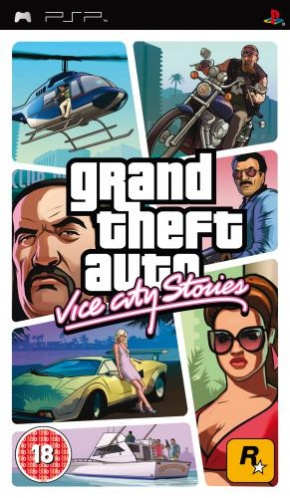
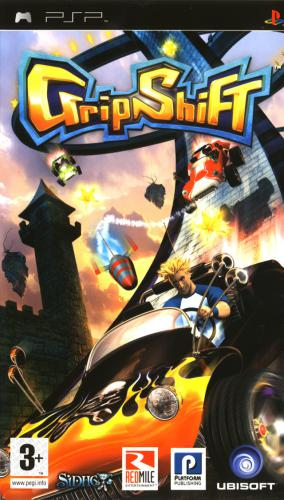

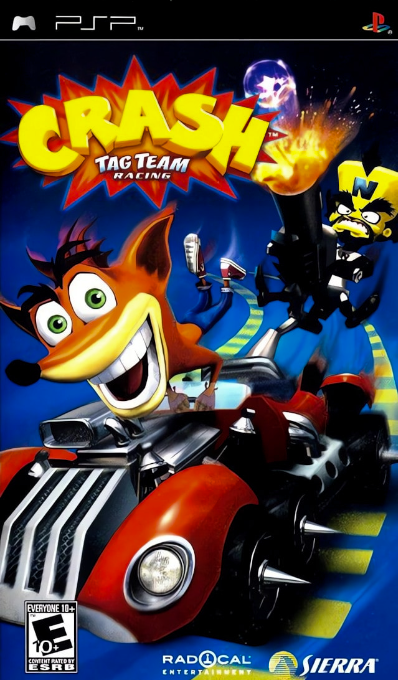

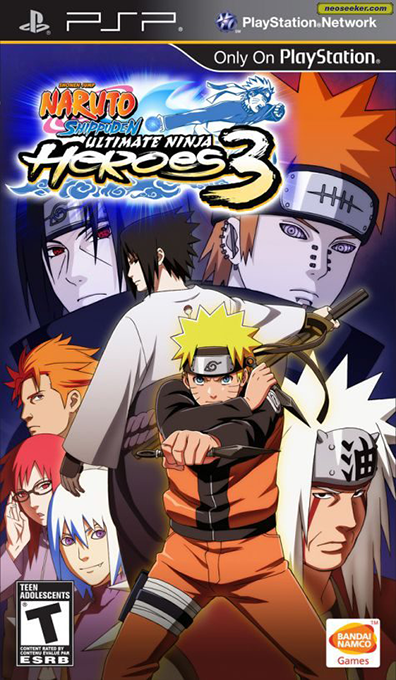


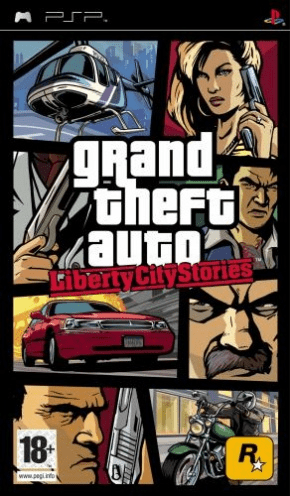
Grand Theft Auto : Liberty City Stories
Grand Theft Auto: Liberty City Stories for PSP brings Rockstar Games’ open-world crime series to Sony’s handheld in a story set in 1998, three years before Grand Theft Auto III. Developed by Rockstar Leeds with Rockstar North and released in October 2005, it returns to the fictional, New York-inspired Liberty City for a new chapter centered on Antonio “Toni” Cipriani. Toni had already appeared in Grand Theft Auto III, but this prequel follows his earlier struggle to regain standing in the Leone crime family after years away from the city. The game is played from a third-person viewpoint across Liberty City’s three connected islands. On foot, Toni can run, fight, use firearms, take vehicles, and move through busy streets full of pedestrians and traffic. Cars, motorcycles, boats, emergency vehicles, and other transport give missions their variety, while the city’s radio stations accompany both driving and exploration. Players can follow story missions at their own pace between diversions such as taxi fares, vigilante work, ambulance jobs, fire-fighting, rampages, stunt jumps, and collectible packages. Saving at safehouses and acquiring new properties provide a familiar sense of progress through the city. Toni’s campaign begins in Portland and expands as he earns the trust of Don Salvatore Leone. The Leone family’s feud with the Sindaccos and Forellis shapes much of the story, but political operators, business interests, the Triads, the Yakuza, and the Sicilian Mafia also pull the protagonist into Liberty City’s competing schemes. Familiar faces and locations from Grand Theft Auto III appear in altered circumstances, letting the game show a city that is recognizable yet not quite the same as its 2001 counterpart. Some districts, landmarks, and travel routes reflect the earlier date, making the setting more than a simple repeat visit. Missions combine driving, shooting, pursuit, protection, and timed objectives, often with a choice of vehicles or approaches before the action begins. Liberty City’s compact layout supports quick trips between jobs, while its dense streets make escapes from police attention a constant consideration. A wanted level summons increasingly serious law-enforcement responses, so repaint shops, vehicle swaps, and knowledge of back alleys can be as useful as firepower. The PSP controls adapt the series’ vehicle handling, aiming, and camera work to the system’s single analog nub, and the game adds motorcycles and several interior spaces to the world inherited from Grand Theft Auto III. The original PSP release also has a local wireless ad hoc multiplayer mode for up to six nearby players. Its competitive and team-based options include variations on deathmatch, vehicle delivery, and territory-oriented play using characters and city spaces from the single-player game. This feature is specific to the PSP edition; it was not carried over to the PlayStation 2 conversion. PSP owners could also use Rockstar Custom Tracks to prepare compatible music for an in-game custom radio option, another feature omitted from that later console port. Grand Theft Auto: Liberty City Stories was notable as the first 3D-era Grand Theft Auto designed for a handheld platform rather than a scaled-down side project. Its October 2005 PSP debut was followed by a PlayStation 2 version in 2006, while mobile releases arrived years later with touchscreen controls and visual enhancements. For players exploring the Grand Theft Auto III era, the PSP game offers a self-contained crime story, a different view of Liberty City’s history, and a full portable open-world adventure built around Toni Cipriani’s rise within the Leone family.