About
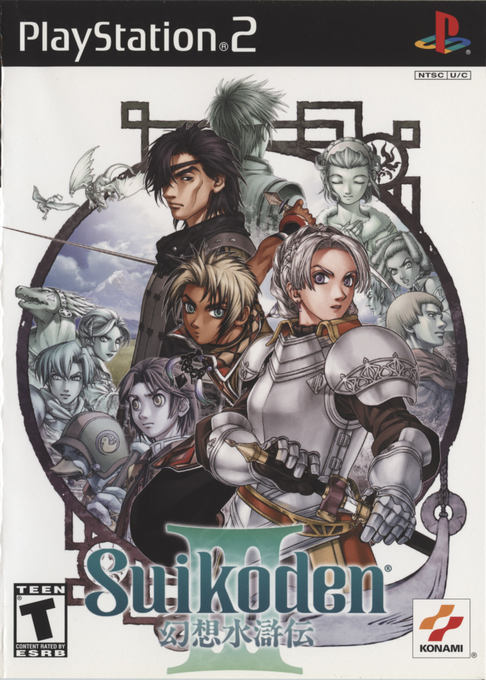
Suikoden III on PlayStation 2 is a 2002 Japanese role-playing game developed by Konami Computer Entertainment Tokyo and published by Konami. The third main entry in the Suikoden series, it follows a new conflict in the Grasslands, roughly 16 years after Suikoden II. Japan received Genso Suikoden III in July 2002, while the North American release arrived that October. It shifted the main series from the earlier games’ 2D presentation to a fully 3D PS2 adventure while retaining its focus on large casts, political tensions, and Rune-powered fantasy.
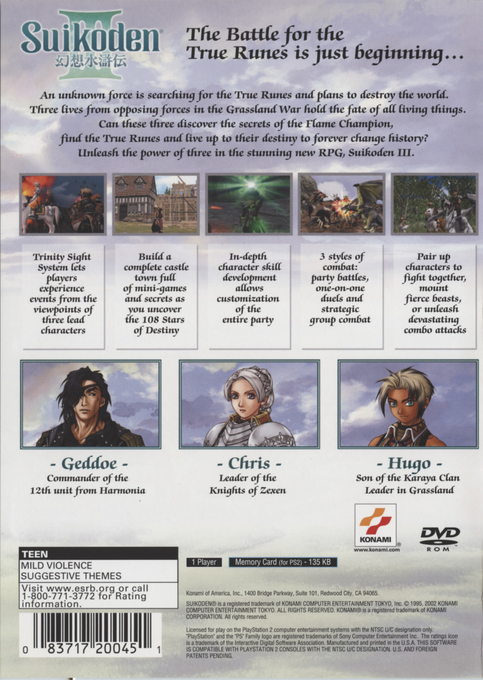
The story is told through the Trinity Sight System, which presents the opening chapters from three viewpoints. Hugo is a young member of the Grasslands’ Karaya Clan; Chris Lightfellow, the respected Silver Maiden, leads the Zexen Knights; and Geddoe commands a unit working on Harmonia’s frontier. Their accounts overlap as friction between the Grassland clans and the merchant nation of Zexen worsens, with the powerful Harmonian state also looming beyond the eastern border. Seeing events from different sides gives each faction its own motives and information rather than reducing the conflict to a single heroic perspective.
Exploration follows familiar console RPG routines. Players guide the current lead through settlements and wilderness, talk with residents, buy equipment, improve weapons, learn skills, and pursue story objectives. Random encounters occur outside towns, and progress eventually brings the group to Budehuc Castle. This headquarters becomes the base for recruiting the series’ traditional 108 Stars of Destiny. Recruits can join the broader cause, open up services, or provide help beyond the main travelling party, making the castle’s growth an important part of the adventure alongside the central campaign.
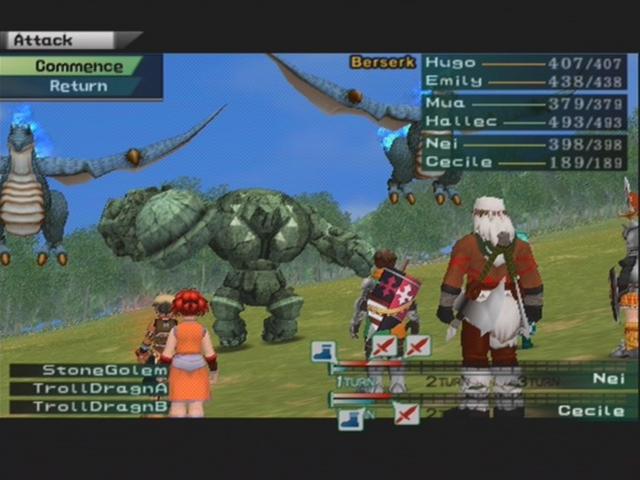
Suikoden III’s regular battles use up to six active fighters and a support character. Combat takes place on a continuous battlefield rather than the fixed formations of the first two games, though characters begin in linked front-and-back pairs. Commands are selected for the pair: a front character can protect the ally behind them during spellcasting, while attacks send fighters toward their targets. Characters develop individual skills, equip Runes for magic and other effects, and can combine certain actions with partners. Rune casting takes time, so placement and protection matter when a character begins chanting.
The game also breaks away from ordinary party combat for larger strategic encounters. These army battles take place across connected map positions, where terrain and locations can offer advantages and nearby units can assist an engagement. Leaders bring their own units and abilities to the field, while battle objectives may require taking, holding, or escaping from particular points. Budehuc Castle also contains optional diversions, including card play, dice gambling, and horse racing, providing activities between the story’s travel, recruitment, and battles.
Suikoden III is a direct sequel in a shared world, but its three-protagonist structure gives it a distinct role within the series. The search for all 108 Stars of Destiny is tied to its unfolding war and to the legacy of the Flame Champion, a figure associated with the True Fire Rune and an earlier Grasslands conflict. The PlayStation 2 original was released in Japan and North America; it did not receive a PAL PS2 edition at the time. Konami later made the game available as a PS2 Classic through PlayStation Network in 2015, including its first official European release.
Gallery
Details
- Developer
- KCET
- Publisher
- Konami
- Genre
- JRPG
- Players
- 1
- Release Date
- October 22, 2002
- System
- PS2