About
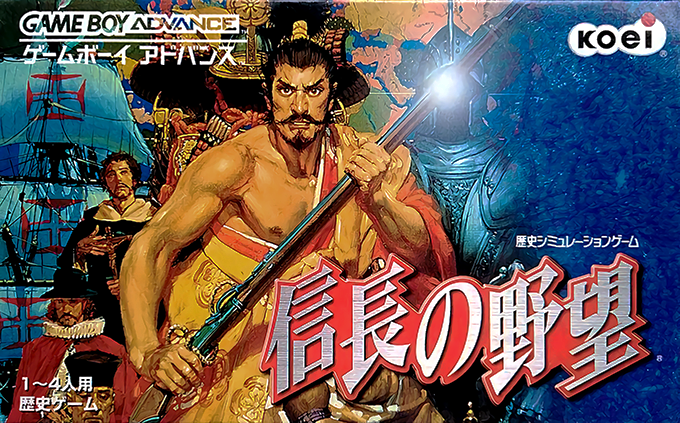
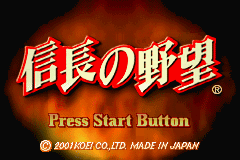
Nobunaga no Yabou for Game Boy Advance is Koei’s 2001 Japanese historical strategy game, developed with iNiS and released on September 28, 2001. Set during Japan’s Sengoku period, it gives the player command of a daimyō rather than requiring them to play as Oda Nobunaga himself. The objective is national unification, but the route to it begins with the much smaller concerns of governing a domain, gaining capable retainers, keeping subjects loyal, and judging when an army can safely march. This handheld entry is closely modeled on the fourth Nobunaga’s Ambition game, Nobunaga no Yabou: Bushou Fuuunroku, known in North America on Super NES as Nobunaga’s Ambition: Lord of Darkness, while being adapted around the GBA’s controls and portable format.
A campaign begins by selecting one of three historical starting points: the turbulent Warring States period in 1555, Nobunaga’s encirclement in 1571, or the Honnō-ji Incident in 1582. Each changes the political map, available rulers, and immediate pressures facing a chosen clan. Players issue orders month by month, assigning officers to domestic development, diplomacy, military affairs, and personnel management. Improving farmland and commerce raises a province’s ability to support its ruler, while taxation, rice, gold, recruitment, and training must be balanced against morale and stability. The central appeal is that military expansion depends on a functioning domain; an army cannot simply be raised in isolation from the economy and people that sustain it.
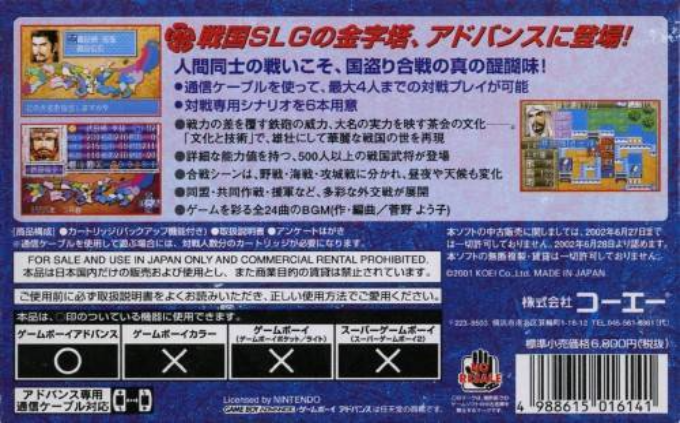
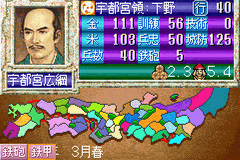
The Game Boy Advance version uses a nationwide map stretching from Kagoshima to Aomori, an unusually broad scope for a portable strategy game of its period. From this map, the player handles relations with neighboring powers, develops territories, appoints and employs officers, and prepares campaigns. Battles are separate, turn-based engagements played on hexagonal maps. Commanders move units and contend with terrain, formations, supplies, and the opposing force’s leadership. Captured officers can be approached for service, but retaining talent is its own responsibility: poor loyalty can make a subordinate vulnerable to defection or enemy persuasion.
Culture and technology distinguish this branch of the series from a purely military conquest game. Tea utensils and tea gatherings are part of courtly management and can affect relationships with officers, while technical investment opens more advanced military options. Firearms can be produced after sufficient development, and further progress permits the construction of armored ships. These systems make infrastructure and specialist officers matter beyond the battlefield, since an order’s outcome can depend on the person assigned to carry it out. The result connects the age’s political maneuvering, administration, cultural prestige, and warfare in one turn-based framework.
Nobunaga no Yabou GBA also reworks the interface for quick access on Nintendo’s handheld. The directional pad calls up broad areas such as domestic policy, diplomacy, military commands, and personnel, with buttons used for contextual information and menus. It supports single-player campaigns as well as cable-linked multiplayer for up to four people. Its multiplayer scenarios use shorter shared objectives, including contests to reach Kyoto or defeat Nobunaga, rather than simply duplicating the main campaigns. That dedicated mode and the broad national map make this a distinct GBA adaptation of a classic Koei historical simulation, not merely a retitled port of the earlier home-console release.
Gallery
Details
- Developer
- iNiS
- Publisher
- Koei
- Genre
- Turn-Based Strategy
- Players
- 1
- Release Date
- September 28, 2001
- System
- GBA