About
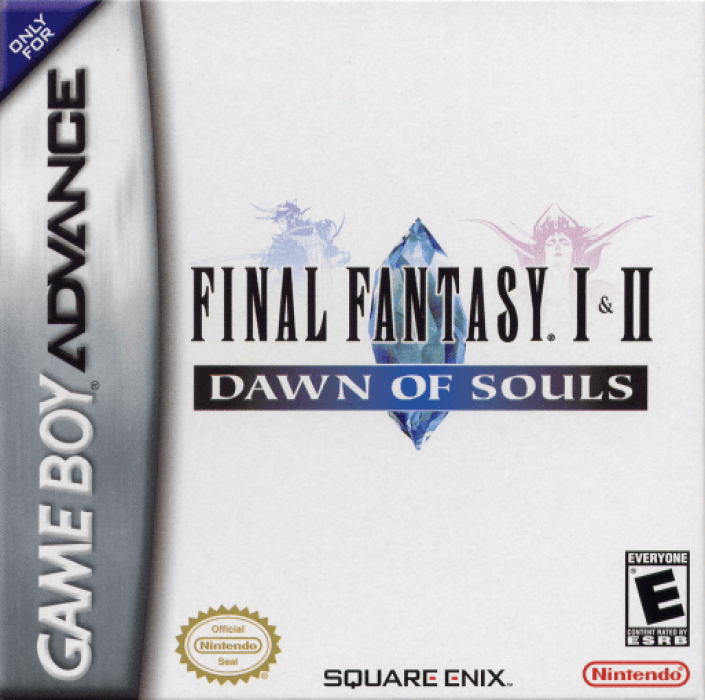
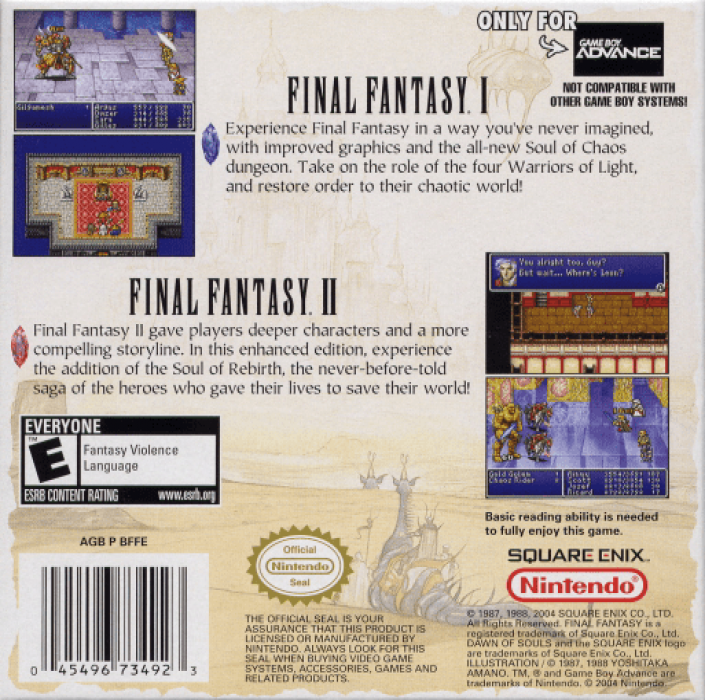
Final Fantasy I & II: Dawn of Souls for Game Boy Advance brings the opening two chapters of Square’s role-playing series together on one 2004 cartridge. Developed for this version by TOSE with Square Enix and published by Nintendo in North America, it adapts the earlier remakes of the 1987 and 1988 Famicom adventures for a portable format. Players can select either Final Fantasy I or Final Fantasy II from the opening menu, then save separate journeys as they explore two influential, but notably different, early Japanese RPG designs.
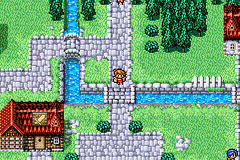
Final Fantasy I begins with four chosen Warriors of Light, each bearing a darkened crystal. The party travels across a fantasy world of kingdoms, towns, caves, and dungeons to restore the elemental crystals and confront the forces behind the growing disorder. Before starting, players build a four-member party from six character classes: Fighter, Thief, Black Belt, Red Mage, White Mage, and Black Mage. That initial choice shapes the weapons, armor, magic, and combat roles available throughout the quest. Exploration unfolds through an overhead world map and individual locations, while turn-based battles ask the player to choose attacks, spells, items, or other commands for the party.
Final Fantasy II uses a separate world, cast, and progression system. Firion, Maria, and Guy are drawn into a rebellion against the Palamecian Empire after the destruction of their home, joining allies as the conflict widens. Conversations can supply key words that are later shown to other characters, helping direct the group toward its next objective. Instead of centering advancement on fixed character jobs, this adventure develops attributes and weapon or magic proficiencies through use. Its party can also change during the story, giving the second game a distinct structure beside the first game’s custom-built four-person team.
Dawn of Souls includes visual and sound updates alongside changes intended for this handheld edition, and it adds a bestiary to both games so players can record encountered monsters and examine their information. Final Fantasy I gains four optional Soul of Chaos dungeons, with their own challenges and bosses, while Final Fantasy II adds Soul of Rebirth. That extra scenario becomes available after the main game and follows several characters whose roles in the original story had ended, extending the second adventure beyond its final confrontation. These additions make the compilation more than a straightforward pairing of the two original campaigns.
The Game Boy Advance release arrived first in Japan on July 29, 2004 as Final Fantasy I & II Advance, then reached North America that November as Final Fantasy I & II: Dawn of Souls and Europe in December. The regional names differ, but both editions place the two games and their GBA-specific material on a single cartridge. It followed the PlayStation collection Final Fantasy Origins while offering its own bonus content and handheld presentation, and it was later made available again through the Wii U Virtual Console in Japan.
As a collection, Final Fantasy I & II: Dawn of Souls lets players compare the roots of a long-running series without leaving the Game Boy Advance. The first game emphasizes a freely selected party, crystal-restoration quest, and a gradually expanding world of travel, while the second focuses on named protagonists, a resistance narrative, and skill growth tied to repeated actions. Its two campaigns, added dungeons and story content, monster records, and portable format give this version a clear place among the many releases of Final Fantasy I and Final Fantasy II.
Gallery
Details
- Developer
- TOSE
- Publisher
- Nintendo
- Genre
- JRPG
- Players
- 1
- Release Date
- November 29, 2004
- System
- GBA