About
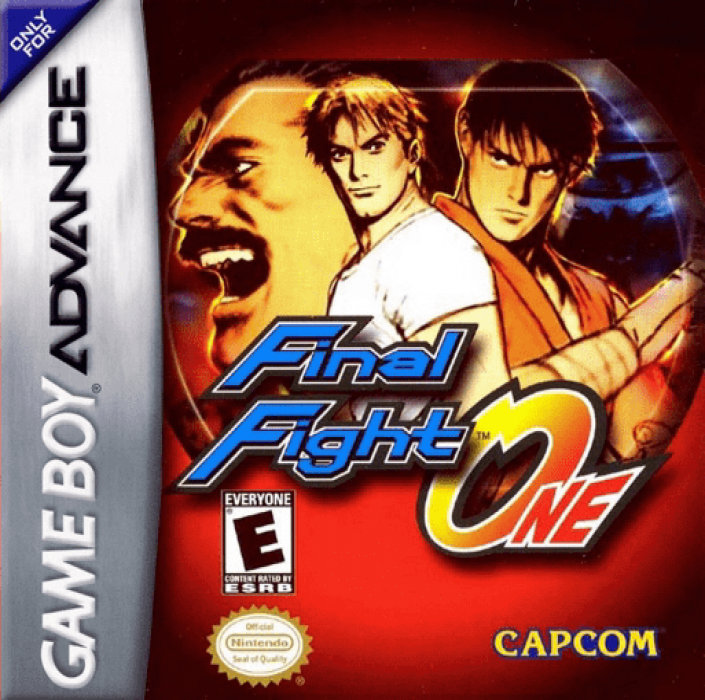
Final Fight One is the 2001 Game Boy Advance revival of Capcom's 1989 arcade brawler, developed for the handheld by Sun-Tec. It arrived in Japan on May 25, in North America on September 26, and in Europe on September 28; Capcom published the North American release, while Ubisoft handled European distribution. Rather than simply shrinking the coin-op, the cartridge revisits the compromised Super NES conversion and rebuilds it into a much fuller portable edition, carrying the Metro City rescue story into a system built for quick sessions and saved progress.
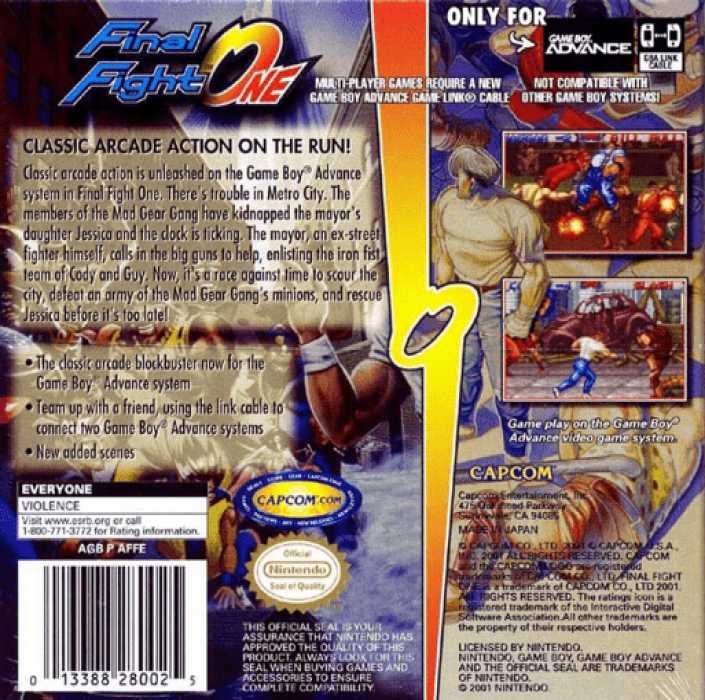
Mad Gear, the criminal gang that rules Metro City, abducts Jessica, daughter of newly elected mayor Mike Haggar and girlfriend of Cody Travers. Haggar answers the kidnapping by taking the fight to the streets with Cody and Guy, the Bushin-ryu martial artist. The three push through gangs in the slums, subway, West Side, industrial district and uptown territory before confronting Mad Gear's leadership and its boss, Belger. It is a direct, archetypal beat-'em-up premise, but the GBA edition gives it a little more shape through new exchanges before the boss encounters.
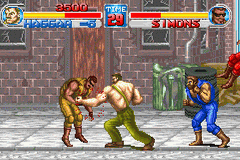
Haggar, Cody and Guy are all selectable from the start. Haggar is the powerhouse, built around wrestling throws and a punishing piledriver; Cody is the all-purpose brawler, and Guy trades some force for speed and acrobatic movement. Their moves share the series' essentials: strings of attacks, jumping strikes, grabs, throws and a crowd-clearing special attack that spends health. Pipes, knives and swords can be picked up from the scenery, while food restores health and point items build the score. The differing reach, mobility and throws make the character choice matter even though the objective remains simple: clear each block of enemies before the timer expires.
This is deliberately closer to a repaired SNES-era port than an arcade-perfect conversion. The original Super NES Final Fight removed Guy, cut the Industrial Area and Rolento battle, and offered no simultaneous multiplayer; the alternate Final Fight Guy restored Guy but replaced Cody and still remained single-player. Final Fight One reunites all three heroes, restores the missing Industrial Area material, and returns two-player cooperation. It nevertheless retains the Super NES line's altered presentation and omits arcade enemies Poison and Roxy, so it should not be mistaken for a literal reproduction of the 1989 board.
Co-op is one of the most consequential restorations. Two Game Boy Advance systems, two copies of the Game Pak and a Game Link Cable allow a pair to play the main game together, and the players can even select the same fighter. That makes the crowded lanes, thrown enemies and weapon pickups feel much nearer to Final Fight's coin-operated design than the lone-player Super NES versions did. The handheld also raises the number of enemies that can appear together compared with its immediate 16-bit template, even if its enemy arrangements still reflect that version's structure.
Sun-Tec and Capcom added features intended for repeat play rather than stopping at restoration. Progress can be saved between levels, a practical concession to portable play, and the game records Battle Points from the cumulative number of defeated enemies. Those points unlock useful options such as more starting lives, stage select, alternate colour palettes and a rapid-punch setting. Earlier Final Fight Guy-style power-ups return as well, joined by a Cody 1-Up doll, giving this edition small rewards that the original arcade game did not offer.
The most conspicuous unlocks are Z-Guy and Z-Cody, alternate playable versions modeled on the Street Fighter Alpha 3 looks of Guy and Cody. They are more than palette swaps in the menu: the edition supplies them with their own boss-dialogue material, turning a simple retro port into an unusually self-aware crossover bonus. The pre-fight conversations likewise vary with the chosen hero, and character portraits borrowed from the Alpha-era visual language help distinguish this version from its predecessors.
Final Fight One therefore occupies a useful middle ground in the game's long port history. Its small screen, adapted sound and SNES-rooted visual compromises keep the arcade cabinet as the reference version, but it restores the pillars that Nintendo's earlier release lost: the full starting trio, the Industrial Area, Rolento and two-player action. Added saves, unlocks, dialogue and alternate fighters make it more than a corrective conversion. For a Game Boy Advance player, it is a compact, feature-rich way to take Haggar, Cody and Guy's six-stage fight against Mad Gear on the road.
Gallery
Details
- Developer
- Suntek
- Publisher
- Ubisoft
- Genre
- Beat 'em Up, Fighting
- Players
- 1-2
- Release Date
- September 26, 2001
- System
- GBA