About
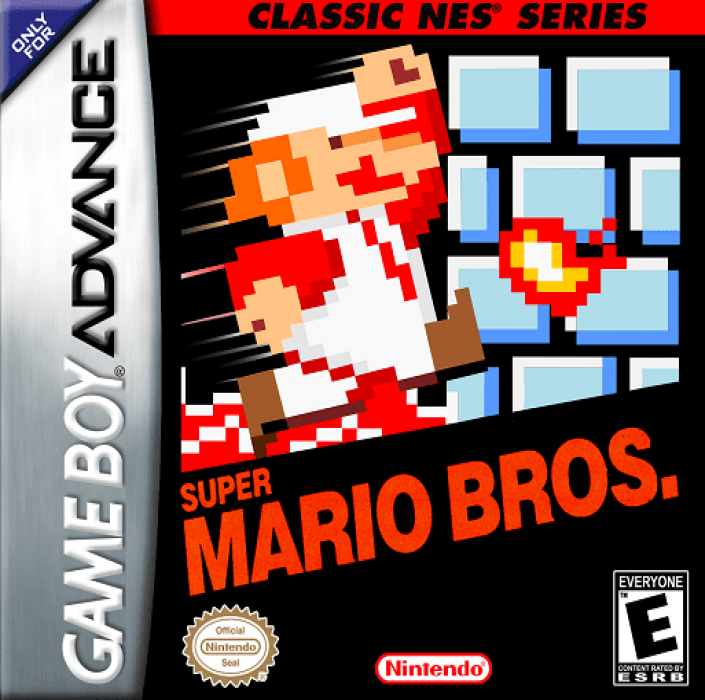
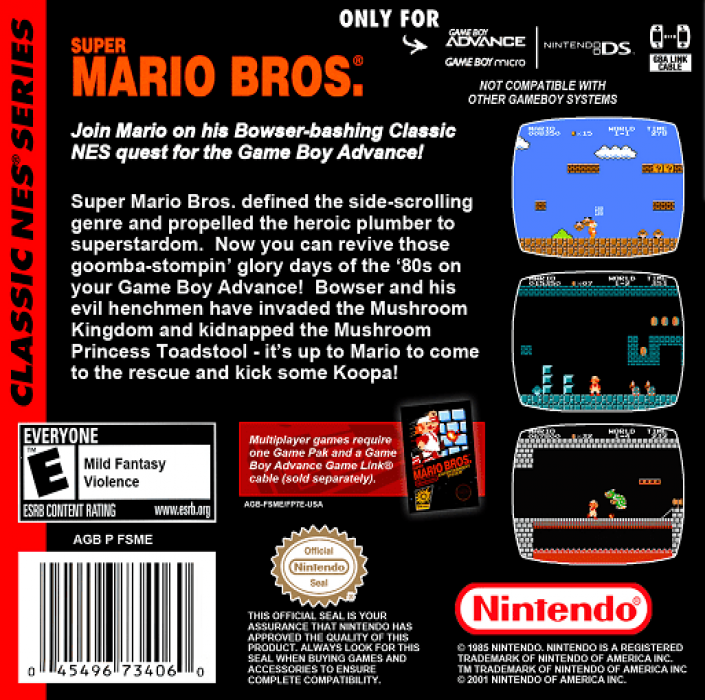
Classic NES Series: Super Mario Bros. is Nintendo’s 2004 Game Boy Advance rerelease of the 1985 NES platform game, not a new Super Mario Advance remake. Nintendo is credited as both developer and publisher. In North America it arrived in the Classic NES Series on June 7, 2004; Nintendo of Europe lists the European release as July 9, 2004. The cartridge returns Mario to the Mushroom Kingdom for the original eight-world, 32-course journey: run to the right, reach each flagpole, and ultimately rescue Princess Toadstool from Bowser.
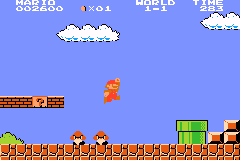
The fundamentals remain as direct as ever. Mario begins small, then uses Super Mushrooms to grow, Fire Flowers to throw fireballs, and Starmen for temporary invincibility. Goombas can be stomped, Koopa Troopas leave shells that can become hazards or weapons, and question blocks, hidden blocks, pipes, underwater stages, castles, and warp zones reward alert play. Each world ends in a castle, where Mario can either reach the axe behind Bowser or, while powered up, defeat him with fireballs. Finishing the quest unlocks the tougher second quest, in which many Goombas are replaced by Buzzy Beetles.
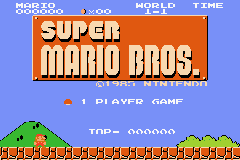
This GBA version is best understood as a very close, emulator-style conversion rather than an expanded adaptation. It preserves the original level layouts, 8-bit sound, rules, secrets, and brisk handling, but the Game Boy Advance’s display has a different aspect ratio from a television. To fit the game on the handheld screen, parts of the image were squeezed, a compromise especially noticeable in some sprite animation and text. The portable presentation makes the original game available on the go, but it is not a pixel-perfect visual reproduction of the NES picture.
The controls translate the NES setup to the Game Boy Advance: the Control Pad moves Mario, while the face buttons handle jumping and running or fireball throwing; Start and Select cover the original system functions. The precise relationship between running speed and jump distance is still the heart of the game. Mario can walk, build speed, and make controlled short or long jumps, so stages that look simple at first become tests of momentum, timing, enemy placement, and knowledge of their shortcuts.
It also adapts the original two-player arrangement for the handheld. One or two players can take alternating turns, either with one Game Pak or with two Game Boy Advances connected by a Game Boy Advance Game Link Cable. This is turn-taking Super Mario Bros., not simultaneous co-op: when one player loses a life, the other takes control, just as Mario and Luigi alternated on NES. The link option makes that familiar competition possible without passing one handheld back and forth.
The conversion should not be confused with Super Mario Bros. Deluxe on Game Boy Color, which added a larger package of extras, nor with the Super Mario Advance games, which are enhanced remakes of later Mario titles. Classic NES Series: Super Mario Bros. instead prioritizes the original game. It does not add a modern campaign save system or new stages. Its cartridge memory is used for features such as high-score data and continuation behavior, but the central adventure still asks players to work through its worlds in the old-fashioned arcade-like fashion.
Japan’s corresponding release was Famicom Mini: Super Mario Bros., issued as part of the Famicom Mini line on February 14, 2004, while the North American release carried the Classic NES Series name and the PAL release was called NES Classics: Super Mario Bros. They belong to the same GBA reissue program, but the regional branding, packaging, and release dates should not be collapsed into a single version. For this record, Classic NES Series refers specifically to the GBA edition distributed outside Japan, which brought Nintendo’s foundational side-scroller to the handheld with only carefully limited presentation and multiplayer adaptations.
Gallery
Details
- Developer
- Nintendo
- Publisher
- Nintendo
- Genre
- Platformer
- Players
- 1-2
- Release Date
- June 2, 2002
- System
- GBA