About
Tron arcade is Bally Midway’s 1982 coin-operated action game based on Disney’s film of the same name. Built for the arcade rather than adapted from a home version, it places players inside the electronic world as Tron and turns several screen moments and computer-world ideas into a sequence of distinct challenges. The game supports one or two players taking turns, and its glowing cabinet presentation and unusual mix of controls help make it one of the era’s most recognizable movie tie-ins.
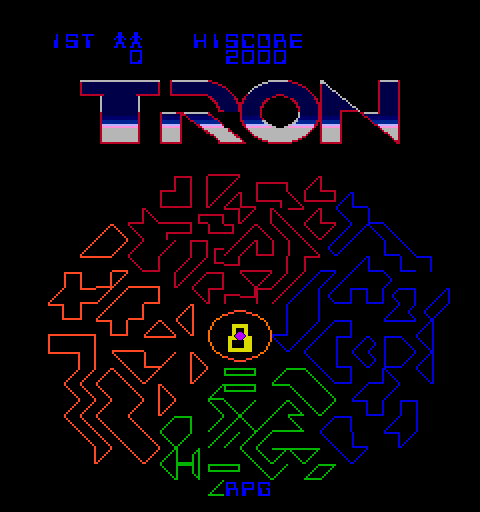
A game begins on the Game Grid, where four concealed selections invite the player to choose the next domain. The choice is strategic only in the sense that it determines the order: the activity behind each quadrant is initially hidden, then revealed once selected. To clear a level, the player must complete all four domains. Finished domains disappear from that level’s grid, while losing a life returns the player to the selection screen. Later levels increase the pressure with tougher enemy patterns and faster action.
The most famous domain is Light Cycles, a head-to-head contest in which Tron’s blue cycle leaves an unbroken trail behind it. The aim is to force yellow rival cycles into a wall, a trail, or one another while keeping Tron from making the same fatal mistake. Here the arcade stick guides the vehicle and its trigger changes the cycle’s speed. The rule set is simple, but the shrinking safe space creates a tense game of steering, timing, and anticipation.
The other domains make greater use of the cabinet’s rotary control. In the I/O Tower challenge, Tron moves around a grid while aiming independently at multiplying Grid Bugs, trying to open a route to the central tower before time expires. Battle Tanks takes place in a maze, where Tron’s tank must eliminate enemy tanks with shots that ricochet from walls; a central relocater can shift the player to another position. Higher stages introduce quick Recognizers that attack by ramming rather than firing.
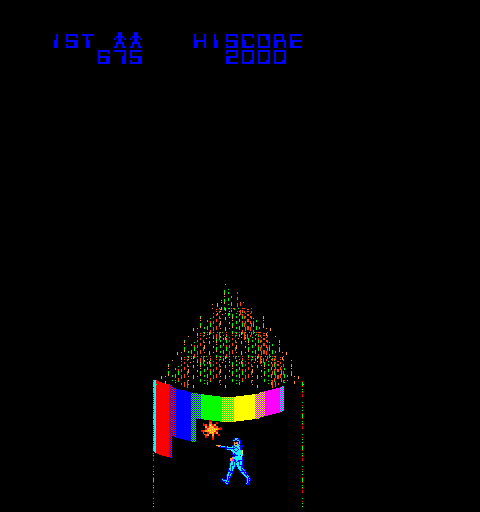
MCP Cone changes the perspective again. Tron stands beneath a descending, rotating wall of colored blocks protecting the Master Control Program’s cone. The player steers Tron, rotates his aim with the dial, and fires to create an opening without touching the moving barrier. Reaching the cone finishes the domain, while removing every block earns an additional bonus. This combination of joystick movement, trigger firing, and dial-controlled aim gives the game a physical control scheme unlike a standard single-stick shooter.
Tron’s arcade progression is organized into twelve named levels, with labels drawn from computing terminology such as RPG, COBOL, BASIC, FORTRAN, and PASCAL. Points come from defeating enemies and completing objectives, with extra lives awarded at score thresholds set by the machine’s operator options. The changing order of the four domains, plus the differing skills demanded by each, means a successful run requires more than mastery of just the Light Cycle arena.
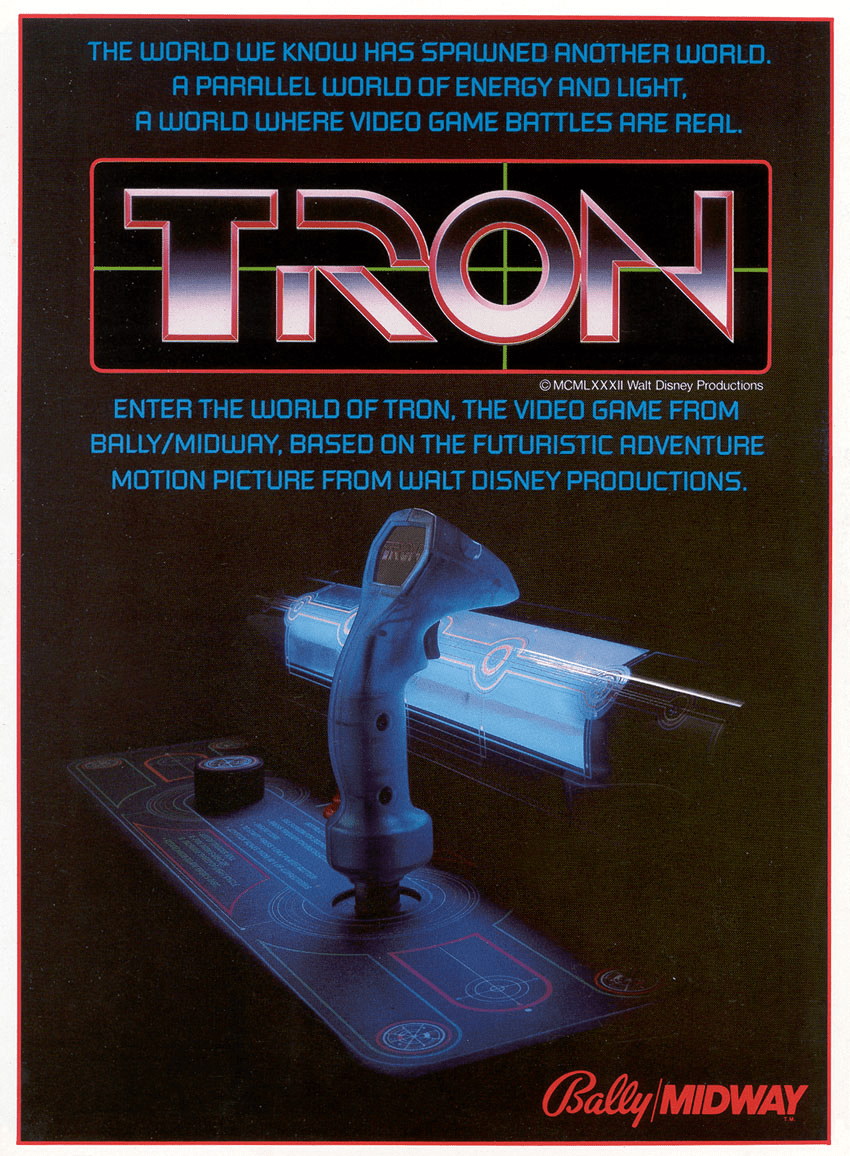
Bally Midway developed and published Tron during the early-1980s arcade boom, working under the deadline of a film release. The resulting game used a collection of playable domains rather than attempting to reproduce a single scene, giving the license a broad range of action within one cabinet. Its design also became closely associated with the arcade version’s black-light accents, fluorescent artwork, translucent controls, and electronic Grid imagery.
The 1982 arcade game led to a separate follow-up, Discs of Tron, in 1983. Later Tron games and home releases explored the same fictional universe, but the Bally Midway original remains defined by its four-domain structure: cycling through a lethal arena, fighting through the tower and tank maze, and breaking into the MCP cone. For players seeking the original Tron arcade experience, that shifting set of challenges is the core of the game.
Gallery

Details
- Developer
- Bally Midway
- Publisher
- Bally Midway
- Genre
- Compilation
- Players
- 1-2
- Release Date
- January 1, 1982
- System
- Arcade