About
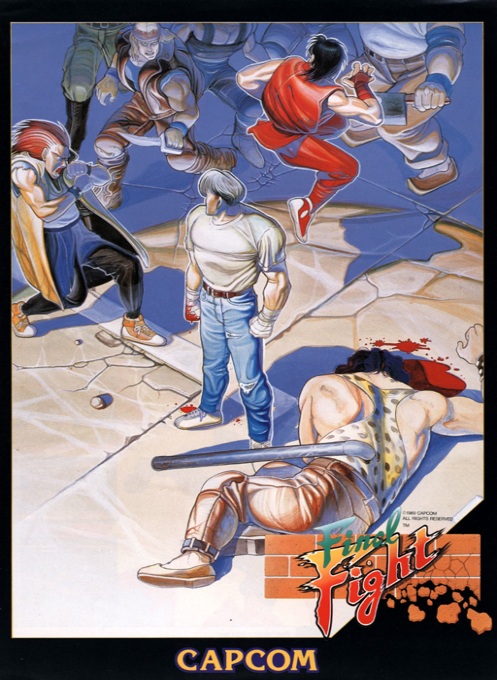
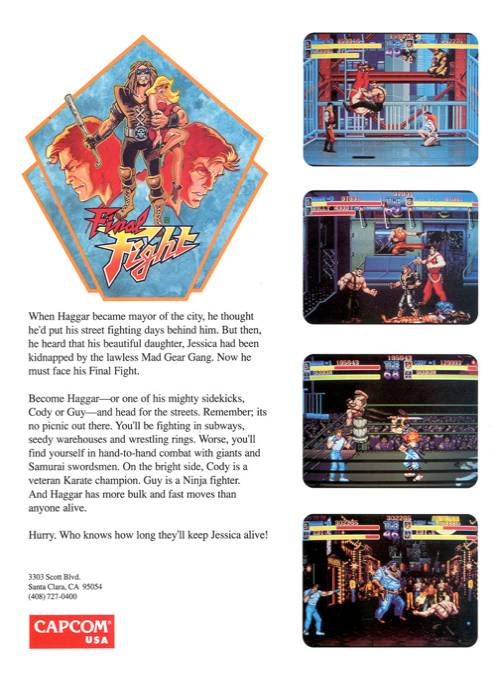
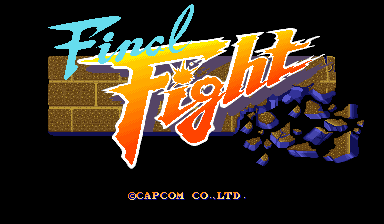
Final Fight (USA, set 1) is Capcom’s 1989 arcade beat ’em up for the CP System board, represented in MAME by the clone set ffightu. The “USA, set 1” label identifies this particular American arcade program set, not a home-console edition or a sequel; MAME lists it as a clone of the World set and separately catalogs later U.S. revisions. Capcom developed and published the game, placing it among the company’s early CP System releases. Its premise sends three vigilantes through the fictional Metro City after the Mad Gear Gang kidnaps Jessica, the daughter of newly elected mayor Mike Haggar and girlfriend of Cody Travers.
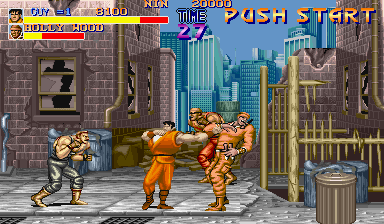
A credit starts one or two players at the same time, with each player choosing from Cody, Guy, and Haggar. Cody is the balanced brawler, Guy is the quick-footed martial artist, and Haggar is the powerful former wrestler; their differing reach, speed, and special techniques give the same route distinct rhythms. In two-player play, the team must manage space as well as enemies: friendly attacks can hit the other player, while a downed partner can be rescued from the surrounding mob. Players may select a different hero when continuing, so a single arcade run need not keep the same roster from beginning to end.
The cabinet uses an eight-way joystick with one attack button and one jump button. Simple inputs produce punches, kicks, jumping attacks, and the evasive jump, but the game’s close-range system is central: walking into an opponent initiates a grab, opening throws, knees, body blows, and character-specific finishing moves. Pressing attack and jump together unleashes a crowd-clearing special that costs a portion of the player’s own health, a deliberate trade between survival and damage. Weapons found in the scenery—such as knives, pipes, and swords—can be picked up and used, though they have limited utility and can be lost when a character is disarmed.
The campaign is organized into six timed rounds, with bonus challenges between them. It begins in the Slums, moves through the Subway and West Side, reaches the Industrial Area, then the Bay Area and Uptown, treating Metro City as a chain of scrolling combat spaces rather than a single arena. Breakable barrels, trash cans, and other objects may yield food for health, score items, or weapons. Each round culminates in a gang leader, including Damnd, Sodom, Edi E., Rolento, Abigail, and finally Belger; the route’s regular enemy groups and screen-filling encounters make positioning, grabs, and emergency specials as important as raw button speed.
The arcade release is the full baseline for its original three-character, two-player design. It should not be confused with the first Super NES conversion, which removed co-op, omitted Guy and the Industrial Area, and altered other presentation details. Final Fight Guy restored Guy in place of Cody but still did not restore the missing arcade stage or simultaneous two-player mode. Those changes belong to the home versions, not to this U.S. arcade set. The Game Boy Advance version Final Fight One later brought back all three leads, the Industrial Area, and link-cable co-op, while adding its own material.
Other adaptations likewise vary in what they preserve. The X68000 conversion is a close Japanese home-computer version with its own audio options, while the Sega CD’s Final Fight CD retains the three-character roster, the Industrial Area, and two-player play, but is still a conversion with changes in performance and presentation. Modern collections and arcade emulations can offer filters, save features, online play, or other conveniences, yet the game represented here is the original coin-operated U.S. set: the CPS-1 program played with a joystick, two action buttons, a shared screen, and arcade credits.
Final Fight was first shown as Street Fighter ’89 before Capcom renamed it for release, reflecting how its direction had shifted away from the one-on-one fighting of the 1987 Street Fighter. Its brawling formula instead centers on advancing through crowds, using a concise move set to control a horizontal playfield, and confronting a succession of memorable bosses. The development team included figures who would go on to work on Street Fighter II, and Final Fight’s characters later became recurring presences in Capcom’s wider fighting-game history. The game therefore stands both as a self-contained arcade action title and as a key part of the company’s late-1980s transition into the CPS era.
For this set, the most useful frame of reference is the arcade original rather than the better-known Super NES release. Its complete route, selectable trio, and simultaneous co-op show the design as it was built for the cabinet, where the action repeatedly asks players to decide whether to conserve health, spend it on a special, grab an opponent, seize a weapon, or press ahead before the timer expires. That combination of direct controls, cooperative crowd management, and a cinematic city-under-siege progression is the core of Final Fight (USA, set 1).
Gallery
Details
- Developer
- Capcom
- Publisher
- Capcom
- Genre
- Beat 'em Up
- Players
- 1-2
- Release Date
- November 25, 1989
- System
- Arcade