About
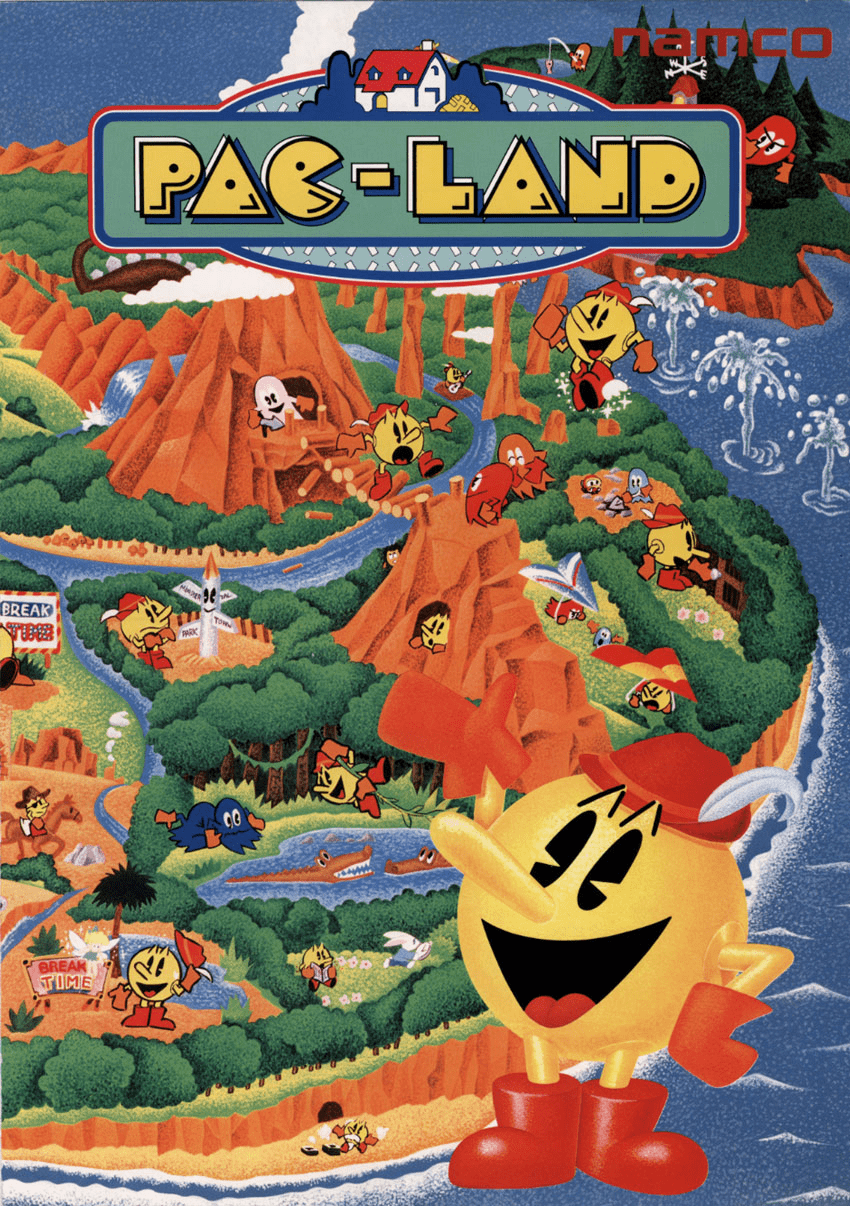
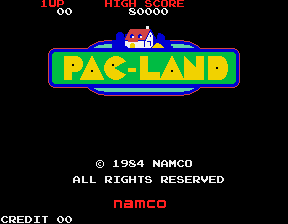
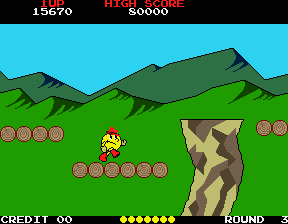
Pac-Land is Namco's 1984 arcade platform game, a major change of direction for Pac-Man after the maze-chase hits that made the character famous. This World arcade set sends Pac-Man across a bright, side-scrolling storybook landscape to escort a lost fairy back to Fairyland. Rather than clearing dots from a single screen, the challenge is to keep moving through towns, woodland, deserts and more hazardous stretches of the journey while dealing with a steadily changing parade of threats.
The arcade controls are immediately distinctive. Separate left and right buttons make Pac-Man walk, while repeated taps build up a run; a dedicated jump button handles pits, obstacles and enemy attacks. That button-driven approach gives the game a physical rhythm, especially when quick movement and a well-timed leap are needed together. Pac-Man's animation, changing expressions and cartoon-like silhouette make the character feel far more like a travelling protagonist than the simple circular hero of the original arcade game.
Each journey, called a trip, is divided into four rounds. The first three send Pac-Man toward Fairyland with the fairy under his hat, and the fourth reverses the direction for the return to his family. The route is not merely a flat run: water-spouting hydrants, quicksand, falling logs, springboards and gaps ask players to read the scenery as they advance. Time pressure also matters, since lingering too long turns the final pursuit into a much more dangerous scramble.
The Ghost Gang remains central to the action, but its members now chase Pac-Man on foot and in imaginative vehicles. Blinky, Pinky, Inky and Clyde are joined by Sue, and they may appear in cars, buses, aircraft, pogo sticks and other contraptions that suit the game's playful cartoon tone. Large flashing Power Pellets still offer a short chance to turn the tables, changing the ghosts blue so Pac-Man can collect them for extra points instead of simply avoiding them.
Pac-Land rewards observation as well as reflexes. Fruit and other bonus items can be uncovered around stages, and certain locations reward precise jumps. On the homeward leg, magical boots let Pac-Man keep jumping in the air, transforming the final round into a buoyant return journey with a different feel from the grounded outward trek. The game also punctuates progress with break-time scenes and score bonuses, giving its long trip structure a clear sense of travel.
Developed and published by Namco, Pac-Land drew on the animated Pac-Man television series for its colorful, character-driven presentation. Programmer Yoshihiro Kishimoto led its development, and the project used a dedicated Namco arcade system designed to support its scrolling backgrounds, plentiful sprites and more detailed animation. The result was technically and stylistically far removed from the black-background maze games that preceded it, with scenery continuously moving behind the hero as the world unfolds.
That combination of automatic horizontal travel, running, jumping, obstacle courses and animated scenery made Pac-Land an influential early arcade platformer. It later reached home systems and has been preserved in Namco compilations and modern arcade reissues, including Arcade Archives. For players exploring the Pac-Man series in release order, it remains a fascinating snapshot of Namco adapting an arcade icon to a new kind of adventure: a demanding, cheerful road trip where every button tap can mean the difference between reaching Fairyland and being caught by the ghosts.
Gallery

Details
- Developer
- Namco
- Publisher
- Namco
- Genre
- Platformer
- Players
- 1-2
- Release Date
- January 1, 1984
- System
- Arcade