About
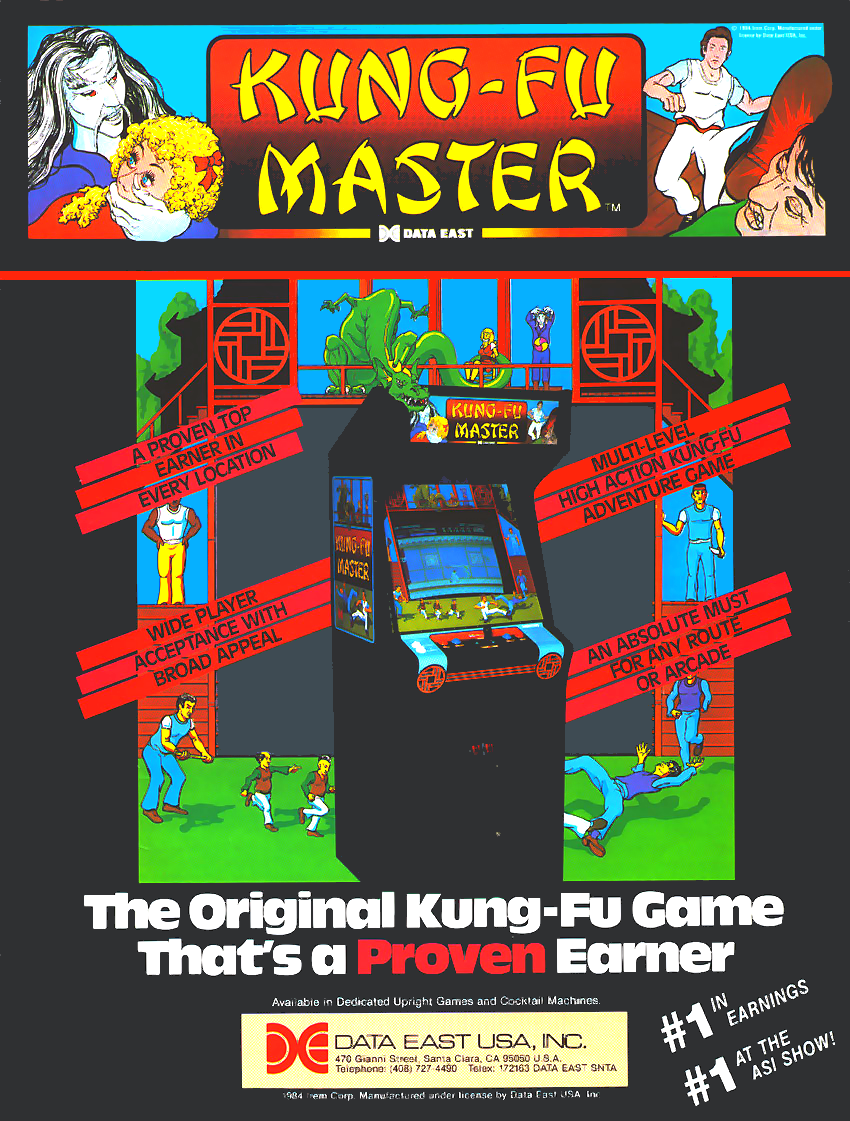
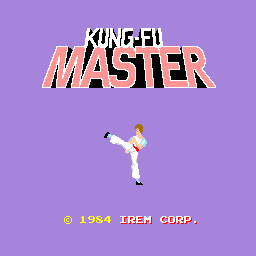
Kung-fu Master (World) is the international arcade release of Irem’s 1984 side-scrolling martial-arts action game, distributed by Data East outside Japan. Known in Japan as Spartan X, it puts the player in control of Thomas, a fighter racing through the Devil’s Temple to rescue Sylvia from the gang led by Mr. X. The game arrived during the early arcade action boom with a format that makes its purpose immediately clear: move from left to right, survive the crowds of attackers, and reach the stairs before time runs out.
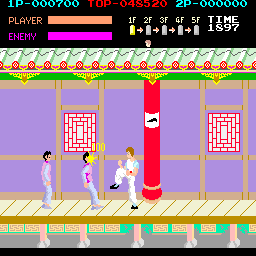
The Kung-fu Master arcade cabinet uses an eight-way joystick and two attack buttons. Thomas can punch or kick while standing, crouching, or jumping, so spacing matters as much as speed. Punches are the stronger close-range option, while kicks reach farther. Players can also crouch under high attacks or leap when enemies and hazards demand it. A health meter shows how much punishment Thomas can take, and a floor must be attempted again after a life is lost, lending every encounter and every second of the countdown real weight.
Each of the Devil’s Temple’s five floors is a compact gauntlet. Common enemies rush in from both sides, with some able to grab Thomas and drain his energy, while knife throwers and acrobatic opponents require careful positioning. The stages add their own threats as well, including falling objects, snakes, moths, and dragons. Rather than being a series of isolated duels, Kung-fu Master keeps pressure on the player by combining advancing movement, repeated enemy waves, and hazards that interrupt a straightforward assault.
Every floor ends with a named guardian, turning the closing stretch into a direct confrontation. Thomas and each boss have health meters, and the player must empty the opponent’s meter to climb to the next level. The final battle is against Mr. X, after which Thomas rescues Sylvia and the game begins again at a higher difficulty. Remaining time and health are converted into bonus points between floors, while an extra life is awarded at a score threshold, tying survival, efficient play, and high-score chasing together.
The World version is distinct from the Japanese Spartan X release chiefly in title and export presentation. Its story and temple-climbing premise draw on the martial-arts cinema that shaped the original, while its clean controls and steady forward momentum were built for the arcade. Takashi Nishiyama designed the game for Irem, and its approach to side-scrolling combat and end-of-stage opponents became an important early reference point for later action brawlers. The original arcade game is a single-player experience; some later home adaptations added features or altered content, but they are not substitutes for this faster, coin-op design.
Kung-fu Master stands as a defining early example of the scrolling beat-’em-up style. It condenses a rescue mission into five escalating floors, a clear set of punch, kick, crouch, and jump controls, and boss encounters that demand a different rhythm from crowd fighting. For arcade players, that combination gives the game a focused structure: learn each enemy’s approach, preserve Thomas’s health, reach the next staircase, and take one more step toward the top of the temple.
Gallery

Details
- Developer
- Irem
- Publisher
- Data East
- Genre
- Beat 'em Up
- Players
- 1-2
- Release Date
- January 1, 1984
- System
- Arcade