About
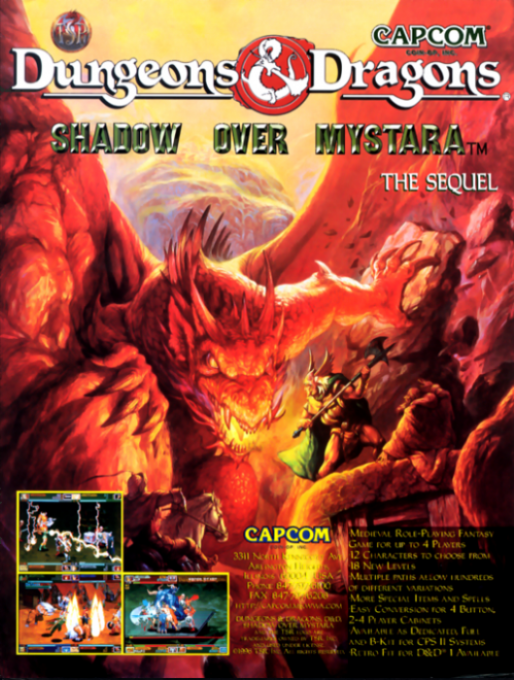
Dungeons & Dragons: Shadow over Mystara is Capcom’s 1996 arcade follow-up to Dungeons & Dragons: Tower of Doom, built for the company’s four-player fantasy brawler line. Set in the Mystara campaign world, the game sends a party of adventurers across dangerous regions as a threat tied to the sorceress Synn grows beyond the earlier battle with the arch-lich Deimos. It combines the immediate, side-scrolling action of an arcade beat ’em up with character classes, equipment, magic, treasure, and route choices drawn from the spirit of Dungeons & Dragons.
The arcade game supports up to four players at once. Players choose from the returning Fighter, Cleric, Dwarf, and Elf, while Shadow over Mystara adds the agile Thief and the spell-focused Magic-User. Each class approaches combat differently: front-line warriors use weapons and physical techniques, the Cleric brings healing and divine magic, the Elf mixes swordplay with spells, the Thief excels at mobility and utility, and the Magic-User trades durability for powerful magic. Character-specific restrictions and strengths make a mixed party feel meaningfully different from a group of the same class.
Its basic controls are built around attacking, jumping, selecting an item, and using it, but the game develops far beyond simple button-mashing. Directional inputs and buttons produce special attacks, including dashing strikes and rising moves that can keep enemies airborne. The inventory system lets players switch among weapons, shields, consumables, and unusual magical finds in the middle of an adventure. Fighters can change their arsenal, while classes such as the Thief can use their own talents to handle locked chests and traps. These choices add a small but important layer of planning to the crowd-fighting action.
Magic is especially central to the game’s Dungeons & Dragons identity. The Elf and Magic-User call on arcane spells, and the Cleric uses divine spells; instead of a conventional mana bar, spell uses are prepared in limited quantities and can be replenished by scrolls or certain rewards. The timing of a spell can turn a packed encounter around, but casting too early may leave a party without a crucial resource later. Shops between stages provide healing and practical supplies such as projectiles and oil, and allow adventurers to turn accumulated gold and special treasures into useful equipment.
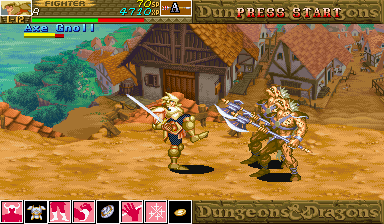
Shadow over Mystara takes the party through a high-fantasy journey of villages, wilderness, caverns, fortifications, and monster-filled confrontations. Enemy groups include familiar Dungeons & Dragons-style creatures, while bosses demand more attention than ordinary arcade brawls. Progress does not always follow one fixed route: decisions at key points can send the party to different areas and help produce different outcomes. Experience earned during play also improves characters and unlocks capabilities, giving repeated credits a reason to explore new classes, paths, items, and cooperative tactics.
The game is a direct sequel rather than a retelling of Tower of Doom. Its story begins after Deimos’s defeat, then expands the conflict around Synn and her plan to dominate neighboring lands. That connection gives returning players a continuing adventure, while the new classes, larger selection of items, and branching structure make it accessible on its own. Capcom’s detailed 2D character animation, large monsters, and elaborate fantasy backdrops were designed for arcade cabinets, where a party could coordinate around the same screen and share the risk of every encounter.
Shadow over Mystara later reached home audiences in the Japan-only Sega Saturn Dungeons & Dragons Collection with Tower of Doom, though that version reduced simultaneous play to two players. Both arcade games were also brought together in 2013’s Dungeons & Dragons: Chronicles of Mystara for modern digital platforms, preserving the pair for a new audience and supporting four-player cooperative play. The original arcade release remains distinctive for weaving an established tabletop setting, class-based abilities, loot management, and branching adventure design into the fast pace of a Capcom side-scrolling brawler.
Gallery

Details
- Developer
- Capcom
- Publisher
- Capcom
- Genre
- Beat 'em Up
- Players
- 1-4
- Release Date
- June 19, 1996
- System
- Arcade