About
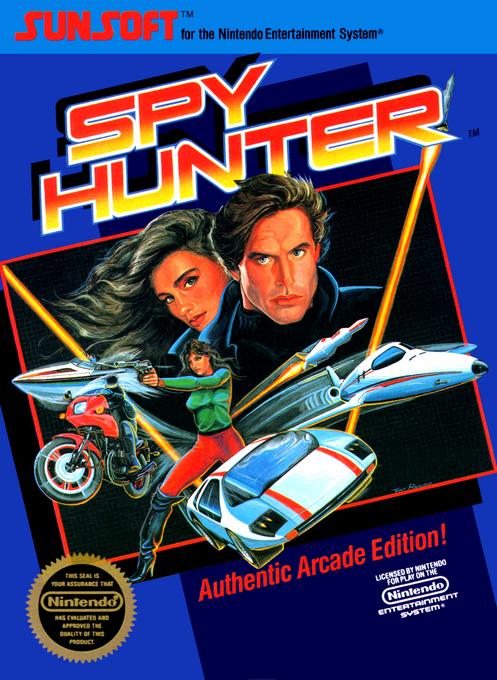
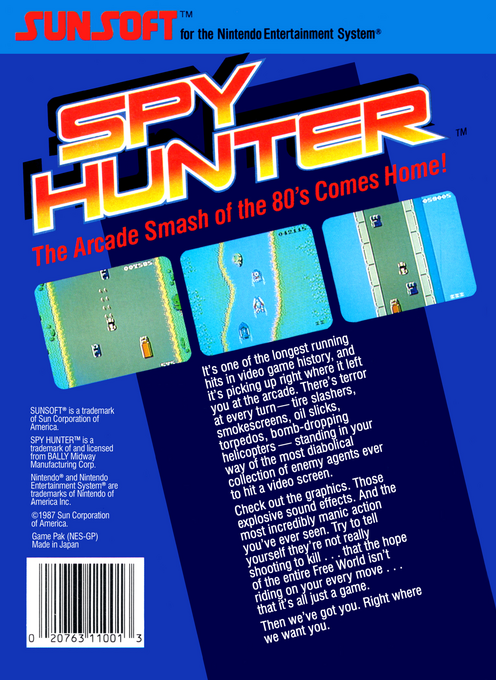
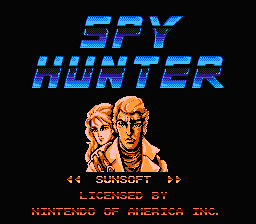
Spy Hunter for the Nintendo Entertainment System is Sunsoft’s 1987 home conversion of Bally Midway’s 1983 vehicular-combat arcade game. This is a one-player, top-down driving action game that casts the player as the operator of the G-6155 Interceptor, an armed prototype car on a continuously scrolling mission. Sunsoft published the licensed NES release in North America, translating the arcade concept to the standard NES controller while preserving its spy-thriller premise, hostile traffic, and relentless push down the highway.
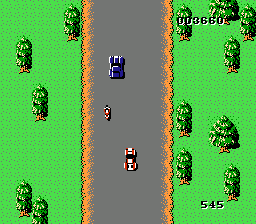
The fundamental task is to keep the Interceptor moving, hunt enemy agents, and avoid destroying civilian vehicles. The Control Pad handles steering, acceleration, and braking, while the B button fires the car’s forward machine guns. Traffic is more than scenery: friendly cars can obstruct a safe line through a bend, whereas enemy vehicles try to ram the Interceptor, force it from the road, or attack it directly. Shooting a non-enemy vehicle temporarily stops score accumulation, so progress calls for careful identification as well as quick reactions.
The NES game introduces a compact set of threats with distinct dangers. Tire-slasher cars can disable the racer, armored “bullies” are resistant from the rear and can shove it aside, and limousines fire on the player from their back seats. Bomb-dropping helicopters add an aerial hazard, leaving dangerous craters in their wake. Crashes at sharply different speeds, bombs, enemy fire, and straying beyond the shoulder can end a vehicle, while changing road conditions such as ice and puddles make steering less predictable.
Machine guns are only the starting equipment. On entering a new territory, the player can call a weapons van and drive up its rear ramp to collect the weapon displayed on it. The Select button chooses an available special weapon and the A button activates it. Smoke screens slow pursuers, oil slicks target vehicles approaching from behind, and heat-seeking missiles are reserved for enemy helicopters. Choosing when to collect and spend these tools gives the high-speed action a tactical edge, especially when the road is crowded or a dangerous enemy reaches the rear of the car.
Routes do not remain entirely on asphalt. At designated riverbanks, entering a boathouse changes the Interceptor into its marine counterpart, carrying over the weapons already obtained. Water stages bring their own opponents and hazards: cruise boats fire torpedoes, speed boats drop explosive barrels, and the helicopter can still attack from above. The transformation keeps the game’s forward momentum intact while asking the player to navigate a new set of collision risks and avoid leaving the riverbank.
Score is tied to distance and survival, and strong runs can earn extra racers: the manual awards one at 10,000 points before the initial counter expires, followed by further cars at 30,000-point intervals, up to five additional vehicles. Road forks create choices of route and opportunities to separate from pursuing enemies. Spy Hunter on NES is therefore more than a straight arcade shooting gallery; it is a sustained driving challenge of positioning, weapon management, route decisions, and survival. Its release also predates Sunsoft’s later NES game Super Spy Hunter, which originated separately in Japan as Battle Formula despite its overseas title.
Gallery
Details
- Developer
- Sun Electronics
- Publisher
- Sunsoft
- Genre
- Racing & Driving
- Players
- 1
- Release Date
- September 1, 1987
- System
- NES