About
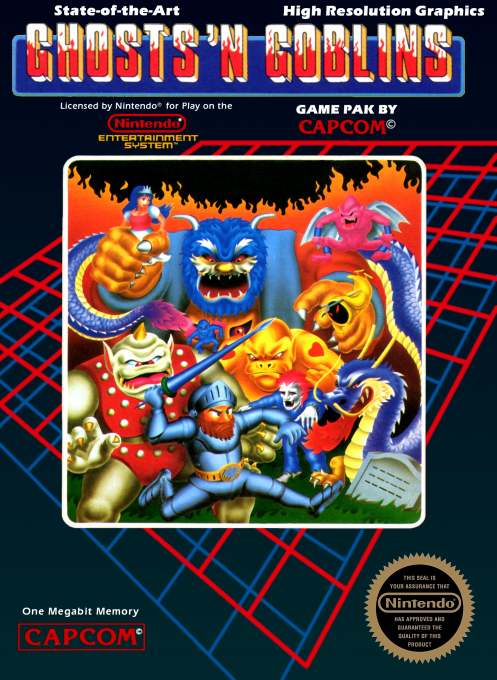
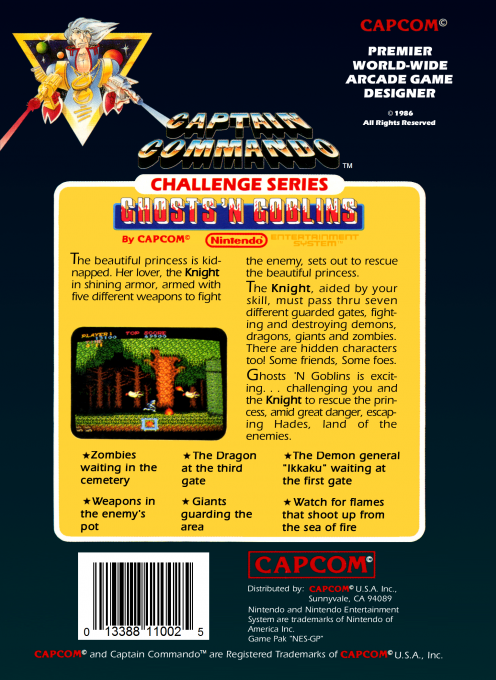
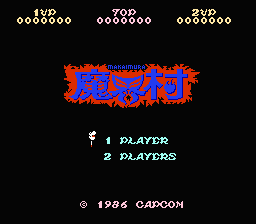
Ghosts 'n Goblins for the NES is Capcom's 1986 home-console version of the 1985 arcade action-platformer, programmed for the Famicom and NES by Micronics. Known in Japan as Makaimura, it casts the armored knight Arthur as the rescuer of a princess carried off to the Demon Realm. Capcom published the Famicom edition in Japan in June 1986 and the North American NES release followed that November, bringing the series' fast, hostile fantasy adventure to Nintendo's 8-bit system.
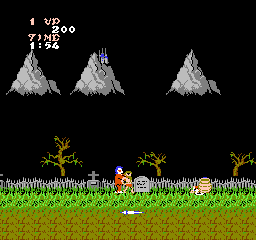
Arthur advances from left to right through a chain of monster-filled areas, negotiating uneven ground, ladders, gaps, and hazards while an on-screen timer keeps the pressure on. The directional pad moves him, lets him crouch, and handles climbing; A makes him jump and B throws his current weapon. The fixed, committed jump trajectory makes enemy placement and timing central to play. Defeating the guardian at an area’s end produces the key needed to continue, so each stretch combines careful movement with quick reactions under a deadline.
The quest begins with Arthur carrying a javelin, but jars placed along the route can replace it with a torch, sword, axe, or cross. These weapons behave differently: the sword travels quickly, thrown axes and torches follow an arc, and torches leave fire where they land. Choosing whether to take a new weapon matters because Arthur has to work with what he finds, while different attack paths suit different foes and terrain. Players can also fire while jumping or crouching, adding useful options when enemies crowd the screen.
Its signature vulnerability system turns every encounter into a risk. A first hit strips Arthur of his armor and leaves him in his underwear; another hit costs a life. The game populates its dark fairy-tale world with zombies, ravens, skeletons, bats, ghosts, demons, giants, dragons, and other supernatural threats, many arriving from awkward angles or forcing split-second positioning. Hidden items and characters reward exploration, though not every surprise is helpful: some discoveries grant armor, time, or an extra life, while others create a fresh problem.
The NES version supports one or two players taking turns rather than simultaneous cooperative play. Its two-player option preserves the same individual challenge, passing control between players as they continue the rescue attempt. Progress is built around repeating the route after mistakes, learning where enemies emerge, how each weapon travels, and when it is safer to jump, duck, or wait. Boss confrontations provide the gates between sections and make precise attacks just as important as getting there intact.
This is a distinct console conversion, not the original arcade board. Micronics adapted Capcom's arcade game for the Famicom/NES hardware, and the North American cartridge was released as Ghosts 'n Goblins while the Japanese version used the Makaimura title. The home version remains closely associated with the arcade game’s premise and enemy-filled action, but it was designed as its own 8-bit release with its own cartridge hardware and play structure. Its Famicom launch is also notable for using a 128 KB cartridge, an early milestone for the platform.
Ghosts 'n Goblins established the series that later continued with Ghouls 'n Ghosts and Super Ghouls 'n Ghosts. On NES, its enduring identity comes from the collision of simple controls and demanding consequences: Arthur has a small set of moves, a changing set of weapons, and very little room for error. For players seeking a foundational Capcom action-platformer, the game offers a compact medieval-horror journey whose route becomes more manageable only through observation, practice, and persistence.
Gallery
Details
- Developer
- Micronics
- Publisher
- Capcom
- Genre
- Platformer
- Players
- 1-2
- Release Date
- November 2, 1986
- System
- NES