About
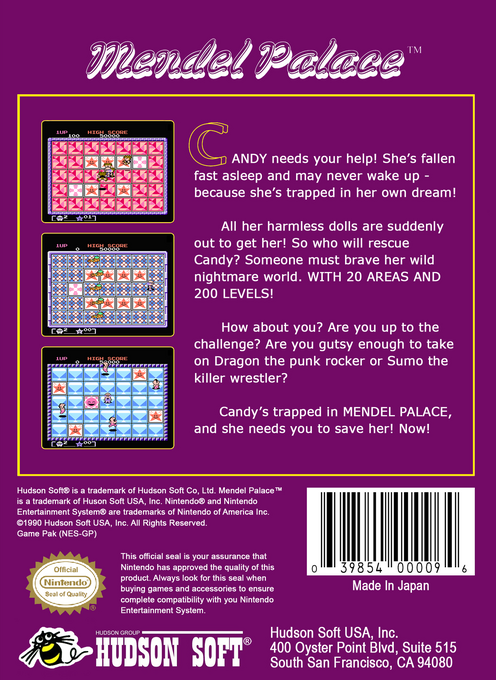
Mendel Palace for the NES is a fixed-screen action-puzzle game developed by Game Freak and released in North America by Hudson Soft in 1990. It arrived in Japan a year earlier as Quinty, published by Namco for the Famicom. The North American story casts the blue-clad Bon-Bon as the rescuer of Candy, who has fallen asleep and become trapped in a hostile dream. It turns that premise into a rapid puzzle chase, with a roomful of animated dolls between the player and the next area.
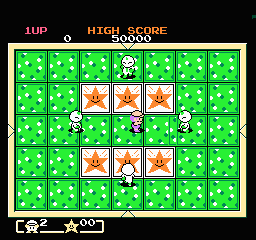
Every stage is built around a 7-by-5 floor of panels bordered by walls. Bon-Bon can run around the board with the Control Pad and use either action button to flip the panel in front of him, or the one beneath him when positioned correctly. A flip launches a doll away rather than striking it directly. The goal is to use that shove to send every enemy crashing into the edge of the room or a solid obstacle. Contact with a doll costs a life, so clearing a screen depends on positioning, timing, and leaving room to evade an opponent’s approach.
The floor is as important as the enemies. Repeated flips uncover further panel layers and can expose items or terrain that changes how a room plays. Some panels offer helpful effects, while sturdy or otherwise unflippable squares reshape the safe routes and provide surfaces against which dolls can be defeated. A spinner panel can turn an enemy’s movement into another attack opportunity. The board therefore changes as a round unfolds: a promising escape route may disappear, a useful item may emerge, or a newly revealed panel may complicate the next exchange.
Mendel Palace supports both solo play and two-player cooperative play. A second player joins as a green counterpart, allowing two people to work through the same compact rooms while maintaining separate lives and star totals. Cooperation can make the board more crowded as well as more flexible, since each player can set up a push or draw danger away from the other. The title screen also lets players select the one- or two-player game before the action begins, and Start pauses play during a stage.
Different doll types give the later rooms more character than a simple sweep of identical foes. Their behavior can vary by area: some merely wander or pursue, while others move in more unusual ways or can affect the panels themselves. Darkened rooms further limit the information available during play. These variations keep the central tile-flipping rule consistent while asking the player to read a new combination of movement patterns, obstacles, and board states. Clearing all the dolls advances the game toward further dream-world encounters and boss rounds.
The regional versions share the same basic gameplay but present their story differently. In Quinty, the protagonist is Carton, the kidnapped girlfriend is Jenny, and Carton’s younger sister Quinty is central to the conflict; the Japanese title takes its name from her. The American localization instead uses Bon-Bon and Candy’s dream as its framing. This makes Mendel Palace a useful early example of how an NES release could retain a game’s distinctive design while adapting its names, plot presentation, and package identity for another market.
It is also a notable first chapter for Game Freak. Satoshi Tajiri led the project, with Ken Sugimori handling character design and Junichi Masuda contributing its music, before the team became widely known for Pokémon. Mendel Palace stands on its own as a fast, arcade-minded NES puzzle game: its rules are easy to explain, but each small room rewards an eye for angles, enemy paths, and the moment when one flipped tile can clear the board.
Gallery


Details
- Developer
- Game Freak
- Publisher
- Hudson
- Genre
- Turn-Based Strategy
- Players
- 1-2
- Release Date
- October 1, 1990
- System
- NES