About
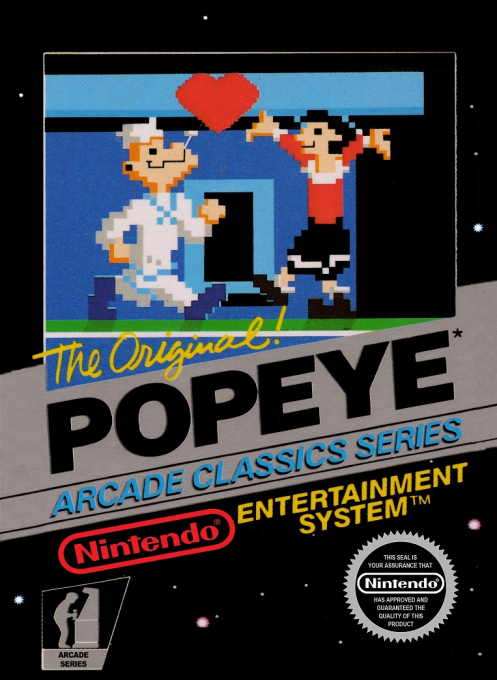
Popeye for the NES is Nintendo's home-console version of its 1982 arcade game, bringing the spinach-powered sailor and the comic-strip cast to the Nintendo Entertainment System. Developed and published by Nintendo, it first appeared in Japan as a Famicom launch title in 1983 before reaching the North American NES in 1986. The game turns Popeye's rivalry with Brutus and his pursuit of Olive Oyl's affection into a compact fixed-screen action challenge built around timing, route planning, and quick reactions.
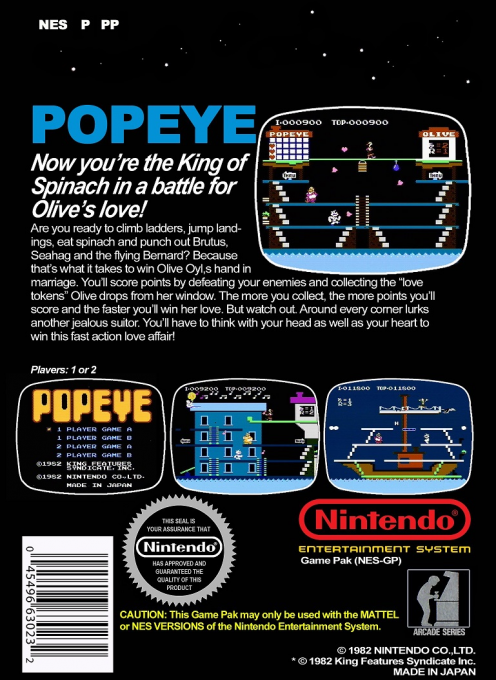
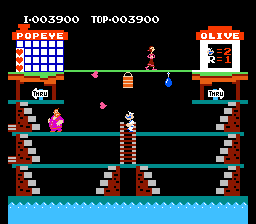
Each round takes place on a single multi-level playfield of platforms, ladders, stairs, and ledges. Olive Oyl stands above the action and sends tokens downward; Popeye has to collect the required set before the objects fall away. The three-scene cycle changes the collection goal from hearts to musical notes and then the letters of HELP, while changing the layout and hazards. Clearing the final scene returns play to the earlier setting with a tougher pace, so success depends on learning safe paths through the screens as the action accelerates.
Popeye can walk, climb, descend, and move through designated openings, but he has no ordinary jump. His main defensive tool is a punch. Well-timed punches destroy threats such as bottles and other hostile objects before they reach him, while Brutus constantly tries to corner Popeye across the platforms. Contact with Brutus or a dangerous flying object costs a life, making positioning just as important as gathering Olive's falling items. The limited moveset gives the game a direct arcade feel: players must decide when to keep collecting, when to clear a hazard, and when to retreat.
A can of spinach changes the balance of a round for a short time. After Popeye eats it, Brutus flees and can be knocked out, opening up room to score and collect without the usual pursuit. Stage devices also provide situational opportunities, including an object that can stun Brutus on the opening screen when Popeye activates it at the right moment. These temporary advantages do not remove the danger permanently, so using them effectively is part of the game's scoring and survival strategy.
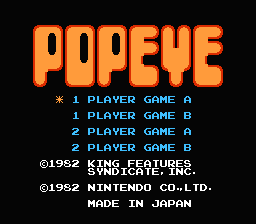
The NES conversion preserves the recognizable three-stage structure and licensed characters, including Olive Oyl, Brutus, the Sea Hag, Swee'Pea, and Wimpy. It supports one player or two players taking alternating turns, and adds home-console conveniences such as selectable difficulty and a pause function. Its colorful character animation and familiar theme make the simple objective immediately readable, yet the different screen arrangements ensure that the same basic task plays differently from round to round.
Popeye also occupies an early place in Nintendo's console history. Alongside Donkey Kong and Donkey Kong Jr., it was among the games available when the Famicom launched in Japan, tying an established Nintendo arcade property to the company's new cartridge system. For NES players, Popeye remains a brisk adaptation of a licensed arcade game: a contest of collecting, climbing, punching, and making the most of a brief burst of spinach power while Brutus closes in.
Gallery
Details
- Developer
- Nintendo
- Publisher
- Nintendo
- Genre
- Platformer
- Players
- 1-2
- Release Date
- June 1, 1986
- System
- NES