About
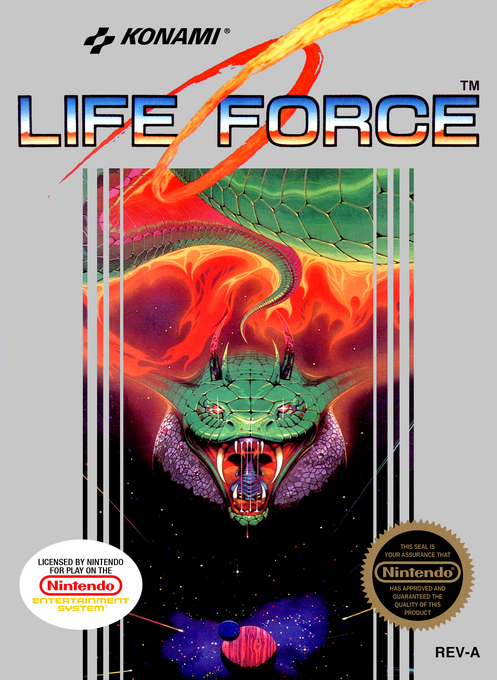
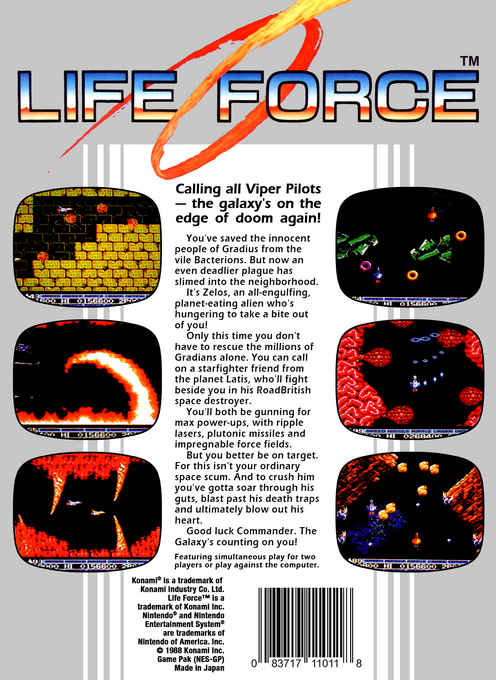
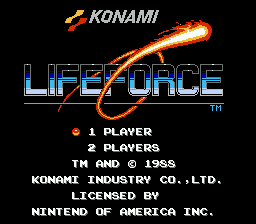
Life Force NES is Konami’s 1988 scrolling shooter for the Nintendo Entertainment System, a home adaptation of the Salamander branch of the Gradius series. It sends the Vic Viper from Gradius and, in two-player play, the RoadBritish Space Destroyer from Latis into a desperate assault on Zelos, a colossal alien menace threatening the galaxy. Rather than simply presenting an arcade mission in miniature, the NES game frames its journey as a flight through the creature’s dangerous interior and builds a full six-zone campaign around that premise.
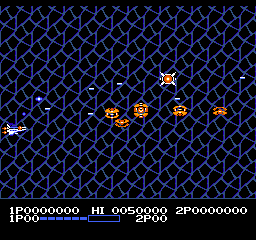
The action alternates between horizontal and vertical scrolling stages, so the direction of the battlefield changes as often as the threats. Players steer with the Control Pad, fire with B, and use A to activate upgrades. Swarms, fixed defenses, terrain hazards, and closing walls demand careful positioning as well as quick shooting, while a major guardian waits at the end of every zone. Reaching Zelos means surviving cell-filled passages, volcanic danger, temple ruins, fiery spaces, and the final mechanical stronghold rather than simply racing through one uninterrupted stretch of space.
Life Force uses a Gradius-style power meter that gives each collected red capsule a tactical purpose. Destroying designated enemies releases the pods, which advance the selection through choices including speed increases, missiles, options, laser weapons, ripple fire, and a force field. The player decides when to spend the accumulated selection, creating a balance between grabbing an immediate upgrade and waiting for a more useful one. Extra Options shadow a ship’s movements and duplicate its attacks, making them especially valuable for covering enemies approaching from different angles.
The NES cartridge supports either solo play or simultaneous two-player cooperation. One player flies Vic Viper, while the second commands RoadBritish; each ship has its own score and power-up selection. Partners share the screen and the pressure of avoiding hazards, but their firepower can also help clear dense formations and bosses. The manual also allows continuations after a game over, making a complete run a matter of learning the route, managing upgrades, and keeping a ship alive long enough to preserve its strongest equipment.
Konami’s Famicom release arrived in Japan in 1987 as Salamander, while the North American NES edition followed in 1988 under the title Life Force. Both console versions combine material from the earlier Salamander arcade game and the Japanese arcade revision called Life Force, but the console conversion has its own stage and boss arrangement. The North American NES release differs from its Famicom counterpart in a few details, including its Life Force name, two obtainable Options instead of three, and the absence of the Famicom version’s multiple endings. In Europe, the game was also marketed with the combined title Life Force: Salamander.
That changing-scroll structure and cooperative play distinguish Life Force within the early Gradius family. The game retains the series’ recognizable spacecraft, capsule-driven upgrading, and demanding enemy patterns, while its biological setting gives the stages an unusually vivid identity. Konami later brought this NES version back through Virtual Console releases, but its original cartridge remains a concise example of how the company reshaped an arcade shooter for the 8-bit Nintendo system without losing the tension of its escalating power-up decisions.
Gallery
Details
- Developer
- Konami
- Publisher
- Konami
- Genre
- Shoot 'em Up
- Players
- 1-2
- Release Date
- August 1, 1988
- System
- NES