About
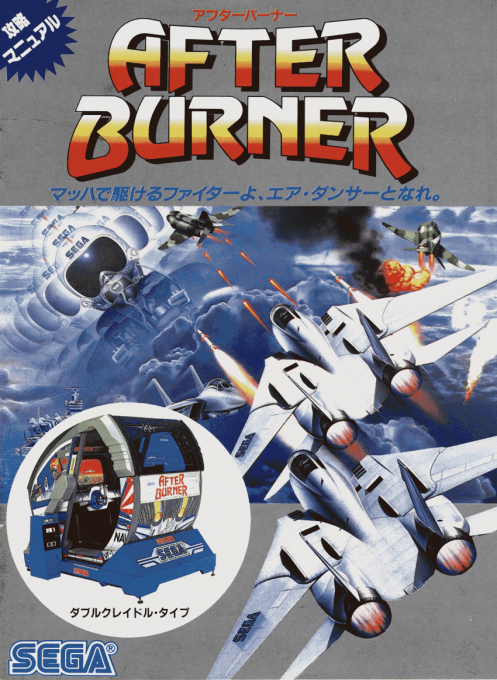
After Burner is Sega's 1987 arcade rail shooter, built to make the player feel as though they have climbed into the cockpit of a high-speed fighter jet. Developed by Yu Suzuki's Studio 128 team and published by Sega, it puts an F-14 Tomcat in the center of an urgent aerial assault across 18 short stages. Rather than simulate every aspect of flight, the game concentrates on the visual rush of pursuing targets, weaving through fire, and surviving long enough to reach the next landing or refuelling sequence.
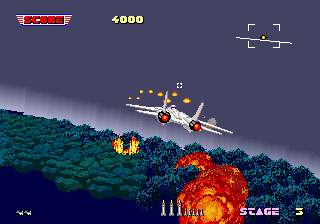
The arcade action is viewed from behind the aircraft, with the jet banking across the screen as hostile planes, missiles, terrain and clouds surge toward the player. A flight stick moves the Tomcat, while separate controls fire its cannon and heat-seeking missiles. Missiles are limited, so lock-ons matter; supplies are replenished by a friendly aircraft after certain stages. The basic goal is direct and immediate: destroy enemy formations, evade their attacks, and clear the route before the action overwhelms the cockpit.
What made After Burner especially striking in 1987 was its use of Sega's X Board hardware and rapid sprite-scaling effects. Jets, smoke trails, explosions and scenery expand and shift at speed to create an exaggerated sense of depth without polygonal 3D graphics. The result is an arcade spectacle in the same broad tradition as Sega's Space Harrier and Out Run, but its subject is military aviation and its pace is much more relentless. The game turns simple target shooting into a screen-filling chase, with the horizon, sea and landscape continually changing beneath the fighter.
The original release was also inseparable from Sega's ambitious cabinet design. Players could encounter a conventional upright machine, but the headline version was a closed cockpit cabinet with a seatbelt, integrated controls, lighting and a hydraulic motion system. The cockpit tilted and rotated in response to the aircraft's movement, so a hard bank on screen could be felt physically in the seat. Regional cabinet variations included open and commander-style machines, yet all were designed to sell the sensation of a theme-park ride as much as a video game.
Yu Suzuki began development shortly after completing Out Run, and the project was conceived as a major arcade attraction for Sega. Work took place in the separate Studio 128 building, while programmer Satoshi Mifune and composer Hiroshi Kawaguchi were among the small core team. The game's approachable pop-culture fighter-jet image was shaped by the era's aviation-film excitement, while its fictional enemy and invented locations kept the experience focused on fast, universal arcade drama instead of a specific real-world conflict.
After Burner reached Japanese arcades in July 1987 and expanded internationally later that year. It became a substantial commercial success, with its visual technology, loud presentation and motion cabinets helping Sega stand out in late-1980s amusement venues. Contemporary reactions frequently singled out the speed of the graphics and the theatrical impact of the cabinet. The game also demonstrated the value of an arcade release that offered something home hardware could not easily reproduce: not only a fast-moving display, but a machine that moved with the player.
Sega quickly followed the original with After Burner II in 1987. That updated arcade version added throttle control and adjusted parts of the presentation, addressing the original game's fixed-speed intensity while preserving its basic F-14 combat structure. Because the sequel is so closely related, later releases and collections often make the distinction important: the 1987 arcade game represented here is the first After Burner, not the throttle-equipped After Burner II revision.
The original game's appeal carried into a wide range of home conversions, even though systems of the period had to reinterpret the arcade's scale and motion. Versions appeared on machines including the Master System, Famicom/NES, ZX Spectrum, Commodore 64, Amiga, Atari ST and several Japanese computers. The series continued through related Sega aerial-action games and later returned with After Burner Climax, while references in games such as Shenmue II and Sega crossover titles have kept its distinctive fighter-jet imagery visible. For arcade enthusiasts, After Burner remains a defining example of Sega's 1980s ability to merge quick, readable action with hardware built to make the entire cabinet part of the experience.
Gallery

Details
- Developer
- SEGA
- Publisher
- SEGA
- Genre
- Third-Person Shooter, Flight Simulator
- Players
- 1
- Release Date
- January 1, 1987
- System
- Arcade