About
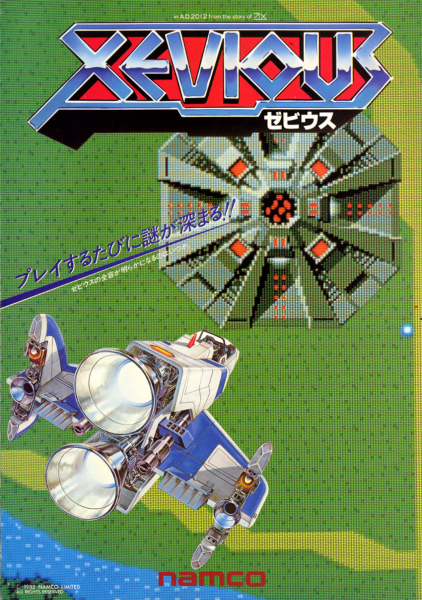
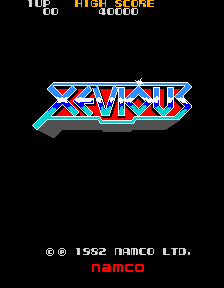
Xevious arcade is Namco’s vertically scrolling shooting game, released in Japan in early 1983 and distributed in North American arcades by Atari. Designed by Masanobu Endō for Namco’s Galaga-based arcade hardware, it puts the player in the cockpit of the Solvalou, an advanced craft sent into hostile territory. Its science-fiction premise has the Xevious forces threatening humanity, but the immediate task is direct and demanding: survive the invasion routes, destroy enemy formations, and press toward the Andor Genesis mother ship.
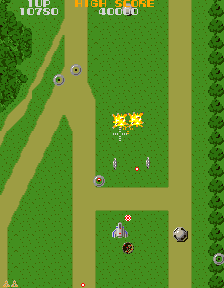
The arcade cabinet uses an eight-way joystick and two buttons, yet its central idea is more involved than simply firing upward. One button operates the Solvalou’s air zapper for airborne attackers, while the other drops blaster bombs onto enemies and installations on the landscape below. A sight ahead of the ship shows where a bomb will fall, making timing and positioning just as important against ground defenses as reflexes are against aircraft. This division between air and ground targets gives every stretch of scrolling terrain two simultaneous layers to watch.
As the screen advances, the Solvalou crosses a changing series of landscapes that include forests, roads, rivers, and mechanical facilities. Squadrons, vehicles, and fixed emplacements approach in different patterns, so a safe line through the air may leave valuable ground targets untouched. The game’s connected areas eventually loop back to the start, while the enemy pressure grows according to how effectively certain opponents are handled. The result is a score-chasing arcade structure that rewards repeated routes, quick recognition, and careful use of both weapons.
The Andor Genesis is the game’s major threat. During these encounters, the large enemy craft fills the action with attacks while the player looks for ways to damage its vulnerable sections or central core. Xevious also hides Sol Citadels in particular ground locations; the blaster reticle can provide a clue by changing color when the Solvalou passes over one. Special Flag items, borrowed from Namco’s Rally-X, can also appear during play and award an extra life, adding discoveries beyond the visible waves of opponents.
This listing is the original Xevious arcade release, not the later Super Xevious update or one of the many home versions. The original supports one or two players taking turns rather than simultaneous cooperative play. Namco later brought Xevious to systems including the Family Computer, and the game was repeatedly included in Namco collections, but its arcade design is defined by the vertical monitor, compact controls, and the contrast between high-altitude shooting and targeted bombing below.
Xevious became one of Namco’s major early arcade successes in Japan and remains a notable step in the development of the scrolling shooter. Its detailed ground scenery, named enemy world, hidden targets, and two-level combat helped distinguish it from shooters focused only on formations in space. The Solvalou and the Xevious name subsequently returned in updates, sequels, and related games, but this 1983 cabinet is the foundation: a single-screen battlefield where each advance asks the player to manage the sky and the ground at once.
Gallery

Details
- Developer
- Namco
- Publisher
- Namco
- Genre
- Shoot 'em Up
- Players
- 1-2
- Release Date
- January 1, 1982
- System
- Arcade