About
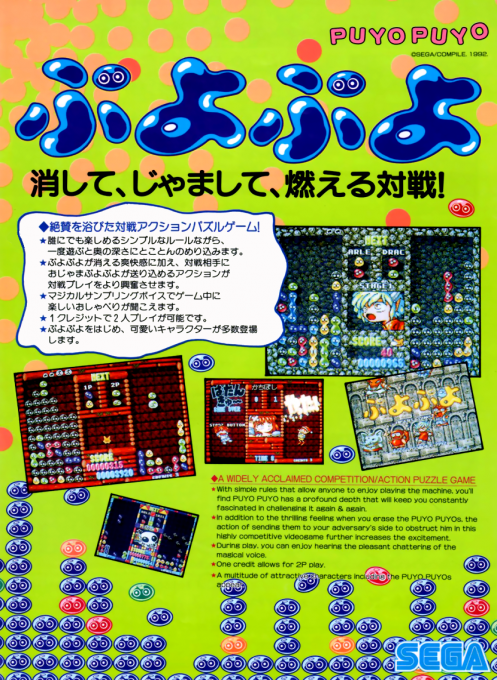
Puyo Puyo Japan Rev A arcade is the Japanese revision of Sega and Compile's competitive falling-piece puzzle game, released to Japanese arcades in October 1992. Running on Sega's C2 board, this one- or two-player cabinet release turned the colorful Puyo Puyo concept into a fast head-to-head game. The title’s familiar cast and fantasy flavor come from Compile’s Madou Monogatari world, but its central challenge is immediate: arrange falling pairs of round Puyos before either player’s field becomes unmanageable.
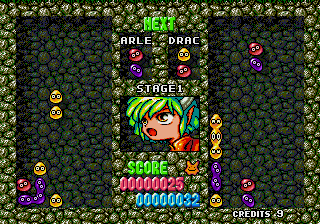
Each player works within a six-column playfield as pairs of colored Puyos descend from above. A joystick moves the pair across the field, while the rotation control changes its orientation before it lands. Connecting four or more Puyos of one color horizontally or vertically makes that group vanish. The cleared space can cause unsupported Puyos to fall, so a careful placement can create another match after the first one disappears. Learning to leave deliberate gaps and color connections is the foundation for building chains rather than merely reacting to every falling pair.
Chains give Puyo Puyo its competitive pressure. When a clear triggers later clears, the resulting sequence sends colorless nuisance Puyos to the opposing field. Those obstacles take up precious space and cannot form ordinary color matches; they are removed only when a neighboring group is popped. Larger groups and multi-step chains therefore serve two purposes at once, opening room on the attacking player’s board while crowding the rival’s. A round ends when a player’s Puyos stack to the top of the field, making both speed and planning important from the opening moves onward.
The arcade game supports direct two-player contests, the format that best shows its attack-and-defense rhythm. Its solo Scenario mode instead sends one player through battles against computer-controlled characters, with a short beginner route and a longer normal progression. These encounters frame the puzzles with the series’ eccentric Madou Monogatari characters while preserving the same basic rule set: create connections, prepare chains, and avoid being buried by nuisance Puyos. The cabinet’s concise rounds made the game easy to understand from a demonstration screen while leaving room for increasingly elaborate board construction.
This 1992 arcade version is distinct from the earlier 1991 Puyo Puyo releases for MSX2 and Famicom Disk System, which included Endless and Mission-style play. The Sega C2 edition sharpened the focus on versus competition and became the basis for numerous Japanese home conversions, including versions for Mega Drive and Game Gear. It is also separate from Puyo Puyo Tsu, the 1994 arcade sequel that introduced additional rules for countering incoming nuisance Puyos. The Rev A label identifies this particular Japanese arcade program revision; it should not be confused with the English arcade version, later regional adaptations, or the many ports and reworks that followed.
Puyo Puyo’s arcade design established the series’ enduring language of paired pieces, four-Puyo clears, cascading chains, and nuisance attacks. Its cheerful sprites and approachable matching rule contrast with the tension of a board that can turn from open to crowded in a few drops. For players exploring early 1990s Sega arcade puzzle games, Puyo Puyo Japan Rev A captures the original competitive C2-board formula: a compact two-player contest built around reading a field, setting up the next collapse, and racing to make the other side overflow.
Gallery

Details
- Developer
- SEGA
- Publisher
- SEGA
- Genre
- Tile-Matching Puzzle
- Players
- 1-2
- Release Date
- January 1, 1992
- System
- Arcade