About
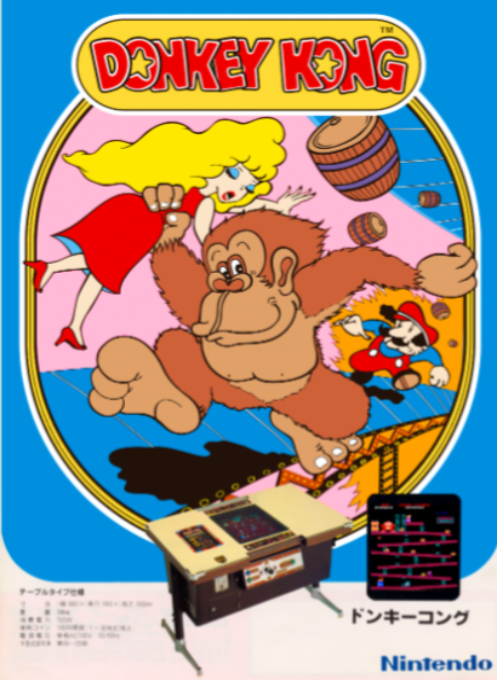
Donkey Kong (US Set 2) is the 1981 Nintendo arcade original: a compact, demanding rescue game set on a towering construction site. Donkey Kong has carried Pauline to the top, and Mario—still presented here in his early carpenter-era role—must climb after her. It is an instantly readable premise made tense by the screen’s steep girders, broken ladders and rolling hazards. Every trip upward asks for quick judgment: make the next jump, wait for a safer opening, or press on before the bonus timer slips away.
The action is built around a four-way joystick and a single jump button, yet that small control set supports a remarkable amount of precision. Mario runs across platforms, ascends ladders and clears gaps, while Donkey Kong’s threats turn each screen into a moving route-planning problem. Timing a leap over a barrel is only part of the challenge; players must also decide when to change levels, when to retreat, and when the short path is too dangerous. The result is arcade platforming at its most direct: easy to understand at a glance, difficult to execute cleanly.
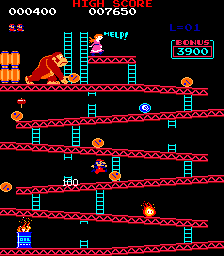
The opening girders establish the game’s famous rhythm. Barrels roll down the slanted steelwork, fireballs patrol the route, and ladders can be either a lifeline or a trap. A hammer power-up briefly lets Mario smash approaching hazards, creating a thrilling change from evasion to attack, but its limited duration makes each use a calculated commitment. Scoring rewards more than simply surviving: jumping hazards, using the hammer, collecting the scattered bonus items and finishing with time remaining all matter to a strong run.
Donkey Kong keeps that basic language fresh across four distinct single-screen stages. The barrel-and-girder climb is followed by a conveyor-belt cement factory, a perilous elevator section with bouncing springs, and a final rivet screen. The objectives shift with the setting, but the goal remains clear: find a path through Donkey Kong’s defenses and reach Pauline. On the rivet stage, Mario removes the supports beneath the ape, turning the rescue into a final puzzle of movement, hazard avoidance and efficient routing.
Completing the four screens does not end the contest. They return in a tougher cycle, with the pressure rising as hazards become harder to manage and the timer remains unforgiving. That looping structure is central to the arcade experience: a successful clear is both a victory and an invitation to see how long your precision can hold up. Lives are limited, so an ambitious score attempt has to balance bold point opportunities against the risk of losing a run to one mistimed jump.
This US Set 2 entry refers to an arcade program set recognized by MAME, rather than a separate sequel, remake or home-console interpretation. Its identity is the original coin-op design: the vertical cabinet-style challenge, the construction-site screens and the pursuit of Pauline. It should not be confused with later Donkey Kong games, the Donkey Kong Country series, or the many home ports, which can differ in presentation and content. The enduring appeal here comes from the arcade source itself.
Nintendo’s design gives each character a strong role without slowing the pace. Donkey Kong looms above the action, his barrel throws and presence framing every ascent; Pauline provides the rescue objective; Mario is defined by what the player can make him do under pressure. Brief story moments connect the screens, but the drama is always carried by the next ladder, the next barrel and the narrowing margin for error. It is a foundational example of a game telling a clear story through play rather than lengthy explanation.
For newcomers, Donkey Kong is a brisk test of timing and observation. For returning players, its appeal is in repetition with purpose: learning safer routes, spotting better scoring chances and turning a chaotic-looking climb into a practiced sequence of decisions. The controls remain approachable, the screens remain memorable, and the difficulty still demands respect. Donkey Kong (US Set 2) captures why the original arcade game became such a lasting landmark: it makes every successful ascent feel earned.
Gallery

Details
- Developer
- Nintendo
- Publisher
- Nintendo
- Genre
- Platformer
- Players
- 1
- Release Date
- July 13, 1981
- System
- Arcade