About
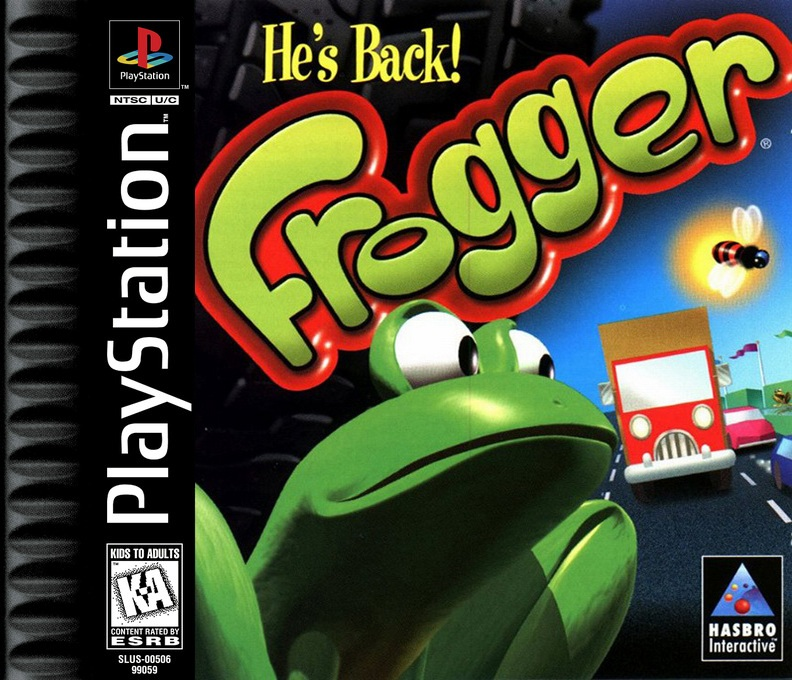
Frogger for PlayStation is the 1997 3D reimagining of Konami’s 1981 arcade game, published by Hasbro Interactive and developed by Sony Computer Entertainment Europe’s Cambridge team. Often called Frogger: He’s Back!, this PS1 release keeps the familiar idea of guiding a small frog through danger, but turns it into a larger action-puzzle adventure. Instead of repeating one screen of traffic and river hazards, Frogger travels through a succession of themed areas built around platforming, timing, route-finding, and quick reactions.
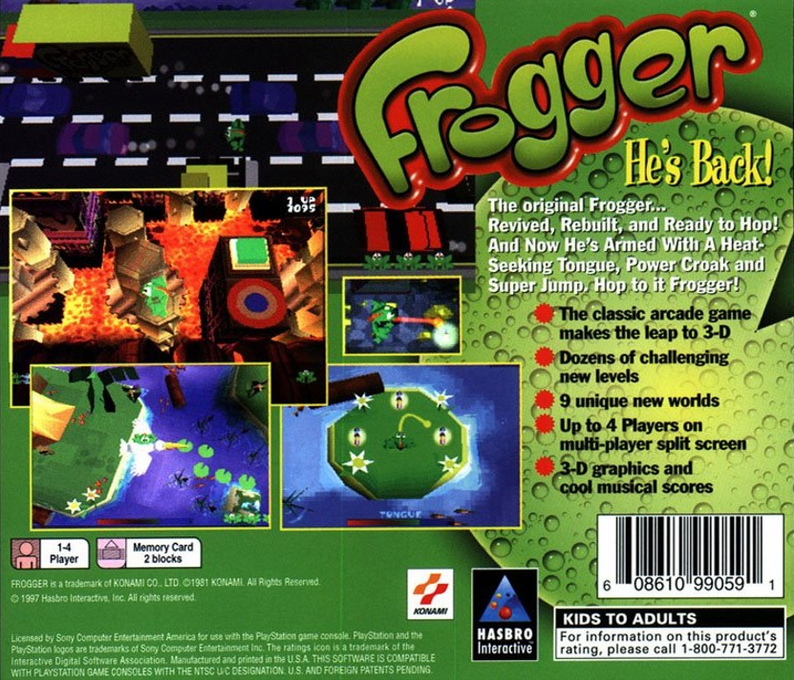
The central goal is to locate and rescue five differently coloured baby frogs in each area before the clock expires. Reaching a youngster is only part of the task: every route is guarded by moving hazards, unfriendly animals, environmental traps, or gaps that need a carefully timed hop. Losing a life returns Frogger to a starting point, so learning the layout and judging each obstacle’s rhythm becomes essential. The game’s camera and fully three-dimensional spaces give the classic upward journey a much broader sense of place while retaining a deliberately immediate, arcade-like pace.
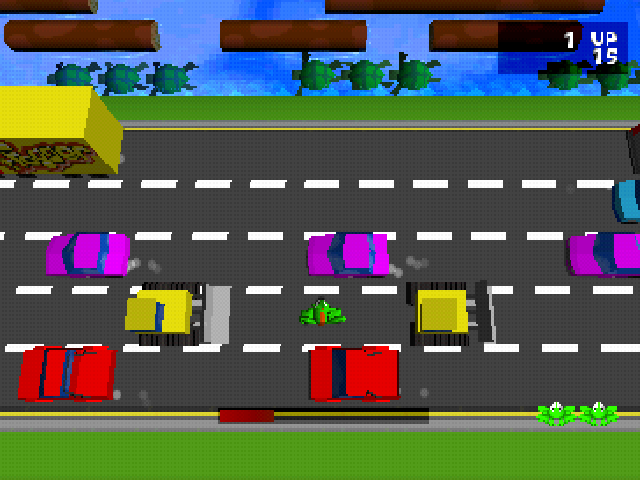
The opening Retro stages make the connection to the original especially clear. Frogger crosses roads full of vehicles, then works across water using logs and turtles, with the basic hop-and-avoid challenge presented in polygonal 3D. From there, the PlayStation game moves into locations with their own hazards and rules. Lily pads, animals, machinery, darkness, boulders, toxic industrial obstacles, deserts, jungles, caves, and suburban lawn mowers all turn the simple act of moving forward into a different kind of navigation puzzle.
Frogger has more options than the arcade character. Along with regular hopping, he can make a higher Super Jump to clear particular barriers, croak to affect certain situations, and use a heat-seeking tongue to catch insects from a distance. Flies and other pickups can add points, time, extra lives, speed, light for dark spaces, or temporary tongue improvements. These abilities do not replace the need for precision; they expand the ways individual levels ask the player to read a path and make use of what is around it.
Progress is tied to both rescued frogs and hidden gold frogs. Finding the gold frog associated with a zone opens access to additional zones, encouraging players to revisit areas and search beyond the most direct route. The single-player adventure contains 33 levels across nine zones, while the PS1 edition also includes specially designed competitive stages. With the appropriate controllers and a PlayStation Multi Tap, up to four players can race at once in split-screen multiplayer, turning the rescue format into a contest to finish first.
The PlayStation release supports memory-card saving for progress, high scores, and controller configurations. Its bright, stylized polygonal presentation and dedicated music score place it firmly in the late-1990s wave of classic arcade properties rebuilt for 3D hardware. The game was also released for Windows in the same period, but the PS1 version is notable for its console-focused split-screen play and Multi Tap support.
Frogger PS1 is therefore not a straight conversion of the 1981 game. It is an expanded remake that uses its famous road-and-river premise as the starting point for a longer, more varied adventure. The sequel Frogger 2: Swampy’s Revenge followed in 2000, while this 1997 entry remains the key PlayStation-era return for the series: a mixture of arcade timing, environmental puzzles, collectible-driven progression, and frantic multiplayer races.
Gallery
Details
- Developer
- Millennium Interactive
- Publisher
- Hasbro Interactive
- Genre
- Platformer
- Players
- 1-4
- Release Date
- October 10, 1997
- System
- PS1