About
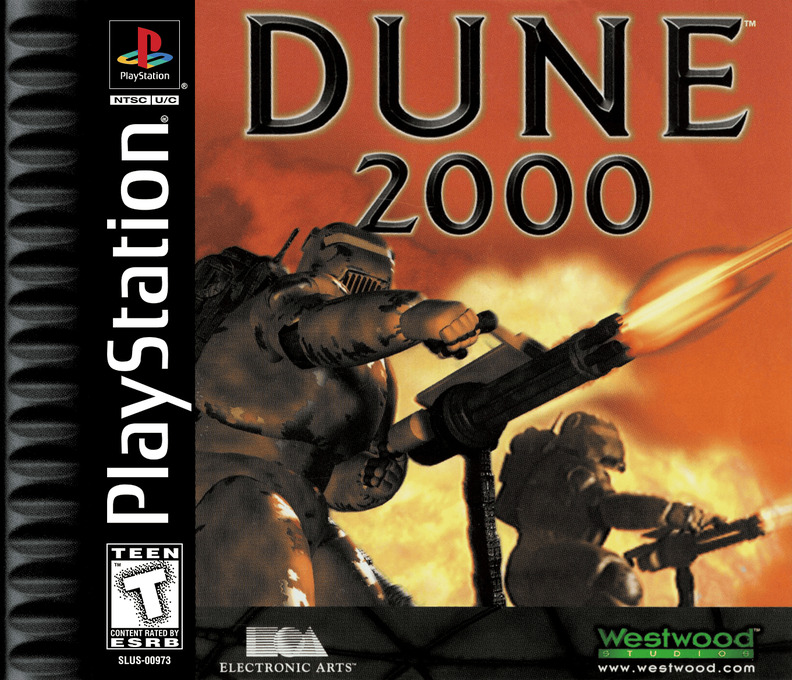
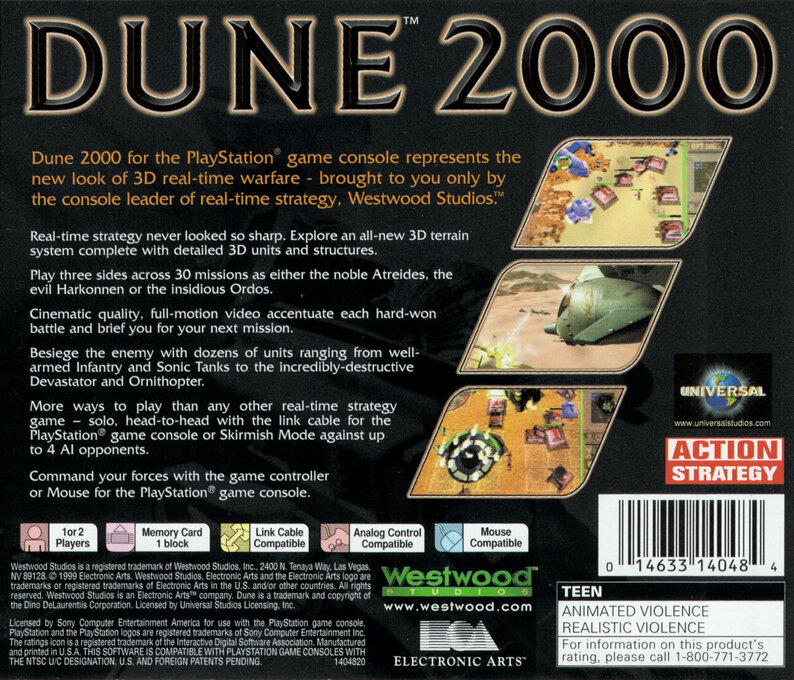
Dune 2000 is a PlayStation real-time strategy game set on Arrakis, the desert world from Frank Herbert's Dune universe. Released in 1999 by Electronic Arts, this console version brings Westwood's return to the ideas of Dune II to Sony's machine, with development credited to Intelligent Games alongside Westwood Studios. It retells a familiar contest for the galaxy's most valuable resource: spice. The Emperor challenges the great houses to secure Arrakis, and the commander who can dominate its mines, territory, and hostile desert may claim control of the planet.
Players choose House Atreides, House Harkonnen, or House Ordos and guide that faction through a campaign. Each house has its own briefing scenes, advisers, and military identity, even though the core economy and much of the technology are shared. Atreides field their distinctive Sonic Tank and lean on ornithopter support and Fremen allies. Harkonnen favor devastating weapons such as the Devastator and Death Hand missile, while the secretive Ordos use tools including the Deviator tank and saboteurs. The houses' contrast gives the three campaigns different flavor while keeping their fight for spice grounded in the same strategic systems.
Every mission starts with the practical work of building a foothold in the sand. A Mobile Construction Vehicle establishes the base, Wind Traps supply power, and a refinery turns harvested spice into credits for more structures and troops. Harvesters must travel onto the dunes and return safely with their cargo, so protecting the economy matters as much as assembling an assault force. Concrete foundations support buildings, defensive towers guard approaches, and a growing base opens access to factories, barracks, radar, and increasingly powerful equipment. The result is a steady rhythm of scouting, harvesting, construction, and attack.
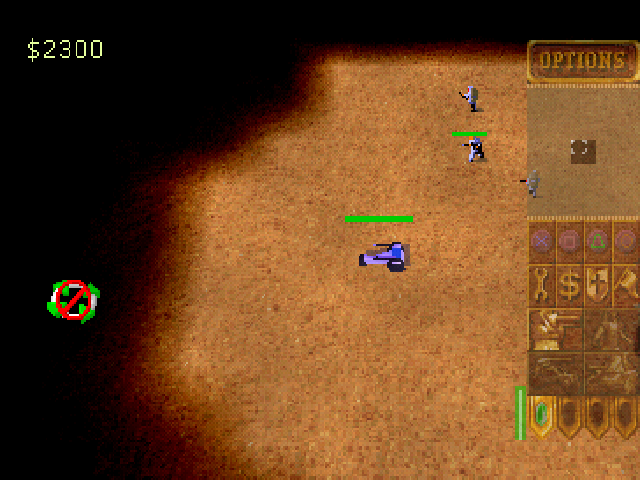
Arrakis is not merely a backdrop. The battlefield begins concealed by fog of war, inviting reconnaissance before a player commits forces or places a new outpost. Open dunes supply spice but expose harvesters to enemy raids and to the planet's enormous sandworms, whose sudden arrival can swallow vehicles whole. Spice blooms can also explode when disturbed. These hazards make map awareness valuable: a convoy that looks secure can become a costly loss, and a poorly defended refinery can stop an entire war effort. Capturing enemy production structures can be equally important, since it may open access to another house's special hardware.
The PlayStation edition preserves the campaign-driven strategy, live-action storytelling, and broad three-house structure of the earlier Windows game, but it is a distinct console port rather than simply that release on a different disc. Its battles are presented with fully 3D terrain and units, an especially notable visual change from the PC version's 2D isometric presentation. The port also had to translate a mouse-oriented RTS interface to the DualShock-era controller. Selecting units, moving the camera, choosing build options, and issuing orders therefore form a deliberate part of the PlayStation experience, offering a different way to manage large desert battles.
Between missions, live-action cinematics frame the conflict and introduce the rivalries surrounding the player's chosen house. The cast includes John Rhys-Davies as Atreides Mentat Noree Moneo and Musetta Vander as Lady Elara, a Bene Gesserit figure who draws the commander into the Imperial contest. These sequences give Dune 2000 a more theatrical presentation than Dune II while remaining focused on the familiar themes of political maneuvering, prophecy, mercenary ambition, and the dangerous value of melange. The campaigns eventually lead each faction from early survival and local skirmishes toward control of Arrakis.
For PlayStation strategy fans, Dune 2000 combines a foundational RTS formula with a setting unusually well suited to resource warfare. The need to balance spice income against armies and base defenses keeps every mission active, while house-specific units and the chance to exploit captured facilities encourage adaptation. Its 3D PlayStation presentation, full-motion-video campaign material, and controller-based command scheme make it an important late-1990s console interpretation of Westwood-style real-time strategy. Whether approached as a Dune game, a remake-minded successor to Dune II, or a PlayStation RTS curiosity, it is a battle for Arrakis where controlling the spice is the route to victory.
Gallery
Details
- Developer
- Westwood Studios
- Publisher
- Electronic Arts
- Genre
- Turn-Based Strategy
- Players
- 1-2
- Release Date
- October 31, 1999
- System
- PS1