About
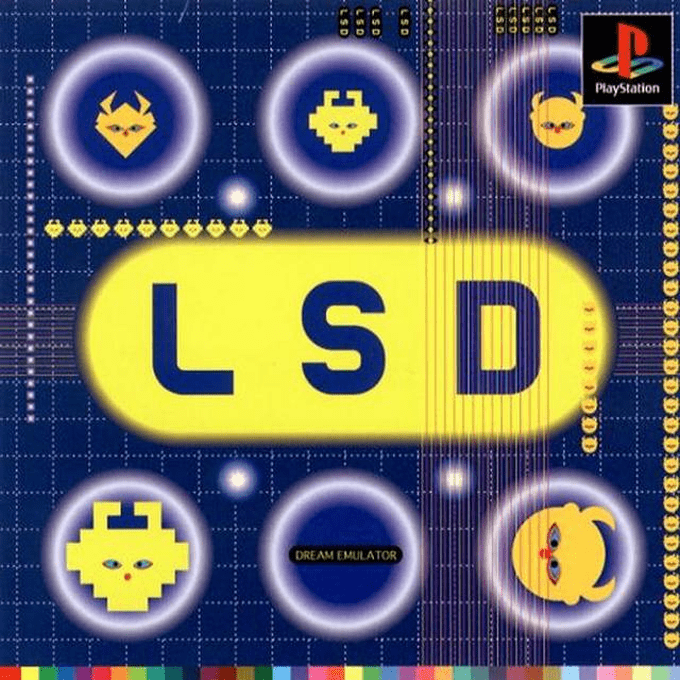
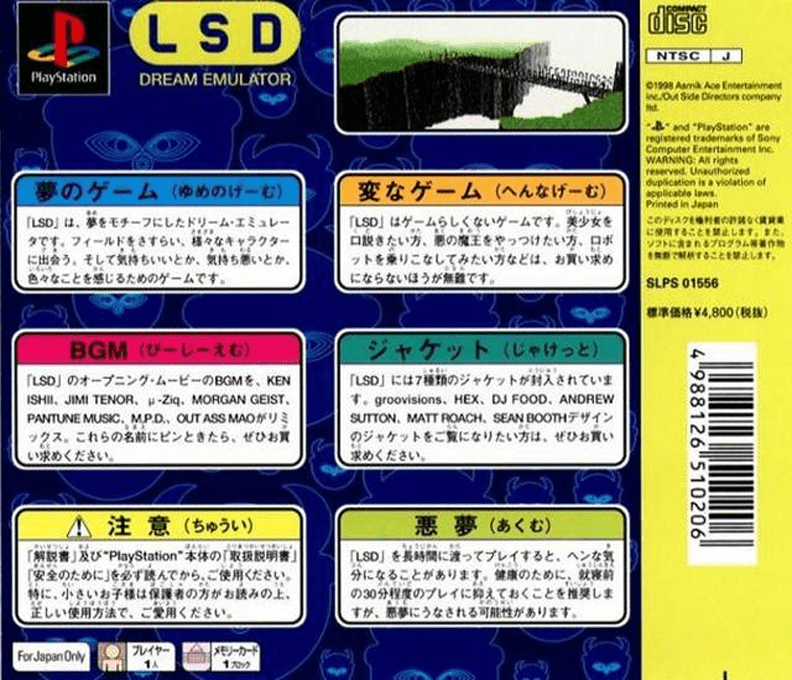
LSD: Dream Emulator for PlayStation is a first-person exploration game published in Japan by Asmik Ace Entertainment on October 22, 1998. Often credited to OutSide Directors Company, it was conceived and produced by multimedia artist Osamu Sato, whose work also shaped its unusual audiovisual identity. Rather than presenting conventional stages, combat, or a score-driven mission, this single-player PS1 release invites the player to move through a succession of short, shifting dreams built around discovery and disorientation.
A session begins in a first-person 3D environment and gives the player a deliberately simple set of movement tools. The directional pad handles walking and turning, while the face and shoulder buttons provide running, looking up or down, looking behind, and side-stepping. There is no inventory to fill and no list of tasks to clear. Progress comes from travelling, noticing places and figures, and seeing what happens when the dream changes around the player.
The key mechanic is known as linking. Contact with scenery, animals, people, or other objects can abruptly carry the player to another location, making collision a route to discovery rather than merely an obstacle. A village, city streets, open natural spaces, interior rooms, industrial-looking areas, and stranger constructions can all be connected in unexpected ways. Familiar spaces may return with altered textures or different inhabitants, so their meaning changes from one visit to the next.
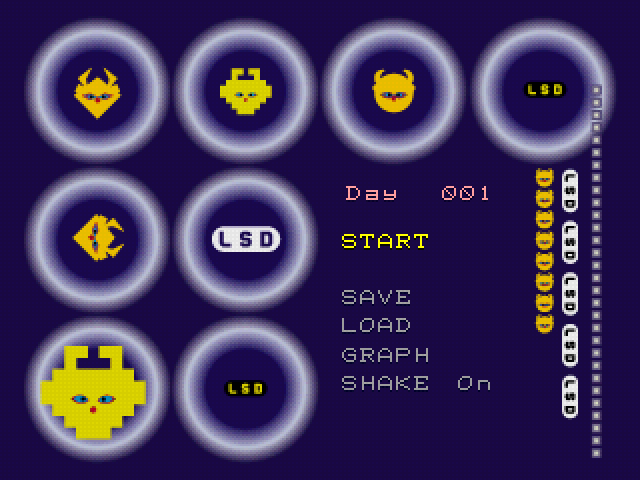
Each dream is time-limited, with the game returning to its menu when the dream ends or sooner if the player falls into certain hazards. Completing a dream advances the in-game day and records its result on a graph divided into Upper, Downer, Static, and Dynamic categories. As more days pass, the combinations of locations, imagery, and audiovisual details grow less predictable. Some dates substitute a short video or a piece of dream text for free exploration, reinforcing the sense that the game is documenting fragments rather than delivering a linear story. A later Flashback feature also lets players revisit a condensed version of a recent dream.
Sato developed the project from an idea that came to him while playing racing games: instead of treating a crash as failure, a collision could lead somewhere impossible. The dream setting gave that idea its logic. The game also drew on the long-running dream diary of Asmik Ace staff member Hiroko Nishikawa. Those origins help explain why LSD: Dream Emulator uses recurring places, sudden transitions, and disconnected images instead of a traditional plot or a named protagonist’s journey.
Music is as important to the atmosphere as the environments. Sato composed the game’s sound from a large pool of short patterns, allowing its electronic audio to shift alongside the places encountered. The original Japanese release appeared in standard and limited editions; the limited package included the bonus music CD Lucy in the Sky with Dynamites, while the related LSD and Remixes album and Lovely Sweet Dream book were issued at the same time. The game later returned in Japan as a PlayStation Store title in 2010. Its unusual structure and freely associative design have made LSD: Dream Emulator a lasting reference point for players interested in experimental PlayStation games and surreal exploration experiences.
Gallery

Details
- Developer
- Asmik
- Publisher
- Asmik
- Genre
- Other Adventure
- Players
- 1
- Release Date
- October 22, 1998
- System
- PS1