About
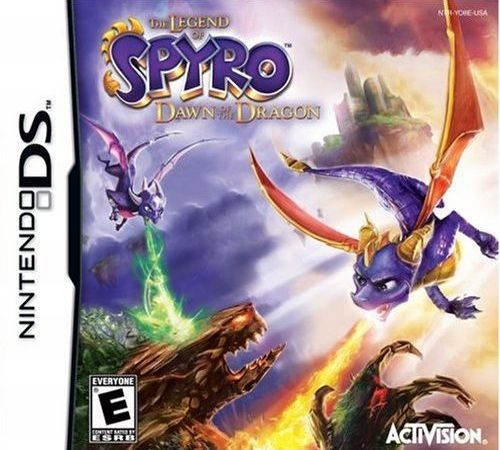
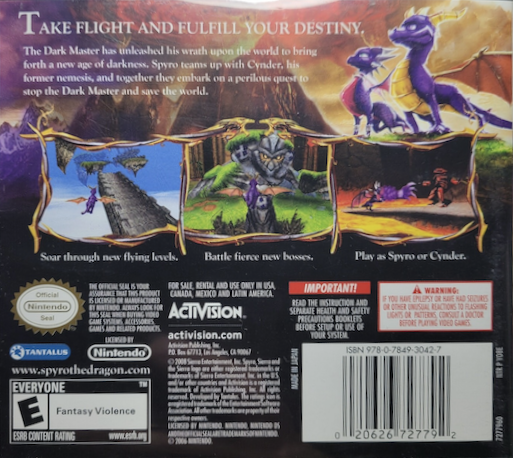
The Legend of Spyro: Dawn of the Dragon for Nintendo DS is the 2008 handheld finale to The Legend of Spyro trilogy. Developed for the DS by Tantalus Media, it was released in North America by Sierra Entertainment, with Activision associated with the wider release. Rather than being a reduced copy of the home-console game, this version gives Spyro and Cynder their own single-player, side-scrolling action-platform adventure. It continues the trilogy's darker storyline as the two young dragons stand together against Malefor, the Dark Master, and the threat hanging over their world.
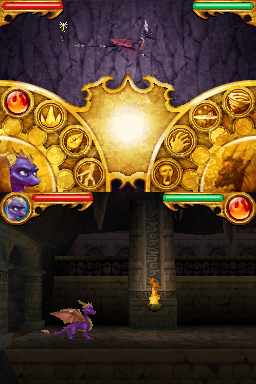
Spyro and Cynder are the center of both the story and the play. Their alliance is especially important here: players can change between the two dragons during the main stages with the L button, choosing the character whose health, elemental attacks, or abilities suit the next encounter. The campaign mixes running, jumping, climbing, wall-jumping, and close-range fighting through hazardous locations. Each dragon can use physical moves as well as breath-based elemental attacks, giving encounters an extra tactical layer when particular foes are vulnerable to a certain power.
The Nintendo DS controls are built around the handheld's buttons and D-pad. A handles ordinary melee strikes, while directional inputs alter attacks into moves such as kicks, tail strikes, punches, and evasive maneuvers. Jumping and double-jumping help the dragons cross gaps, and wall jumps open up vertical routes. The R button cycles elemental powers, while the Select button opens the upgrade screen. Instead of unrestricted flight through the platforming levels, the DS game reserves flying for dedicated three-dimensional on-rails sequences, where the D-pad steers the dragons and the touch screen is used to aim breath attacks at enemies.
Combat rewards active play. Defeated enemies and gem clusters yield colored gems: red gems restore health, green gems replenish breath energy, and blue gems fill an experience gauge. That experience can be spent to improve elemental moves through several levels, making battles serve as more than simple obstacles between platforms. The two-character system also provides a practical survival choice, since switching lets the inactive dragon recover while the other continues the fight. The adventure includes larger confrontations with figures and forces tied to its finale, including the Golem, the Destroyer's Heart, and Malefor.
Dawn of the Dragon brings the trilogy's central conflict to its conclusion. Spyro, a purple dragon connected to an important prophecy, must confront Malefor with help from Cynder, once an enemy and now his partner. The DS presentation uses voiced scenes and retains the recognizable cast associated with the game, including Elijah Wood as Spyro, Christina Ricci as Cynder, Gary Oldman as Ignitus, and Mark Hamill as Malefor. Its plot shares the broad final-chapter premise of the contemporary console release, but its level structure and moment-to-moment design were made specifically for Nintendo's dual-screen handheld.
For Spyro fans looking for the Nintendo DS entry, The Legend of Spyro: Dawn of the Dragon combines 2D platforming, brawler-style combos, character switching, elemental upgrades, and stylus-targeted flight segments in one compact solo quest. It is also historically notable as the fourth consecutive annual Spyro appearance on DS and as Tantalus Media's contribution to the franchise. As the closing chapter of the Legend of Spyro continuity, it provides a handheld route through Spyro and Cynder's final battle against the Dark Master.
Gallery
Details
- Developer
- Sierra
- Publisher
- Activision
- Genre
- Platformer
- Players
- 1
- Release Date
- October 21, 2008
- System
- NDS