About
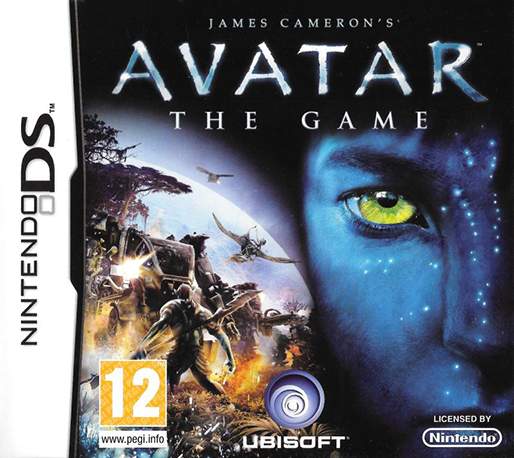
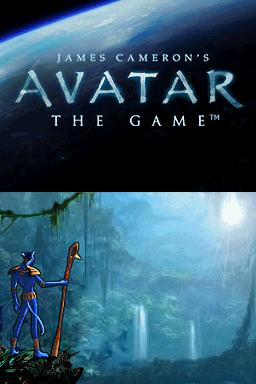
James Cameron's Avatar: The Game for Nintendo DS tells a separate Pandora story built for the handheld rather than a reduced version of the console release. You play as Nok, a young Na'vi drawn into a conflict with the RDA, the human organization exploiting the moon's resources. When an object from the sky disrupts the natural world, Nok is pulled into a sacred quest that leads through jungles, caverns, villages, and industrial sites. The adventure is set against the familiar tension between Pandora's living ecosystems and the machinery brought in by the invaders.
Nok's mission centers on stopping the dangerous biological research of RDA scientist Dr. Anthony Ossman. His daughter, Molly, becomes an important ally as the plot unfolds, giving this version of the game its own cast and objective. That focus makes the DS story distinct from the versions in which the player chooses between the RDA and Na'vi, and from the Wii and PSP adventure following Raiuk. Here, the journey remains with Nok as he works to protect Pandora from the consequences of Ossman's work.
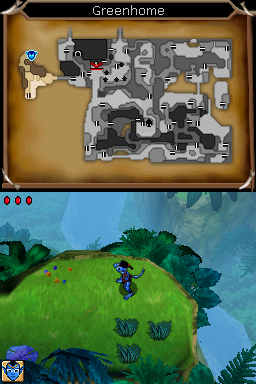
The game is a top-down action-adventure, with a structure closer to a touchscreen exploration quest than to the third-person shooting found on larger systems. Pandora is divided into areas filled with paths to investigate, locked routes, hazards, creatures, and RDA opposition. Progress comes from pushing farther into each region, learning what is blocking the way, and returning with the right tool or piece of information. The overhead viewpoint keeps the environments readable while still making the alien plant life, waterways, rocky passages, and human-built installations part of the route-finding challenge.
The Nintendo DS stylus drives Nok's movement and much of his combat. Touching the landscape directs him across an area, while taps and stylus motions trigger attacks with his staff. Encounters call for more than simply rushing forward: opponents can use ranged weapons, travel in groups, or occupy narrow spaces where position matters. Nok also gains equipment that broadens how he interacts with the world, allowing the adventure to mix direct fights with careful use of projectiles, switches, obstacles, and environmental features.
Puzzles are woven into the trek across Pandora. Doors, platforms, movable blocks, key devices, and small openings turn many locations into compact problem-solving spaces. Some barriers can only be cleared after Nok finds a new item, so earlier terrain takes on a different role once his options expand. Platforming is also part of the exploration, asking players to time crossings and navigate dangerous sections without losing sight of the next objective. Boss encounters add another layer, often requiring attention to a foe's behavior or a specific opening rather than relying on ordinary attacks alone.
As Nok advances, lore and currency can be collected and exchanged for upgrades. These improvements strengthen his abilities, increase his resilience, or make it easier to carry and use the items needed on the journey. The system encourages looking beyond the most direct path for optional discoveries, while the main quest keeps moving toward the RDA threat. Maps and objectives help organize the search across the game's regions, making the DS version an accessible adventure even as later puzzles and encounters become more demanding.
Although it shares the film's setting and the broader struggle over Pandora, this is its own interpretation of that world. Nok is the sole playable hero, and the RDA serves as the opposing force throughout rather than one of two player-aligned factions. The result is a more focused, linear quest about a Na'vi teenager confronting a human operation that endangers the planet. It retains the recognizable themes of nature, technology, and resistance while telling a story created specifically for this handheld release.
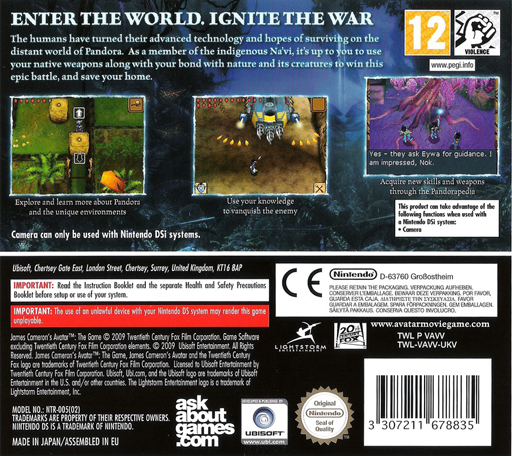
Released in 2009, James Cameron's Avatar: The Game on Nintendo DS is an action-adventure for players who want to explore Pandora through touchscreen-led combat and puzzle solving. Its combination of top-down navigation, staff-based battles, collectible upgrades, environmental obstacles, and story-driven progression sets it apart from the shooter-oriented console and PC editions. For fans of Avatar or of stylus-controlled handheld adventures, it offers a different route into Pandora: one guided by Nok's quest, Molly's assistance, and the effort to stop Dr. Ossman's research before it causes greater harm.
Gallery
Details
- Developer
- Ubisoft
- Publisher
- Ubisoft
- Genre
- Platformer
- Players
- 1
- Release Date
- December 1, 2009
- System
- NDS