About
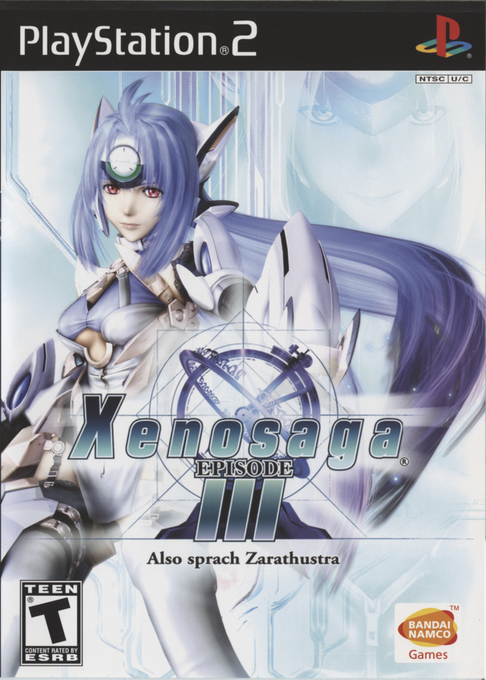
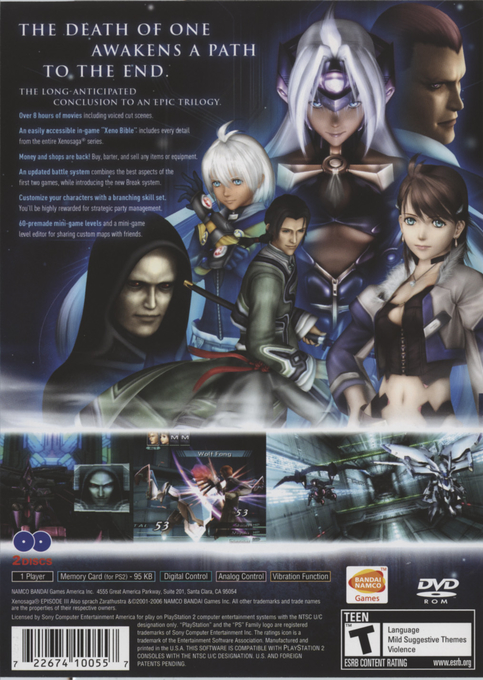
Xenosaga Episode III: Also sprach Zarathustra is a science-fiction role-playing game for PlayStation 2, developed by Monolith Soft and published by Namco in Japan in July 2006. Namco Bandai Games brought the game to North America that August. It is the third and concluding main entry in the Xenosaga trilogy, continuing directly from the events of Episodes I and II. The story follows former Vector Industries employee Shion Uzuki, the anti-Gnosis android KOS-MOS, and their allies as a widening crisis forces them to confront the Gnosis, Vector, and the mysteries connecting their past.
The adventure moves between story-driven exploration, towns with shops and side quests, and hostile locations where enemies are visible on the field. Encounters are optional when players can avoid opponents, while traps can temporarily stop enemies and create an advantage when combat begins. Cinematic scenes and voiced in-engine dialogue carry the narrative, and the in-game database collects terminology, character information, and story material to help players navigate the series' dense setting.
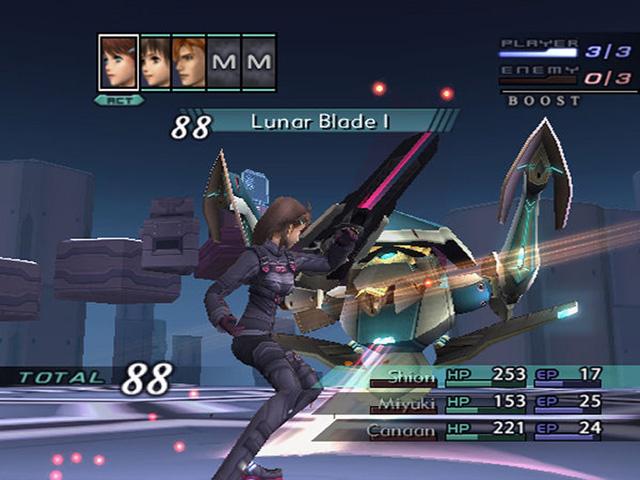
Combat is turn-based and uses parties of three characters, with reserves available to replace an active fighter at the cost of a turn. Each character can make standard attacks, use Arts and Ether abilities that consume EP, defend, use items, or attempt to escape. Attacks build a Break gauge on either side; filling it leaves a target unable to act briefly and more vulnerable to damaging critical strikes. Ether abilities can also restore health and reduce Break danger, so choosing between offense, support, and recovery matters throughout difficult encounters.
A Boost gauge gives battles another tactical layer. As characters deal damage, they gain Boost counts that can be spent to interrupt the normal turn order or trigger character-specific special attacks. Finishing enemies with these attacks improves battle rewards, including experience, money, and skill points. Skill points unlock abilities through character-specific skill trees, letting players shape party members toward offensive Arts, Break-focused attacks, Ether techniques, or defensive and support roles. Equipment also returns as an important way to adjust statistics, with weapon and armor choices joined by accessory slots.
Xenosaga Episode III: Also sprach Zarathustra also alternates human battles with combat involving E.S. units, the series' powerful mecha. E.S. encounters use related turn-based principles but add weapon energy and the Anima gauge. Landing attacks builds Anima energy, allowing an E.S. unit to enter Anima Mode for improved attack power and lower energy costs. The machines can be customized in several upgrade areas, making their durability, recovery, experience rewards, and other attributes part of the player's planning.
The game brings back Shion, KOS-MOS, Jr., chaos, MOMO, Ziggy, Jin, and other familiar figures while introducing further conflicts surrounding Scientia, the Testaments, T-elos, and the fate of humanity's interstellar civilization. Its subtitle comes from Friedrich Nietzsche's Thus Spoke Zarathustra, reflecting the philosophical and religious imagery that runs through the wider Xenosaga series. The Japanese release uses the subtitle Tsarathustra wa Kaku Katariki, while the North American version is titled Also sprach Zarathustra.
Designed as the trilogy's finale, the PlayStation 2 game concentrates on resolving the long-running arc around Shion and KOS-MOS while expanding systems established by its predecessors. Its combination of elaborate cutscenes, a terminology database, on-foot exploration, customizable party combat, and separate E.S. battles makes it a distinctly story-led Japanese RPG. Players coming from the first two Xenosaga episodes will find returning systems and characters presented in a final chapter built around the series' unresolved questions.
Gallery
Details
- Developer
- Monolith Soft
- Publisher
- Namco
- Genre
- JRPG
- Players
- 1
- Release Date
- July 6, 2006
- System
- PS2