About
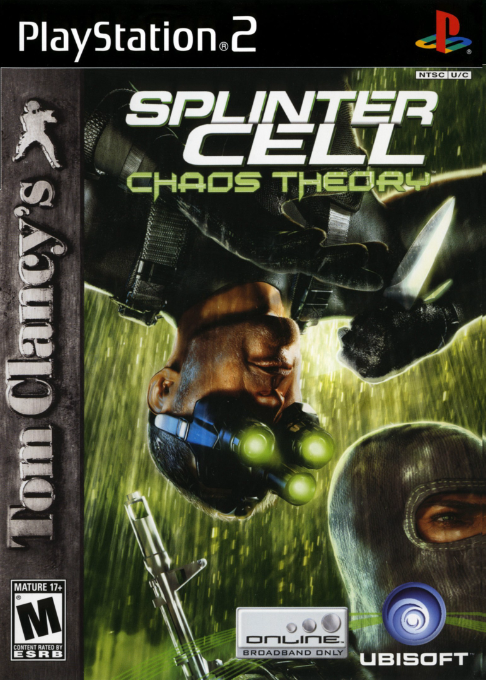
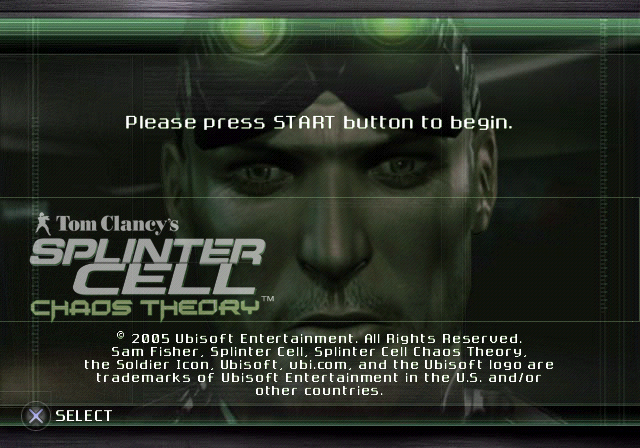
Tom Clancy's Splinter Cell: Chaos Theory for PlayStation 2 is a 2005 stealth-action game from Ubisoft Montreal and Ubisoft, and the third main entry in the Splinter Cell series. Players return as Sam Fisher, the field operative working for Third Echelon, a covert branch of the National Security Agency. Set in a near-future political crisis across East Asia, the campaign sends Fisher into a chain of international operations where intelligence gathering, sabotage, and quiet escapes are as important as reaching the end of a level.
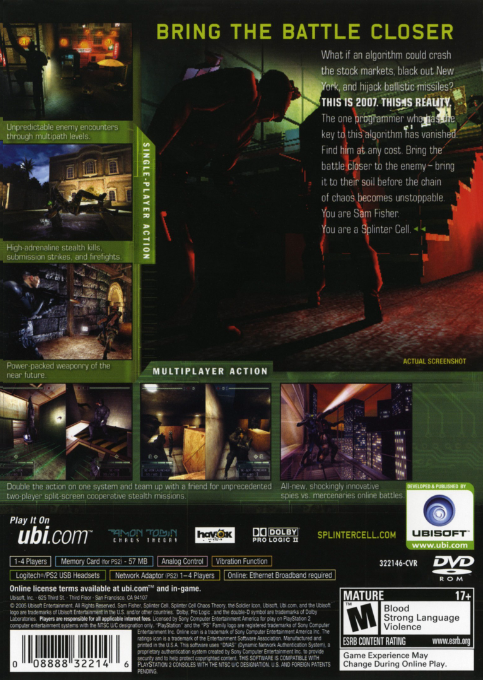
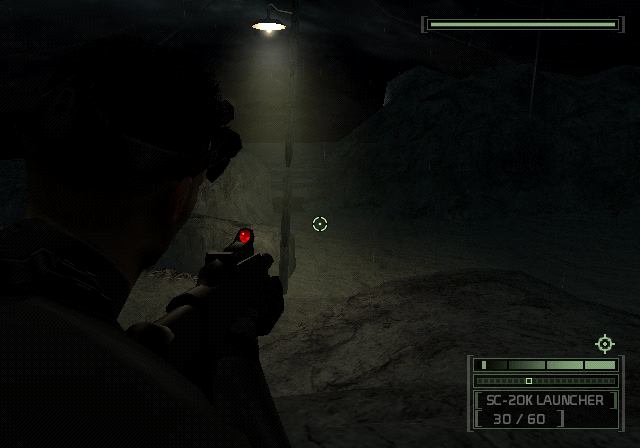
Chaos Theory is built around managing visibility and sound. The familiar light meter shows how exposed Fisher is, while an audio indicator makes the noise of footsteps, movement, and equipment part of every decision. Dark corners, cover, ledges, pipes, and alternate approaches give missions room for careful planning. Guards react to what they see and hear, and evidence of an intrusion such as an open door, a disabled device, or a discovered body can change the pressure in an area. Missions are scored according to performance, encouraging disciplined infiltration while allowing players to choose their own route through many objectives.
Fisher's equipment supports both restrained and direct tactics. His 5-7 pistol carries the Optically Channeled Potentiator, a rechargeable attachment that can temporarily disrupt suitable lights, cameras, and other electronics. The SC-20K rifle can be fitted with different attachments and launcher ammunition, including tools that distract, observe, or incapacitate opponents. Sticky cameras can survey an area and create diversions, while airfoil rounds, gas, smoke, flashbangs, and other gadgets offer ways to solve a problem without simply opening fire. A combat knife expands close-quarters options, including interrogating captives, breaking certain locks, and deciding how to end a confrontation.
The single-player story begins with the disappearance of computer programmer Bruce Morgenholt and grows into a conflict involving the Masse Kernels, weaponized information algorithms, military tensions, and Fisher's former associate Douglas Shetland. Operations move through locations including Peru, Panama, New York, Hokkaido, North Korea, Seoul, and Tokyo. Michael Ironside again voices Fisher, alongside returning Third Echelon figures Irving Lambert and Anna Grímsdóttir. The game follows Pandora Tomorrow, but its darker spy-thriller plot and expanded choices give its missions a distinct tone within the early Splinter Cell run.
On PlayStation 2, Chaos Theory also includes multiplayer play alongside the solo campaign. Cooperative missions let two players work as Splinter Cell trainees whose assignments become tied to the wider crisis; the levels are designed around communication and paired actions as well as individual stealth. The competitive Spy vs. Mercenary mode returns with asymmetrical teams: spies depend on mobility, shadows, and non-lethal equipment, while mercenaries use stronger weapons and security tools. Additional modes such as Disk Hunt and Deathmatch broaden the multiplayer selection.
Released for PlayStation 2 in spring 2005 alongside versions for Xbox, GameCube, and Windows, Tom Clancy's Splinter Cell: Chaos Theory remains a defining example of the series' methodical espionage design. Its PlayStation 2 edition preserves the campaign's surveillance, infiltration, and gadget-driven problem solving while bringing Sam Fisher's third mission to Sony's system. For players exploring PS2 stealth games or the original Splinter Cell trilogy, it is a substantial chapter in Fisher's long-running covert-operations story.
Gallery
Details
- Developer
- Ubisoft Montreal
- Publisher
- Ubisoft
- Genre
- Action-Adventure
- Players
- 1-2
- Release Date
- April 1, 2005
- System
- PS2