About
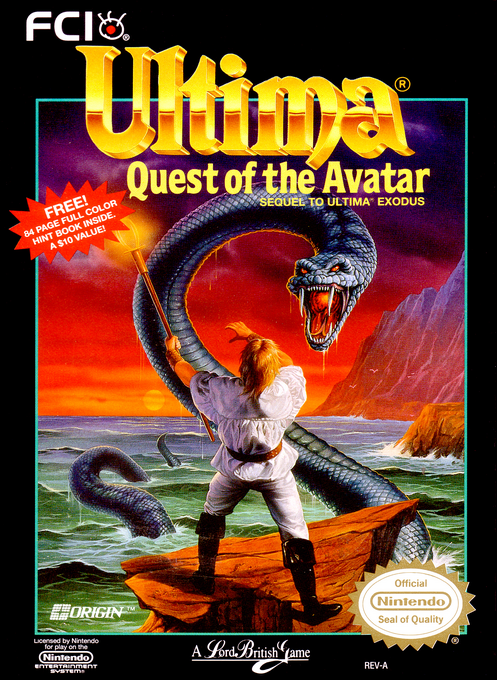
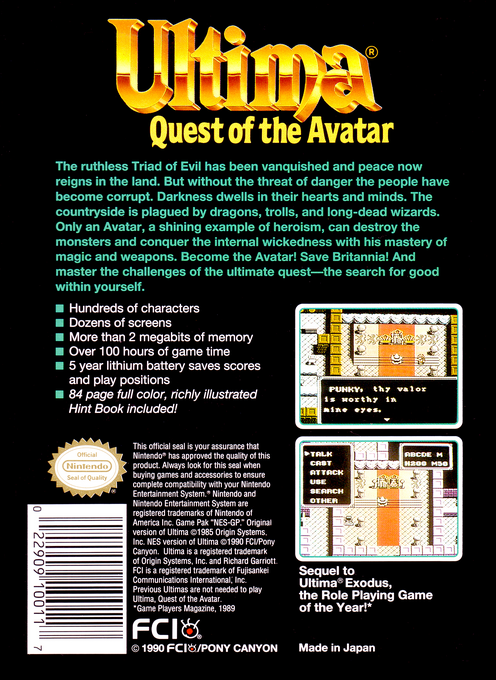
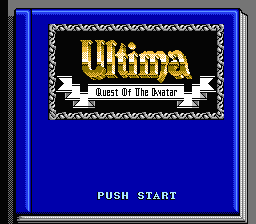
Ultima Quest of the Avatar NES is a console adaptation of Richard Garriott's fourth Ultima role-playing game, released in Japan in 1989 as Ultima: Seisha e no Michi and in North America by FCI in December 1990. The NES version was produced for the Famicom by Newtopia Planning and Infinity, with Pony Canyon behind the Japanese release. Rather than sending a hero to destroy a final villain, this journey asks a player-created adventurer to become Britannia's moral example: the Avatar. It carries the series into its Age of Enlightenment, where the goal is personal growth through the principles of Truth, Love, and Courage.
The adventure begins with questions from a gypsy fortune teller. The answers establish which virtue matters most to the hero and determine the starting profession, such as Fighter, Mage, Bard, Tinker, Druid, Ranger, Paladin, or Shepherd. From there, the player explores the kingdom of Britannia from a top-down view, talking with residents, preparing for dangerous expeditions, gathering equipment, and gradually building a party. The task is deliberately broad: learn how the land works, seek the items connected to the virtues, and prove worthy of the journey into the Stygian Abyss.
The Eight Virtues give the quest its unusual direction. Honesty, Compassion, Valor, Justice, Sacrifice, Honor, Spirituality, and Humility are not merely background lore; actions can affect the hero's progress toward them. Offering help to those in need, behaving responsibly in towns, confronting threats, and choosing modest responses all fit the game's larger ethical framework. Runes, shrines, meditation, and the advice of Britannia's inhabitants turn that framework into a long-form adventure built around discovery and careful attention to what characters say.
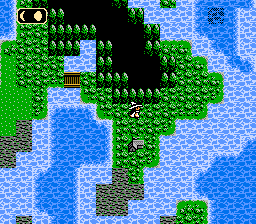
Exploration alternates between towns, the overworld, dungeons, and turn-based battles. Encounters use a tactical grid in which party members move, attack with weapons, use magic, or employ the NES version's automated-combat option. Recruiting allies broadens the group's abilities, but this cartridge adaptation permits only four active characters at once; additional companions wait at Castle Britannia's hostel until the player returns to reorganize the party. That limit makes party selection a practical part of planning for travel and combat.
This NES release is not simply the computer game transferred unchanged to a cartridge. Its character art, environments, and music were redrawn and rearranged for the system, its conversations were streamlined, and several puzzles were omitted. Spell use was also simplified compared with the computer editions, which required players to combine spell ingredients. The conversion even changes the companion Julia the Tinker into Julius. These choices give Ultima: Quest of the Avatar its own console identity while retaining Britannia, its virtue-centered objective, and the principal shape of the original quest.
For NES role-playing game players, Ultima: Quest of the Avatar offers an open-ended fantasy journey whose endpoint depends on learning a world rather than racing through a linear rescue mission. The 1990 North American release arrived after the original computer game had established the setting, but its accessible controller-based interface and distinctive production let a new audience meet Lord British's Britannia. It is also a direct predecessor to the later NES release Ultima: Warriors of Destiny, continuing a console branch of one of role-playing gaming's foundational series.
Gallery
Details
- Developer
- Infinity
- Publisher
- FCI
- Genre
- JRPG
- Players
- 1
- Release Date
- December 1, 1990
- System
- NES
/Tashiro_Masashi_no_Princess_ga_Ippai.png)
/Urusei_Yatsura_Lum_no_Wedding_Bell.png)

/Nekketsu_Kakutou_Densetsu.png)