About
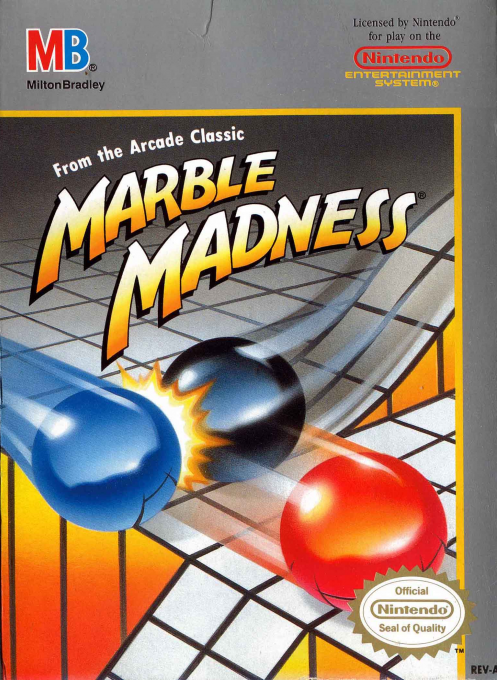
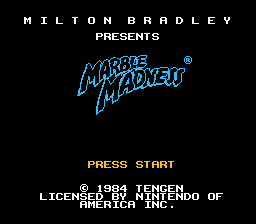
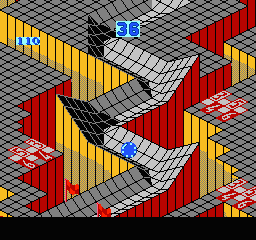
Marble Madness NES is Rare's 1989 Nintendo Entertainment System conversion of Atari Games' arcade marble-racing challenge, published in North America by Milton Bradley. Rather than putting players behind the original cabinet's trackball, this version translates the isometric obstacle courses to a standard NES controller. The objective remains direct but demanding: guide a colored marble through each three-dimensional-looking raceway to its Goal Line before the clock expires. Its carefully angled paths, sudden drops, moving hazards, and short time allowances make every route a test of reading the screen and correcting momentum quickly.
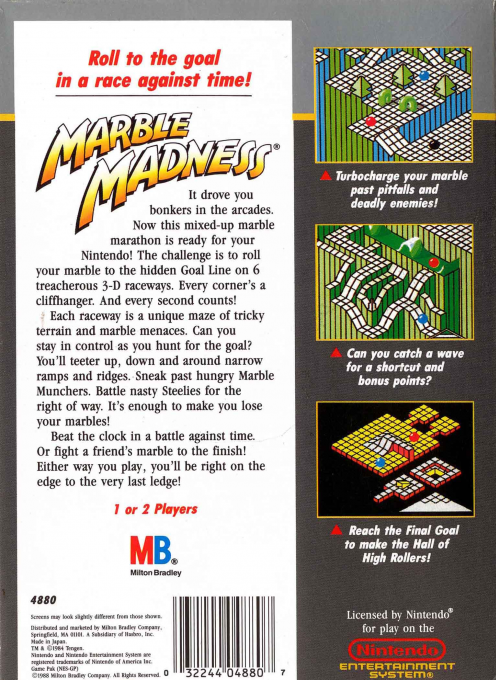
The NES game contains six raceways, each presenting a maze-like course viewed from an elevated isometric angle. The opening stage introduces the basic idea, while the later routes demand faster decisions around narrow ledges, slopes, traps, and enemies. A fall from the course or contact with a dangerous opponent costs time while the marble returns, so surviving is not merely a matter of preserving lives. The player has unlimited marble returns, but delays make an already tight finish much harder to reach. Learning where the exits lie and when a risky shortcut is worthwhile becomes central to repeated runs.
Rare's controller adaptation gives Marble Madness NES its own practical feel. The directional pad rolls the marble, and the game lets players select a conventional horizontal controller orientation or a diagonal orientation intended to better match the slanted playfield. Button A activates a turbo burst. Used well, turbo can trim precious seconds, help the marble get clear of a threat, or propel it through an advantageous route; used carelessly, extra speed can send it off an edge. The result is a game of continual small judgments between restraint, acceleration, and safe positioning rather than a simple straight race.
Time links the six courses together. After the first level, seconds left over carry forward and also contribute a time bonus, rewarding clean runs early in the game. The courses also hide opportunities beyond the most obvious route. The manual points players toward shortcuts, including a wave-assisted path on the third level, and notes bonus-score opportunities for exploration and encounters with certain foes. That structure gives the compact course set an arcade-style replay loop: finish a route more efficiently, discover a safer line, and carry a healthier clock into the next test.
Marble Madness NES supports one or two players. In the simultaneous two-player mode, the blue and pink marbles share the course as competitors racing for each Goal Line and for the higher score. Winning a race can provide an extra time advantage, while collisions, hazards, and limited room make the other marble part of the challenge as well as an opponent. Players can enter names for the High Rollers display, tying the pursuit of course completion to score chasing even when a run ends before the sixth finish.
This is specifically the Rare-developed, Milton Bradley-published NES release from spring 1989, not the 1984 Atari arcade machine, the later Game Boy edition, or the separately released Japanese Famicom version. Its standard-pad controls and console presentation necessarily differ from the arcade game's trackball setup, but the six-course, time-pressure design and head-to-head play preserve the defining idea. For NES players, Marble Madness is a focused action-puzzle racer whose personality comes from its unusual viewpoint, rolling physics, and the constant urge to shave another second from a familiar course.
Gallery
Details
- Developer
- Rare Limited
- Publisher
- Milton Bradley Co.
- Players
- 1-2
- Release Date
- March 1, 1989
- System
- NES