About
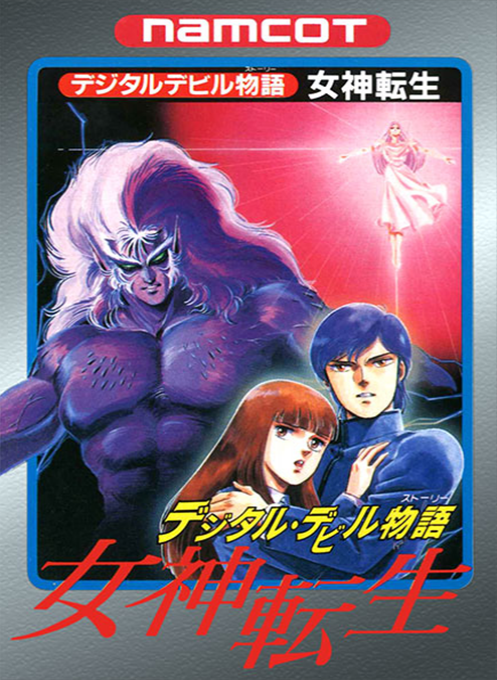
Digital Devil Story: Megami Tensei NES is the Famicom role-playing game released in Japan by Namco on September 11, 1987. Developed by Atlus, it is the console version of a wider adaptation of Aya Nishitani’s Digital Devil Story science-fiction novels. The title is often called an NES game in English-language catalogues, but its original release was for Nintendo’s Japanese Family Computer. It established the game branch of Megami Tensei with a combination of computer-era occult fiction, labyrinth exploration, and an unusually flexible demon party system.
The story follows high-school programmer Akemi Nakajima after his demon-summoning software opens a path for hostile supernatural forces. He joins Yumiko Shirasagi, a transfer student connected to the conflict, and the pair descend into a demon-filled underground world. Their quest takes them against threats including Loki and Set before a confrontation with Lucifer. While the game draws on Nishitani’s novels, its Famicom scenario continues beyond material from the earlier books rather than simply reproducing one volume.
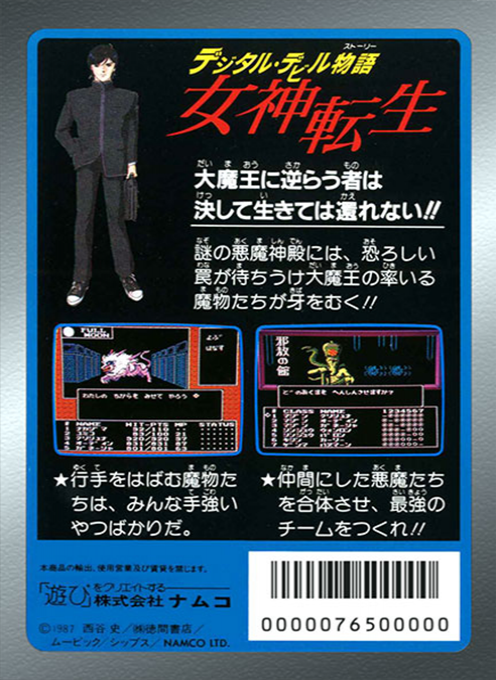
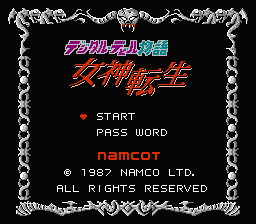
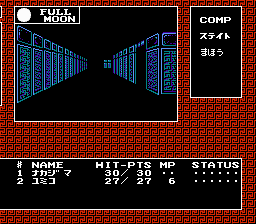
Exploration uses a first-person view inside large, grid-based dungeons. Players guide Nakajima and Yumiko through passages, locate chests and shops, manage equipment and restorative items, and contend with random enemy encounters. Battles unfold in turns, with the human leads using weapons and items while summoned demons contribute their own attacks and magical abilities. Progress is recorded with a password system, a familiar solution for a long cartridge RPG of its period.
Its defining feature is the ability to engage enemy demons instead of treating every encounter as a mandatory fight. Negotiation can persuade a demon to join the party in return for resources or items, though its response can depend on the moon phase. The player can keep a reserve of allied demons and call a limited group into battle. This shifts the challenge from simple combat toward deciding which creatures to recruit, pay to summon, and maintain while moving through the maze.
Recruitment also feeds the game’s demon fusion system. Allied demons do not gain levels in the way the two human protagonists do; instead, stronger allies can be created by combining demons at a dedicated location. Magnetite is consumed as summoned demons travel with the party, adding another consideration to dungeon expeditions. Together, negotiation, summoning, and fusion give Digital Devil Story: Megami Tensei a party-building loop that was distinctive among Famicom dungeon RPGs.
The Famicom game should not be confused with Telenet Japan’s separate 1987 computer release, which used top-down, real-time action rather than Atlus’s first-person, turn-based role-playing format. Its success led to Digital Devil Story: Megami Tensei II for Famicom in 1990, while a later Super Famicom package, Kyuuyaku Megami Tensei, reworked both early games. As the origin point for the long-running Megami Tensei lineage, this Namco-published adventure remains notable for bringing demon conversation and fusion into an early console RPG framework.
Gallery
Details
- Developer
- Atlus
- Publisher
- Namcot
- Genre
- Action RPG
- Players
- 1
- Release Date
- September 11, 1987
- System
- NES