About
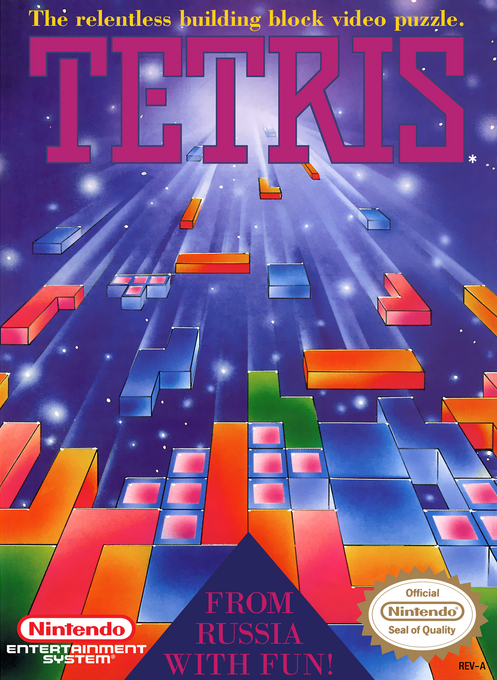
Nintendo’s 1989 NES release of Tetris turns Alexey Pajitnov’s falling-block puzzle into an exceptionally direct one-player challenge. Developed and published by Nintendo, it asks the player to arrange the seven tetromino shapes as they descend into the playfield. Complete a horizontal row and it vanishes, pulling everything above it downward; let the stack climb high enough to obstruct the next piece and the game ends. The simple rule set makes every placement matter, whether the immediate aim is survival, a cleaner surface, or a high-scoring four-line clear.
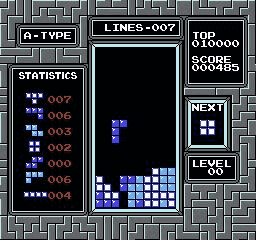
The NES controller keeps that puzzle language wonderfully physical. Left and right on the Control Pad slide a falling piece across the well, Down speeds its descent, and the A and B buttons rotate it clockwise and counter-clockwise. The game also displays the next piece, allowing a player to make decisions one turn ahead; Select can hide that preview for a self-imposed challenge. Start pauses play, while the menu offers three music selections or silence. There is no modern hold function or instant hard drop here, so planning depends on quick positioning, rotation, and commitment.
Type A is the long-form score attack. Players choose a starting level, which determines the initial fall speed, then keep clearing lines for as long as the field remains playable. The level rises during the game, progressively accelerating the pieces and turning a calm opening into a test of reactions and board management. The screen tracks score, total lines, current level, piece statistics, and the next tetromino, making the essentials easy to read while the growing stack creates the real pressure.
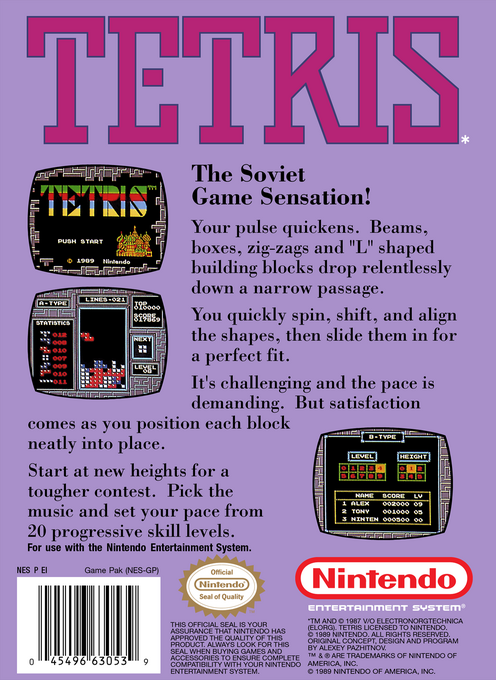
Type B reframes the same mechanics as a compact clearing challenge. Its target is 25 lines, and players set both the starting speed and HEIGHT, which adds a pile of random blocks at the bottom of the field. Unlike Type A, the selected level does not increase during a B-Type game. Clearing the required lines earns a bonus based on the chosen level and height, while tougher successful settings trigger celebratory ending scenes. It is an ideal mode for practicing recovery from a messy board rather than building from an empty one.
Scoring strongly favors clearing several lines together. Singles, doubles, triples, and four-line clears all earn points scaled by level, with the latter giving the game its name: a “Tetris.” That incentive shapes the familiar strategy of leaving a one-column gap for the long I-shaped tetromino while keeping the rest of the stack low and flat. Soft-dropping pieces also adds points, but greed can be costly; a high score depends on knowing when to preserve the board and when to cash in a well-prepared clear.
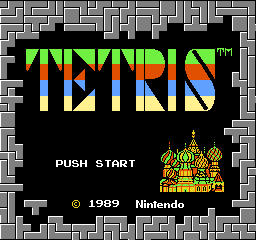
This is the Nintendo NES version, released in North America in November 1989, rather than the separate 1988 Famicom Tetris made by Bullet-Proof Software. The distinction matters: both are early console versions of the same puzzle phenomenon, but they are different releases with different development and publishing histories. Nintendo’s version was also distinct from Tengen’s short-lived NES release, which disappeared from sale after the console-rights dispute. The database’s NES record and Nintendo developer/publisher metadata fit the 1989 Nintendo release; the shared “FC” system tag should not be read as identifying it with the Bullet-Proof Famicom game.
Its clean presentation, escalating Type A pace, and tightly defined scoring made this version a lasting reference point for competitive play. The challenge comes not from complicated rules but from the accumulating consequences of ordinary choices: an awkward hole, an I piece used too early, one rotation too late. More than a historical port, Nintendo’s Tetris remains a sharply focused puzzle game in which a few buttons and seven shapes can create endlessly tense decisions.
Gallery
Details
- Developer
- Nintendo
- Publisher
- Nintendo
- Genre
- Tile-Matching Puzzle
- Players
- 1
- Release Date
- November 1, 1989
- System
- NES
/Astro_Fang_Super_Machine.png)