About
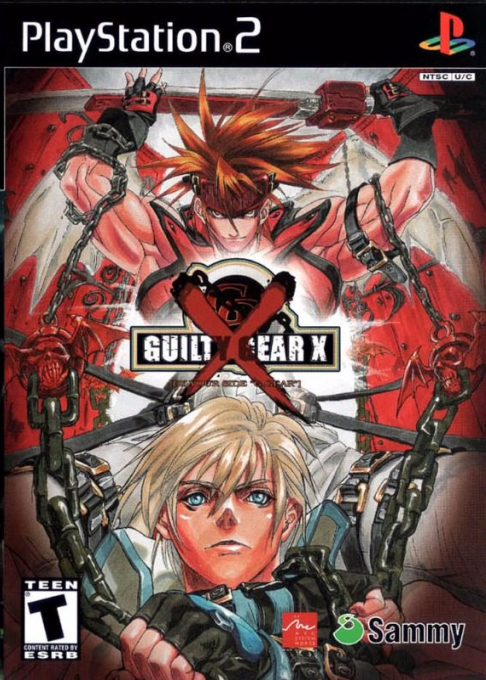
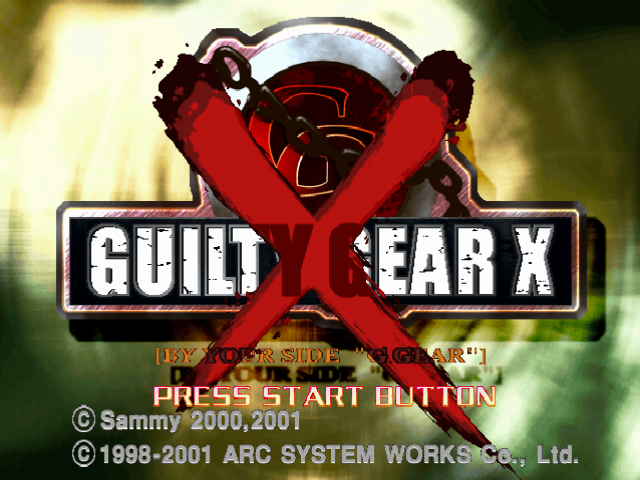
Guilty Gear X for PlayStation 2 is Arc System Works’ high-speed 2D fighting game, published in North America by Sammy in 2001. It follows the original Guilty Gear and brings the series’ hand-drawn anime presentation, heavy rock character themes, and elaborate combat system to Sony’s console. The PS2 release is a home conversion of the arcade and Dreamcast game rather than the later Guilty Gear XX sequel, placing its story in the year 2181 after the war against the bio-engineered Gears.
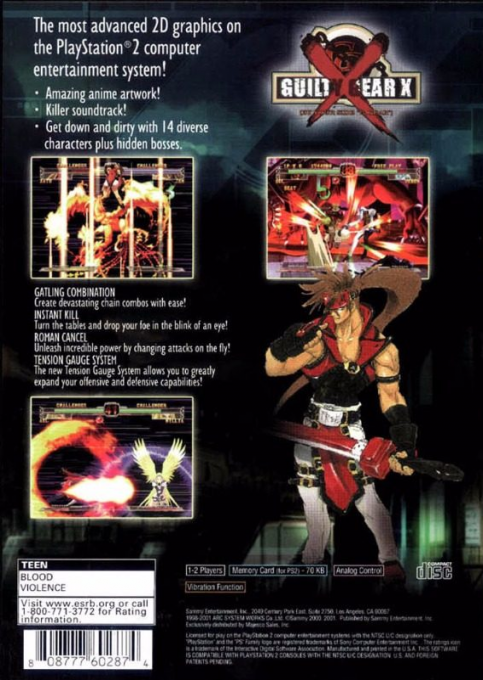
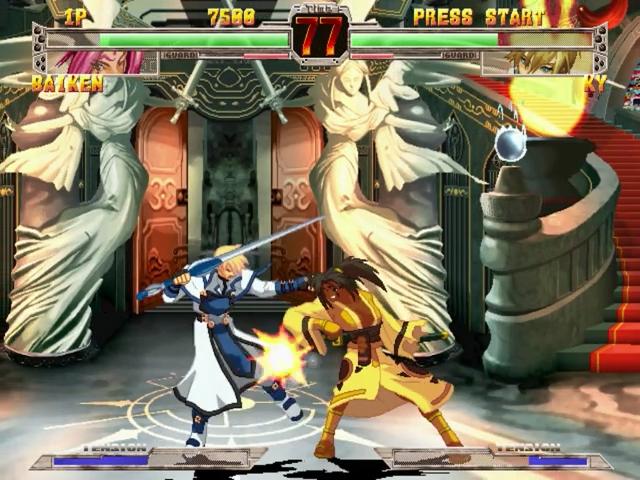
Matches use four primary attack buttons—Punch, Kick, Slash, and Heavy Slash—and ask players to take two rounds before time expires. Each combatant has a very different reach, movement style, and special-move arsenal, from Sol Badguy’s aggressive fire-based offense to Ky Kiske’s lightning attacks, May’s oversized anchor swings, and Potemkin’s powerful grapples. Ground and aerial exchanges can develop into combos, while counter hits and carefully timed defense create openings for larger attacks.
A central part of Guilty Gear X’s strategy is the Tension Gauge. Advancing on an opponent and landing attacks builds this meter, while retreating or remaining inactive drains it. With sufficient Tension, fighters can spend meter on damaging Overdrive Attacks; a full gauge also enables an Instant Kill attempt. Roman Cancels provide another important option, allowing a move and its recovery to be interrupted so a player can extend pressure, recover more safely, or create a new combo route.
The game’s roster includes returning fighters such as Sol, Ky, Baiken, Faust, Chipp Zanuff, Millia Rage, Zato-1, Axl Low, and Testament, alongside newcomers including Jam Kuradoberi, Johnny, Anji Mito, Venom, and Dizzy. Dizzy is especially important to the plot: reports of a Gear who appears not to harm humans lead to a new bounty and draw former Sacred Order figures and the Jellyfish Air Pirates into the conflict. Fourteen characters are initially available, with Testament and Dizzy earned through play.
On PlayStation 2, Guilty Gear X offers Arcade, Versus, Training, and Survival play. Arcade mode frames the game’s events through battles, Training supplies a move list for learning each fighter, and Survival challenges a player to continue through an endless sequence of opponents. The local Versus option supports head-to-head play, making the console version suited both to practicing execution alone and testing character matchups with another player.
Regional labeling matters for this release. The North American and European PlayStation 2 editions are Guilty Gear X conversions closely based on the Dreamcast version. Japan received the expanded Guilty Gear X Plus edition later in 2001, adding Story and Gallery material as well as home-only unlockable content involving Kliff Undersn, Justice, and Robo-Ky. Those additions should not be assumed to be part of every PS2 copy sold under the Guilty Gear X name.
As the series’ first arcade entry, Guilty Gear X established much of the foundation carried into later Guilty Gear games: the four-button layout, meter-driven offense, distinctive character designs, and dramatic 2D visual style. Its PS2 release preserves an early chapter of that evolution, with a focused roster and one-on-one system that rewards learning both universal mechanics and each combatant’s individual tools.
Gallery
Details
- Developer
- Arc System Works
- Publisher
- Virgin Interactive
- Genre
- Fighting
- Players
- 1-2
- Release Date
- September 30, 2001
- System
- PS2