About
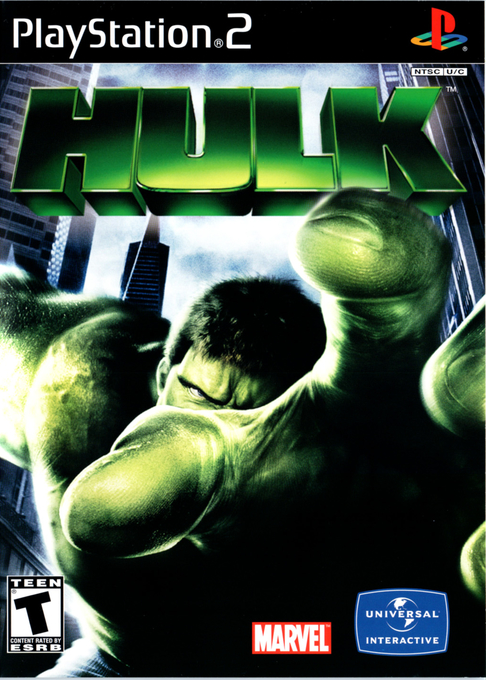
Hulk for PlayStation 2 is a 2003 third-person action game from Radical Entertainment and Universal Interactive. Released alongside Ang Lee’s Hulk film, it uses the movie’s version of Bruce Banner and features Eric Bana returning as Banner, but it tells a new story set after the film rather than simply replaying its scenes. The PS2 game moves between the destructive power of the Hulk and the vulnerable, methodical work of his human alter ego, creating two markedly different kinds of missions within a single-player campaign.
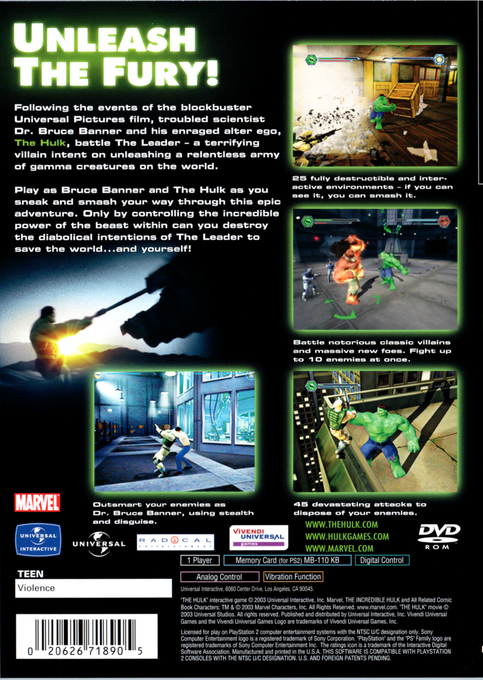
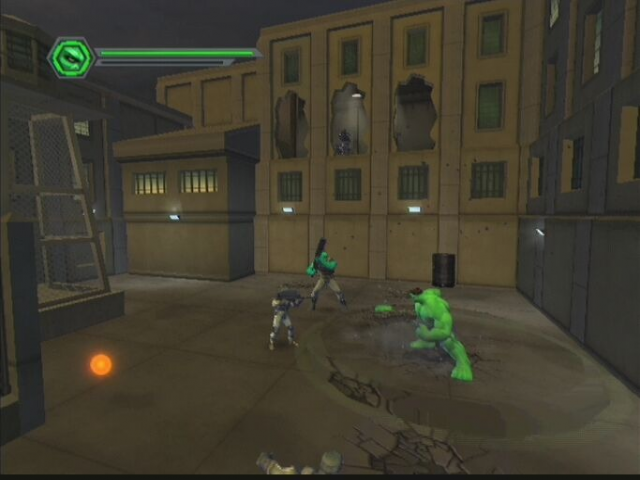
Most of Hulk is built around close-quarters combat and environmental destruction. Players guide the Hulk through linear locations filled with soldiers, mutant adversaries, machinery, and breakable scenery, using punches, grabs, throws, stomps, and other powerful attacks to clear a path. Large objects can become improvised weapons or projectiles, so crates, vehicles, and pieces of the battlefield can be turned against enemies. The focus is not on open-world exploration: each stage presents a sequence of combat encounters, hazards, and objectives that lead toward the next story event.
The Hulk’s combat is supported by health and rage systems. Health can be replenished with pickups, while red energy pickups fill a rage meter. When that meter is full, the Hulk can enter a more destructive state, increasing his offensive force; rage can also be spent on particularly broad attacks. This gives encounters a simple resource-management element alongside the basic button-driven fighting. Checkpoint items lessen the cost of defeat, and the campaign’s varied enemy types and bosses ask players to use movement, throws, and special techniques as well as ordinary attacks.
Bruce Banner’s levels deliberately slow the pace. Unable to rely on the Hulk’s strength, Banner infiltrates guarded areas while avoiding soldiers, cameras, searchlights, and other security measures. He can crouch, climb around ledges, move objects, and interact with terminals. Some locked routes require a small hacking puzzle, while discovery can mean failure rather than a chance to overpower every guard. The contrast between Banner’s stealth sections and the Hulk’s action stages is central to the game’s interpretation of the character: one identity needs careful planning, while the other is an overwhelming physical force that can tear through obstacles.
The story places Banner in conflict with former mentor Professor Geoffrey Crawford and the Leader, a major Hulk comic-book antagonist. Their efforts to exploit gamma energy bring together film-connected characters and comic-book villains, including the military officer John Ryker, Betty Ross, Ravage, Half-Life, Madman, and Flux. Banner and the Hulk travel through places such as San Francisco, Alcatraz, a military gamma facility, and the Leader’s New Freehold base as the plot develops from Crawford’s apparent offer of help into a wider plan involving gamma-powered forces.
Beyond the main campaign, Hulk includes Challenge Modes that put the green hero in focused score- and survival-oriented scenarios. These activities ask the player to withstand continuing waves, defeat opponents within a time limit, or cause as much destruction as possible before time expires. They provide a separate use for the Hulk’s combat system without changing the story, and they underline the game’s interest in the character’s raw strength, throws, and damage to the surrounding environment.
Radical Entertainment developed Hulk for PlayStation 2 alongside GameCube, Xbox, and Windows versions. Its stylized comic-book presentation combines the 2003 film’s likenesses with an original continuation, making it distinct from both the separately designed Game Boy Advance game and Radical’s later The Incredible Hulk: Ultimate Destruction. The PS2 release arrived in 2003, during an era of movie-licensed superhero games that often adapted a film directly; Hulk instead uses its film connection as a starting point for a larger original adventure. For players looking for a PlayStation 2 Hulk game built around brawling, destructible surroundings, and occasional Bruce Banner stealth missions, it captures two sides of Marvel’s character in one campaign.
Gallery
Details
- Developer
- Radical Entertainment
- Publisher
- Universal Interactive
- Genre
- Beat 'em Up
- Players
- 1
- Release Date
- June 13, 2003
- System
- PS2