About
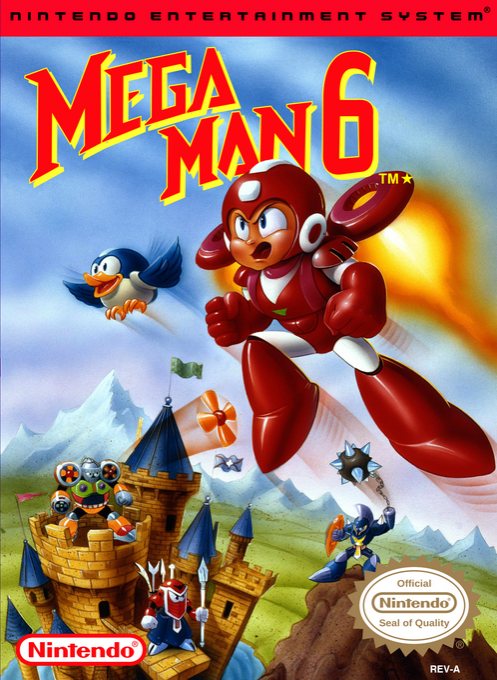
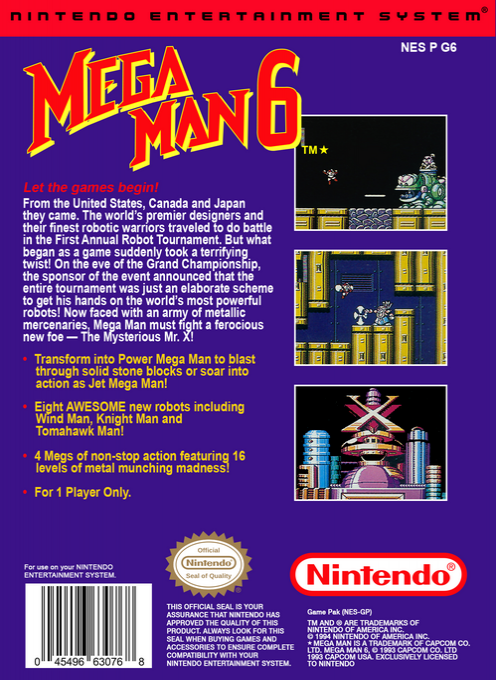
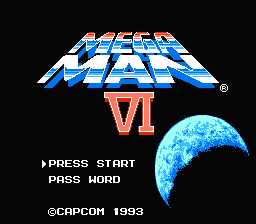
Mega Man 6 for the Nintendo Entertainment System is a side-scrolling action-platform game from Capcom and the sixth entry in the original Mega Man series. Released in Japan in 1993 as Rockman 6: The Greatest Battle in History!! and in North America in 1994, it arrived near the end of the NES era; Nintendo published the North American cartridge. The adventure begins at the first annual Robot Tournament, where eight leading robots are suddenly taken over by the tournament's sponsor, the mysterious Mr. X. Mega Man sets out to stop the threat before its robot army can be used to conquer the world.
As in the earlier NES games, the player guides Mega Man through a choice of eight themed stages in any order. Each level combines precise running and jumping with enemy encounters, hazards, and a Robot Master waiting at the end. Mega Man's arm cannon is his basic tool: it fires regular shots and can be charged for a stronger blast. Defeating a Robot Master awards that character's special weapon, and the different bosses have particular weapon vulnerabilities. Choosing a route through the opening stages and deciding when to spend weapon energy therefore becomes part of the game's strategy.
The initial roster consists of Blizzard Man, Centaur Man, Flame Man, Knight Man, Plant Man, Tomahawk Man, Wind Man, and Yamato Man. Their stages draw on their individual themes while presenting moving platforms, environmental obstacles, smaller enemies, and occasional larger mid-stage foes. Health pickups restore Mega Man's energy, while weapon-energy items replenish acquired abilities; players can also find extra lives and energy tanks for later use. After the eight Robot Masters are beaten, the quest continues through the enemy strongholds, where a confrontation with Mr. X reveals the familiar force behind the scheme.
Mega Man 6 gives Rush, Mega Man's robotic dog companion, a more central role through two transformation systems. The Jet Adaptor combines the pair and lets Mega Man rise or hover in the air for a limited time, opening up aerial routes and helping with difficult jumps. The Power Adaptor instead gives him a powerful close-range punch capable of breaking certain large blocks. These forms involve tradeoffs rather than simply replacing the standard equipment: for example, Jet Mega Man cannot use charged shots, and neither adaptor allows sliding.
Several stages also offer alternate paths to the boss room. In four of them, access to one route depends on using an adaptor, and the route taken affects whether Mega Man can collect one of four letter plates. Gathering all four plates assembles the helper bird Beat, which can be called to attack enemies. This optional reward gives repeat runs and exploration a concrete purpose while preserving the series' familiar pick-a-stage structure. Mega Man 6 also introduced the Energy Balancer, which directs collected weapon energy toward the currently lowest-powered special weapon.
The game was one of the final major Mega Man releases built for Nintendo's 8-bit hardware, even as the series was beginning its move to the Super NES with Mega Man X. Its Robot Master lineup reflected fan design contests: the game included ideas submitted by fans in Japan and North America, with Knight Man and Wind Man originating from the North American Nintendo Power contest. Capcom later returned Mega Man 6 through releases including the Japanese Rockman Complete Works edition, Mega Man Anniversary Collection, and Nintendo 3DS and Wii U Virtual Console versions. The NES original remains a single-player chapter that closes the classic six-game run on the system with familiar boss-weapon strategy and distinctive Rush-powered mobility.
Gallery
Details
- Developer
- Capcom
- Publisher
- Capcom
- Genre
- Platformer
- Players
- 1
- Release Date
- March 2, 1994
- System
- NES