About
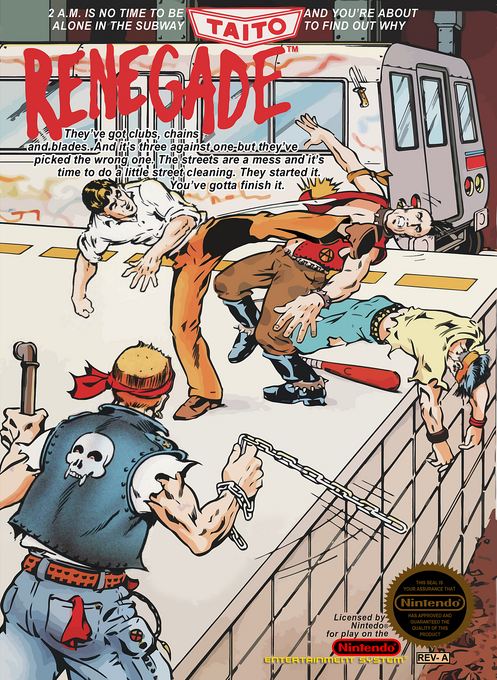
Renegade NES is Technos Japan’s home-console adaptation of the 1986 arcade brawler, published in North America by Taito in 1988. It recasts the Japanese arcade and Famicom original, Nekketsu Kōha Kunio-kun, as a Western street-gang rescue story: the player guides the Renegade through hostile territory to reach and free his kidnapped girlfriend. Rather than simply duplicating the coin-operated game, this NES release remakes its campaign around new multi-screen encounters, hazards, routes, and a final indoor maze. It is a one- or two-player action game, with selectable difficulty and four stages per run.
The central idea is close-range fighting in lanes that allow movement across the screen as well as left and right. The Control Pad positions the fighter, while the A and B buttons attack in the direction he faces; their purpose changes with position and momentum. A quick double tap starts a run, opening running punches and a flying kick, while opponents who have been softened up can be grabbed for knees, tossed with a shoulder throw, or attacked on the ground. These moves give each crowded encounter a tactical edge: keeping space, lining up an enemy, and recognizing when a foe can be grappled matter as much as repeatedly pressing an attack button.
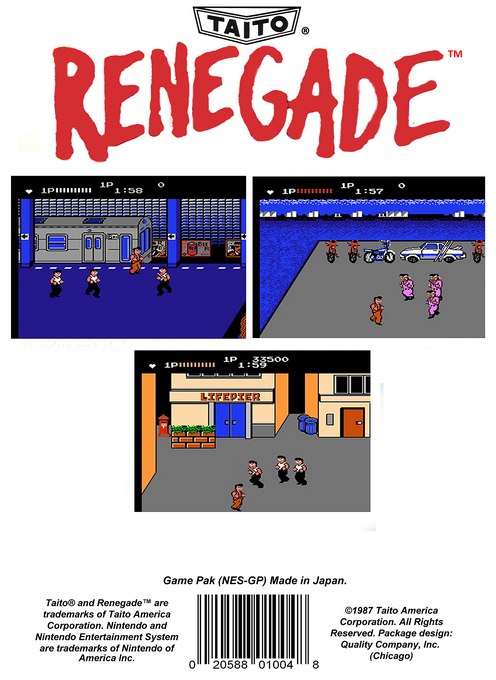
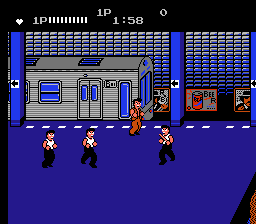
The opening subway section establishes the port’s more segmented structure. The Renegade must clear groups of punks on a platform, survive a fight inside a train car, and reach the gang leader beyond it; the platform edge can be as dangerous to the player as to an opponent. The next stage shifts to a wharf and begins with a motorcycle sequence. Here the regular on-foot controls give way to balancing, accelerating, braking, and kicking at rival riders before the brawl resumes. The manual identifies the following settings as a wharf confrontation, an alley fight against female fighters, and a final maze crowded with hostile hoods.
The third stage introduces a choice after its first battle. One direction advances toward the boss, while the other leads through an additional confrontation with lesser enemies. That branching detour is one of the clearest ways the NES design differs from the arcade source, whose gang battles use a different stage layout and progression. The fourth stage expands the change further: instead of a single climactic area, the Renegade navigates a building of connected rooms, meeting returning enemy types and bosses on the way to the gun-wielding leader. Wrong exits and trap doors can send a player back, turning the finale into a navigation challenge as well as a fight.
A power meter and time limit govern each attempt, and losing either costs a life. The game’s available lives and the arrangement of its encounters vary with the selected difficulty, so later runs demand both faster clearing and better use of the fighter’s special attacks. Two players can join the same campaign, making positioning important when both are surrounding the same gang. The clear visual distinction between weapons, bikers, larger grapplers, and the final gunman also signals different dangers before an attack begins. Completion starts another cycle at a tougher setting, preserving the arcade-style pressure behind the console-specific campaign.
Renegade has an important split identity. In Japan, Technos’ Famicom version retained the Kunio-kun name and the original school-delinquent setting, while the overseas Renegade presentation changes the characters and premise to a city-gang drama. The NES game also belongs to the earliest home-console work from Technos and arrived before the developer’s later Double Dragon became a defining name in beat ’em ups. Its Western Renegade branding should not be confused with Ocean Software’s separate computer sequels, Target: Renegade and Renegade III: The Final Chapter. For NES players, this is a distinctly rebuilt version of Technos’ formative brawler rather than a straightforward arcade conversion.
Gallery
Details
- Developer
- Technos Japan
- Publisher
- Taito
- Genre
- Beat 'em Up
- Players
- 1-2
- Release Date
- January 1, 1988
- System
- NES



/Don_Doko_Don_2.png)