About
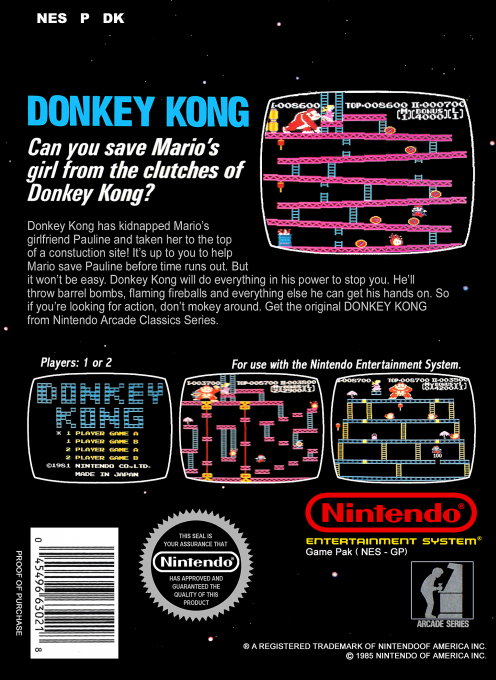
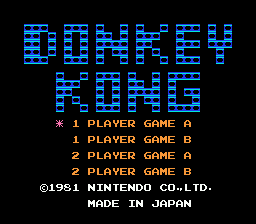
Donkey Kong for the Nintendo Entertainment System brings Nintendo’s landmark arcade challenge to the home console in a compact single-player format. Developed and published by Nintendo, the game reached Japan’s Famicom in 1983 and arrived on the NES in North America in June 1986. Mario must climb a towering construction site to rescue Pauline from Donkey Kong, the gorilla who has carried her to the top. The home version preserves the brisk, score-driven structure that made the arcade original a defining early platform game while adapting it to the NES Game Pak.
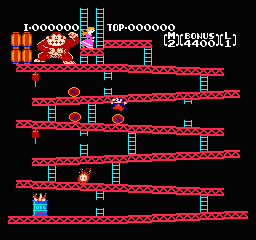
Each attempt begins at the foot of the structure, where Mario runs along slanted girders, climbs ladders, and times jumps over hazards. Donkey Kong’s rolling barrels create the most immediate threat on the opening screen, and later areas introduce different routes and moving obstacles. The Control Pad moves Mario left and right or guides him up and down ladders, while the jump button is central to clearing gaps and avoiding danger. Contact with a hazard, a long fall, or an expired timer costs a life, so progress depends on reading each screen’s layout as well as reacting quickly.
The game’s objective is more involved than simply reaching a high platform. Players earn points for actions such as jumping hazards, picking up bonus items, using a hammer, and finishing a stage before its bonus count runs down. Hammers briefly let Mario smash certain approaching obstacles, creating a useful but temporary opening in a dangerous route. After a successful screen, the challenge returns at a faster pace, with more demanding timing and busier hazards. This escalating loop gives Donkey Kong NES the pressure of an arcade score chase while remaining easy to understand from its first climb.
Mario and Pauline’s rescue story is conveyed through short animated scenes and the action itself. Donkey Kong watches from above, throws hazards down the structure, and retreats upward after Mario reaches Pauline, sending the pursuit to another section. The NES game includes the barrel, elevator, and rivet stages, each with a distinct arrangement of platforms and ladders. The rivet screen changes the goal: Mario must remove the supports beneath Donkey Kong rather than merely climb to the top. Completing it brings the confrontation to a close before the game’s stages cycle again at increased difficulty.
This NES release is a conversion of the 1981 arcade game, not a later remake or a Donkey Kong Country-style adventure. It is also not a complete reproduction of the arcade program: the original arcade game’s cement-factory stage does not appear on this cartridge, leaving three of its four stage types. That difference makes the version particularly notable in the history of early home console conversions, where cartridge space and hardware limits often required changes to arcade designs. Its clear presentation, colorful construction-site screens, and recognizable character animation nevertheless retain the identity of the original.
Donkey Kong also occupies an important place in Nintendo history. The arcade debut introduced the character who would become Mario, and the home version brought that rivalry to Famicom and NES players during the company’s formative console years. Its combination of running, jumping, ladder climbing, changing hazards, and simple narrative helped establish ideas that would become common in platform games. For players exploring the NES library, Donkey Kong remains a focused test of timing and route planning, as well as an early chapter in the long-running Donkey Kong and Mario series.
Gallery

Details
- Developer
- Nintendo
- Publisher
- Nintendo
- Genre
- Platformer
- Players
- 1-2
- Release Date
- June 2, 1986
- System
- NES