About
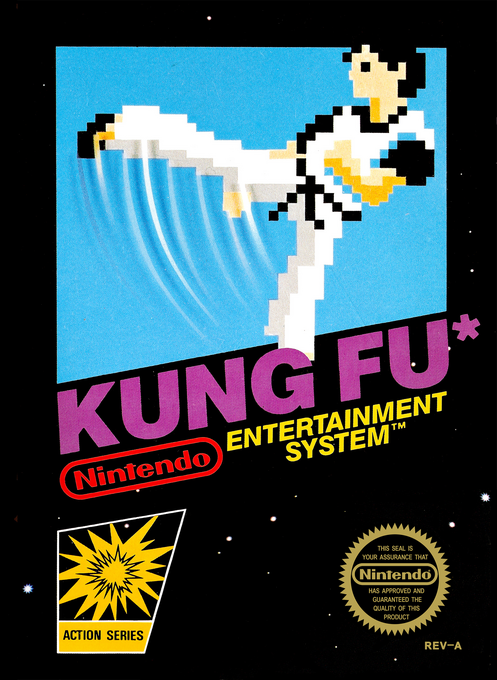
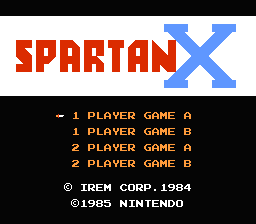
Kung Fu for the Nintendo Entertainment System is Nintendo’s 1985 side-scrolling martial-arts action game, released in Japan for the Family Computer as Spartan X. It is Nintendo’s home-console version of Irem’s 1984 arcade game Kung-Fu Master, adapted for the NES by a Nintendo team led by Shigeru Miyamoto. In North America it arrived under the shorter title Kung Fu, while the Japanese release retained Spartan X. The game casts the player as Thomas, a kung-fu expert racing into Mr. X’s stronghold to rescue Sylvia, who is being held on the top floor.
The journey is a direct climb through a five-floor building, with each floor operating as a scrolling action stage. Thomas advances through corridors packed with attackers, and every floor ends in a duel against a guardian before the stairs to the next level open. Clearing all five floors means facing Mr. X and reaching Sylvia. The structure gives the game a clear objective beyond score-chasing: survive the building, manage its hazards, and complete the rescue before time or energy runs out.
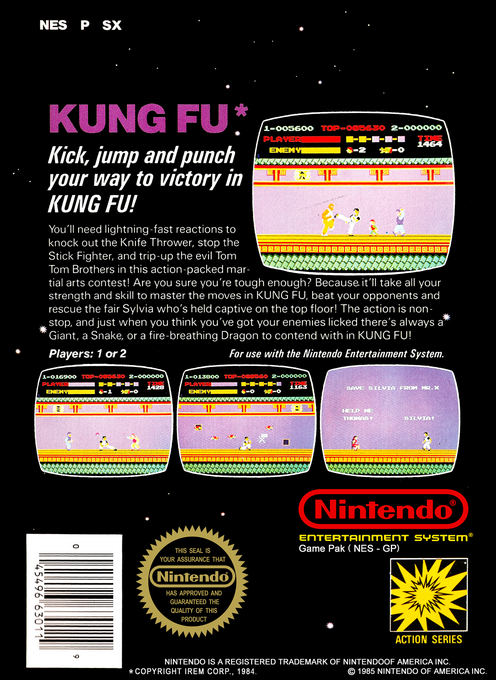
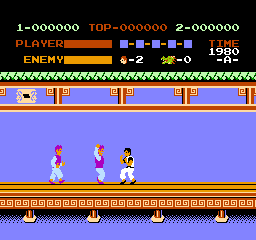
Kung Fu NES uses the control pad for movement, jumping, and crouching, with one button assigned to punches and the other to kicks. Those simple inputs produce choices that matter in the middle of a crowd. Punches are useful at close range, kicks extend Thomas’s reach, and jumping while attacking creates airborne strikes. Players must react to the approach and height of threats rather than relying on a single move, particularly when an enemy closes in or a projectile enters the screen. The game also offers Game A for beginners and the more demanding Game B, plus alternating turns for up to two players.
Ordinary opponents create the pressure between boss battles. Grippers swarm Thomas and can drain his energy when they get hold of him, knife throwers attack from a distance, and Tom Toms use acrobatic approaches that can catch an unwary player. Later floors add dangers from above and below, including falling objects, snake baskets, moths, and fire-breathing dragons. Thomas has an energy meter as well as a time limit, so progress depends on both avoiding damage and moving with purpose. Remaining time and energy become bonus points after a floor, while a score of 50,000 earns an extra life.
Each stage boss asks for a different response. The Stick Fighter guards the first floor, followed by the Boomerang Fighter, the Giant, and the Black Magician; Mr. X waits at the summit. These encounters set Thomas against a single opponent with a visible energy bar, interrupting the crowded corridor action with a more focused fight. The contrast between handling groups of enemies and recognizing a boss’s attack pattern is central to Kung Fu’s rhythm. After the rescue, the game begins again at a higher difficulty, extending the challenge for players trying to master its increasingly severe pace.
Kung Fu occupies an important early place in the NES library and in the development of scrolling combat games. Its arcade source combined continuous forward movement, groups of opponents, and end-of-level adversaries into a format that would become familiar in later beat ’em ups. The NES release makes that approach work through compact stages and immediately readable controls rather than a large move list. It is also a notable Nintendo production from the period: Miyamoto directed the conversion, Toshihiko Nakago programmed it, and Koji Kondo is credited for its NES music. For players exploring formative NES action games, Kung Fu is a concise rescue mission built around timing, spacing, and a determined climb toward the top floor.
Gallery
Details
- Developer
- Nintendo
- Publisher
- Nintendo
- Genre
- Beat 'em Up
- Players
- 2
- Release Date
- October 2, 1985
- System
- NES