About
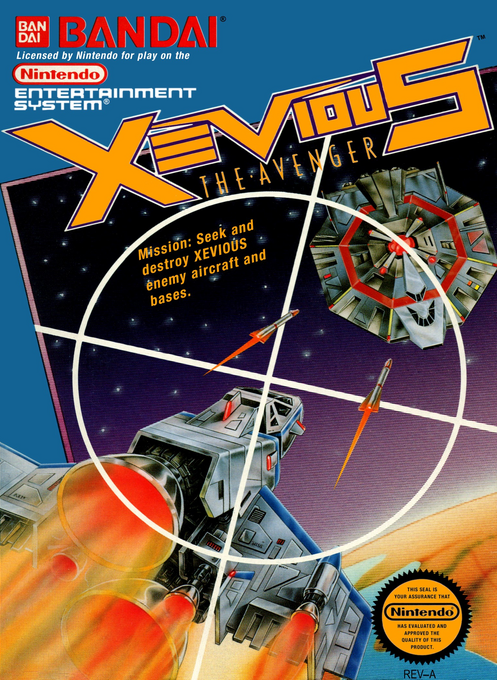
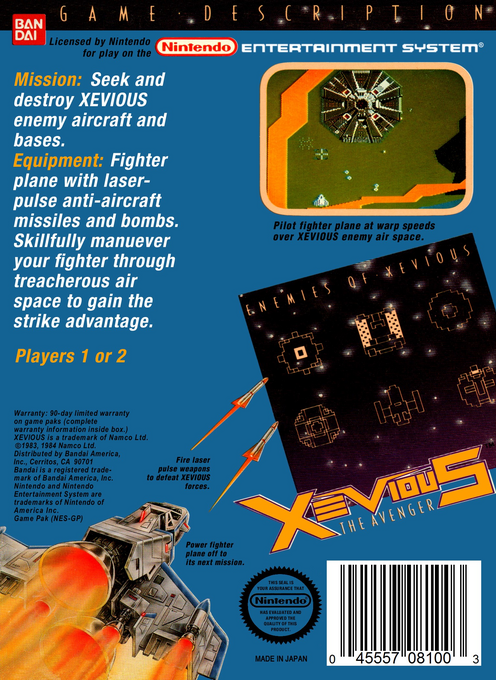
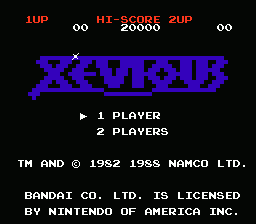
Xevious: The Avenger for the NES is Bandai’s 1988 North American release of Namco’s landmark scrolling shooter. It adapts the 1984 Famicom version of Namco’s 1983 arcade game, placing players in the cockpit of the Solvalou, a lone strike craft sent into hostile territory. The mission is to break through the invading Xevious forces and confront an enemy war machine before its campaign against Earth can succeed. Its mix of science-fiction action, continuously advancing scenery, and unusual target system made it stand apart from many early shooters.
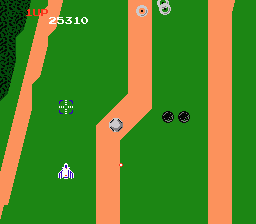
The NES game scrolls vertically through a sequence of broad battle zones without stopping between ordinary stages. Forests, rivers, roads, fields, and mechanical installations pass below the Solvalou while enemy formations approach from above and ground defenses occupy the landscape. The goal is simple to state but demanding to carry out: survive the advancing terrain, clear dangerous threats, and learn where major targets and hidden opportunities appear. The game eventually cycles back through its areas, so lasting runs depend on steadily improving control and pattern recognition.
Xevious: The Avenger revolves around two separate attack layers. The Solvalou’s forward zapper fires at airborne opponents, while its ground blaster drops bombs on targets below. A sight positioned ahead of the fighter shows where a bomb will land, requiring players to line up each ground strike while still dodging incoming air attacks. On the NES controller, the directional pad steers the ship, with separate buttons assigned to the forward shot and bomb. That division gives every encounter a split focus: an aircraft may need immediate fire while a tank, radar, or installation requires careful bombing.
Enemy forces include flying attackers and ground emplacements, and the landscape itself can hide threats and rewards. Some areas contain large Andor Genesis fortresses that fill the screen with fire and can be attacked at vulnerable sections. Radar installations can affect the pressure of enemy attacks, while concealed Sol Citadels and Special Flags reward players who probe the terrain with their bombs. These secrets give repeat play a discovery element alongside the direct shooting. The conversion supports one or two players, with two-player games taking turns rather than putting both pilots on screen together.
The NES edition follows the original game’s futuristic world and its distinctive contrast between natural-looking terrain and alien machinery. Rather than relying on a changing inventory of power-ups, it asks players to make the most of the Solvalou’s fixed equipment and to understand enemy movement, safe routes, and bomb placement. Its repeated areas become more demanding as a run develops, and lost ships can send players back to a checkpoint depending on how far they have advanced through the current section. The result is a shooter built around precision and accumulated knowledge instead of a short, self-contained set of stages.
In Japan, Xevious had already become an important Namco arcade hit before the Famicom cartridge arrived in November 1984. That home release was among Namco’s early Famicom games, while Bandai later brought the same core conversion to the NES as Xevious: The Avenger. The series continued with updates, sequels, and compilations, but this NES release remains a direct home version of the game that established the Solvalou’s air-and-ground combat formula. For players exploring classic NES shooters, it is a concise example of how Namco translated an influential arcade design to Nintendo’s 8-bit system.
Gallery
Details
- Developer
- Namco
- Publisher
- Bandai
- Genre
- Shoot 'em Up
- Players
- 1-2
- Release Date
- September 2, 1988
- System
- NES
/Gekitotsu_Yonku_Battle.png)