About
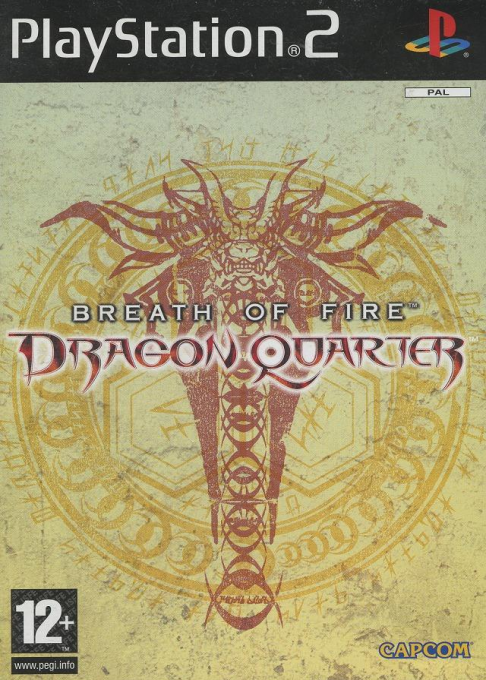
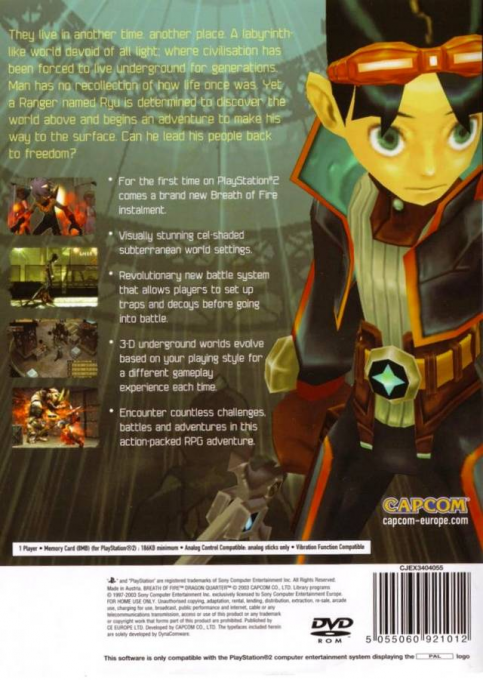
Breath of Fire: Dragon Quarter is a PlayStation 2 role-playing game developed and published by Capcom. It arrived in Japan in November 2002 as Breath of Fire V: Dragon Quarter and reached North America in February 2003, taking the long-running series in a markedly different direction. Instead of broad fantasy continents, this fifth main entry unfolds in a sealed, industrial world far beneath a ruined surface. Its science-fiction setting, fully three-dimensional presentation, and tight focus on survival give the adventure a distinct identity within the Breath of Fire series.
The story follows Ryu, a low-ranking underground citizen whose life changes when he encounters Nina, a young woman altered for a dangerous air-purification experiment. The underground society measures status with a numerical D-Ratio, and the people closest to the surface enjoy cleaner air and greater privilege. Ryu, Nina, and the ranger Lin set out on an upward journey through tunnels, facilities, and defended districts, seeking the world above. The premise puts the group’s personal struggle alongside a larger conflict over a rigid social order and humanity’s lost connection to the surface.
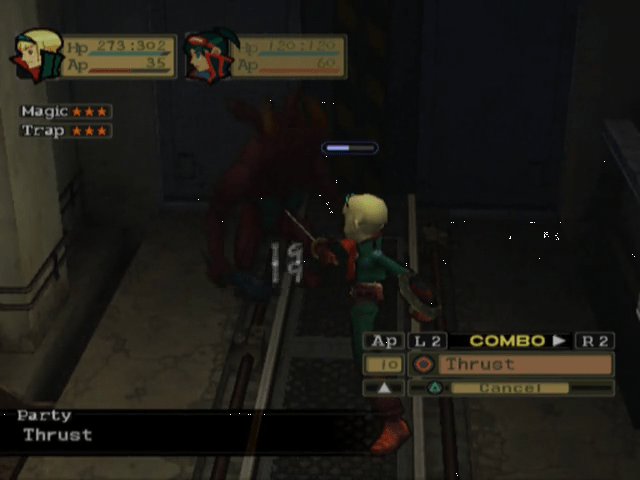
Dragon Quarter is built around connected locations rather than a traditional overworld. Enemies are visible while exploring, allowing players to decide when to engage, try to slip past, or use the environment to their advantage. Encounters use the Positive Encounter and Tactics System, which blends turn-based battles with free positioning during a character’s turn. Every step, attack, and action draws from Active Points, so a turn is not simply about selecting a command: moving into range, choosing an attack level, and preserving enough points for the next decision all matter. Weapons can provide different attacks, while collected skills expand the party’s options.
Ryu’s connection to a dragon is both a source of exceptional power and a constant risk. Dragon forms and abilities are governed by the D-Counter, a percentage that rises over the course of play and climbs more quickly when those powers are used. Reaching its limit ends the current attempt, so the system makes each use of Ryu’s strongest abilities a deliberate trade-off. This pressure works alongside limited permanent save tokens, supplies, traps, and visible enemy placement to make planning and resource management central to progression through the underground.
The PlayStation 2 game also treats repetition as part of its design. Its Scenario Overlay system lets players begin again through SOL: Restore while retaining accumulated equipment, items, and certain progress. A higher D-Ratio can open access to additional scenes and areas on later runs, meaning a restart is not merely a failure state but a way to uncover more of the adventure. This structure deliberately departs from the one-pass format of many console RPGs and supports a gradual process of learning routes, conserving resources, and improving the party’s chances of reaching the surface.
Capcom’s change in tone extended to the audiovisual design. Character designs came from series artist Tatsuya Yoshikawa, while Hitoshi Sakimoto composed the score under sound producer Yasunori Mitsuda. The result is a tense, mechanical atmosphere that differs from the earlier games’ more conventional fantasy settings while preserving recurring series names such as Ryu and Nina. Regional releases also differed in saving: the European version removed the temporary soft-save function and supplied additional save tokens as compensation. Breath of Fire: Dragon Quarter remains a singular PlayStation 2 chapter for players interested in a strategic RPG whose story, setting, and systems all revolve around the difficult climb toward the sky.
Gallery
Details
- Developer
- Capcom
- Publisher
- Capcom
- Genre
- JRPG
- Players
- 1
- Release Date
- November 28, 2003
- System
- PS2