About
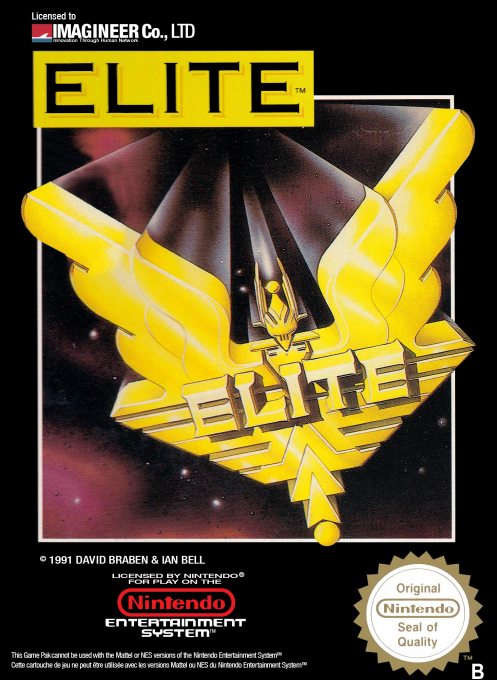
Elite NES is the 1991 console version of David Braben and Ian Bell's open-ended space trading and combat game, published by Imagineer for PAL Nintendo Entertainment System consoles. The original game began on the BBC Micro in 1984, but this release reshapes its ambitious science-fiction simulation for the NES. Braben and Bell are credited for the NES conversion, with Eurocom Developments handling artwork and David Whittaker coding the sound and music. It remains a one-player voyage built around the idea of starting small and deciding for yourself what kind of commander to become.
The journey begins with Commander Jameson at Lave Station, 100 credits, and a modest Cobra Mark III. From there, the central routine is to use the galaxy map to choose a reachable system, jump there, fly between its planet and orbital station, and buy or sell cargo. Economic conditions differ from world to world, so a profitable run depends on comparing a market's prices and availability rather than following a fixed set of stages. Credits can also come from bounties, salvaged cargo, mining, or piracy, though attacking the wrong ships can bring the authorities into the fight.
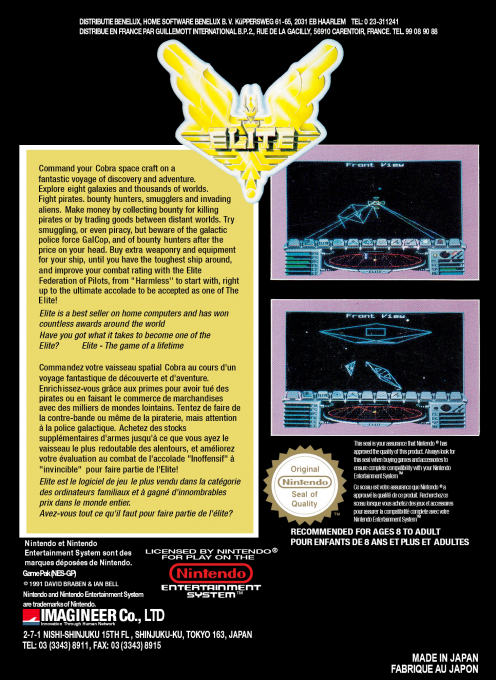
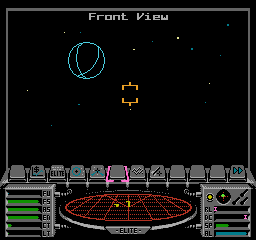
Flight takes place from a cockpit view in a sparse wireframe 3D space scene. The player searches for targets and landmarks with the instruments, turns the Cobra to line up shots, controls speed, and manages shields and energy in encounters with pirates, police, traders, and alien Thargoids. Docking at a rotating Coriolis station is a skill in its own right: a successful approach opens the market and equipment screens, while a bad one can destroy the ship. Fuel is normally bought at stations, but a fuel scoop lets a properly equipped commander collect energy near a star, adding another risk-and-reward choice to a voyage.
Profits can be reinvested in hardware such as stronger lasers, missile systems, defensive equipment, extra cargo capacity, additional energy banks, and an automatic docking computer. These upgrades change what the Cobra can safely attempt, whether that means carrying more goods through dangerous territory or pursuing combat. Hyperspace jumps have a limited range, so route planning matters, and the costly galactic hyperdrive eventually provides access to Elite's eight-galaxy universe. Each galaxy contains 256 generated systems, giving individual worlds fixed names, economies, governments, descriptions, and markets without turning the campaign into a linear adventure.
Elite NES replaces the keyboard-heavy controls of earlier computer editions with a pad-oriented icon bar. The D-pad directs the ship in flight, A fires its laser, and holding B changes how directional inputs work, including speed control and moving through the on-screen command icons. Those icons provide access to the map, markets, equipment, views, and other ship functions. The design is an important platform-specific compromise: it keeps the many commands of Elite available on a two-button controller, though learning when to switch between steering and interface selection is part of mastering this NES release.
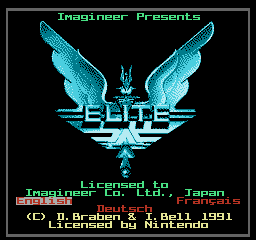
The cartridge also adds a language choice and a scrolling introductory combat demonstration before the main career begins. Its sound credits include Aidan Bell and Johann Strauss I alongside Whittaker; the music is a notable contrast with the silence of the earliest BBC Micro version. Under its console presentation, however, the game preserves the original's broad blend of navigation, trading, ship management, and first-person space combat. There is no final level that dictates success: a commander can pursue money, equipment, exploration, or a feared reputation at a personal pace.
Elite's NES release is especially unusual in regional terms. Imagineer's 1991 PAL cartridge was the only official NES edition, despite later NTSC-oriented program variants that were created for compatibility with some emulators rather than released as a full commercial North American conversion. That makes Elite NES both a late 8-bit adaptation of a landmark British computer game and the series' only official console version of this era. Its target is the same as the title itself: earn combat recognition through enough victories to rise through the ranks and ultimately reach Elite status.
Gallery
Details
- Developer
- Braben & Bell
- Publisher
- Imagineer
- Genre
- Other Simulation
- Players
- 1
- Release Date
- January 1, 1991
- System
- NES