About
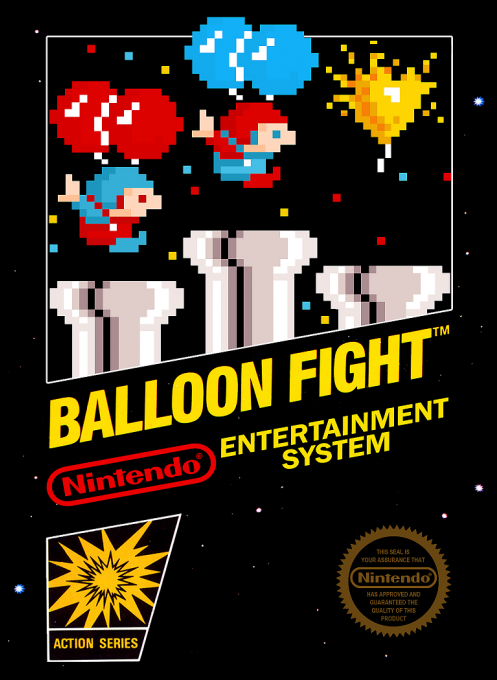
Balloon Fight for the Nintendo Entertainment System is a buoyant single-screen action game from Nintendo, released in North America in 1986 after its 1985 Japanese Famicom debut. Its arcade counterpart had appeared in 1984. The premise is instantly clear: guide a helmeted Balloon Fighter through the sky on two balloons and bring down every rival before they do the same to you. Nintendo developed and published the game; Yoshio Sakamoto designed it, while Satoru Iwata, then at HAL Laboratory, programmed the NES version.
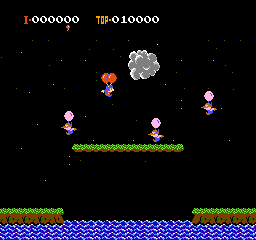
Each match turns movement into the central challenge. The Control Pad steers left and right, while tapping A makes the fighter flap upward and holding B produces a rapid rise. Those simple inputs create a deliberately floaty, momentum-driven flight model: gaining height, slowing a drift, and positioning above an opponent all require careful timing. The safest attack is from above, because colliding with an enemy's balloons pops them. Losing one of the player's own balloons reduces lift; losing both costs a life.
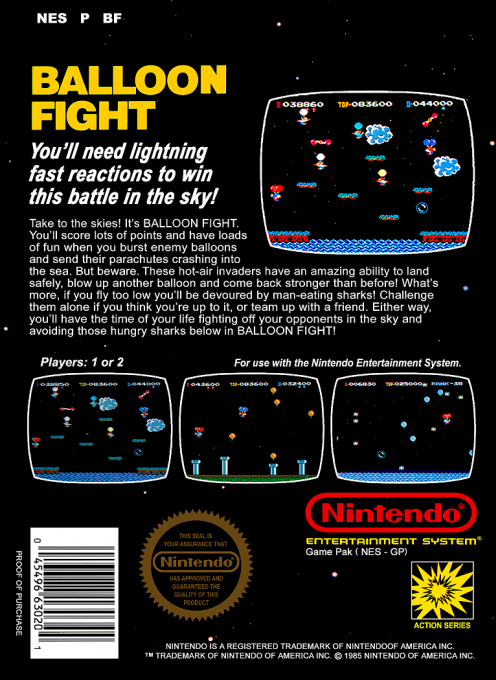
A popped enemy is not gone immediately. The fighter descends under a parachute and can return to the floor to inflate another balloon unless the player hits it again first. That extra step gives the game its distinctive rhythm, alternating aerial duels with quick attempts to finish a vulnerable opponent. Enemies can also fall into the water, and bubbles rise afterward; popping those bubbles adds to the score. The water is not a refuge, however, since a fish can leap from it to swallow a low-flying fighter. Lightning adds another threat to avoid.
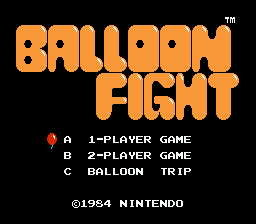
The standard game supports one player or two players. Solo play is a succession of stages built around clearing every enemy on screen. In two-player play, the pair shares the task of removing the enemies while still competing for the higher score, so a cooperative rescue or a well-timed interception can change the result. After every three cleared stages, a timed bonus round fills the screen with balloons to burst. As stages continue, the screen becomes more demanding through additional foes and the need to manage the game's responsive but inertia-heavy movement.
The NES release also includes Balloon Trip, a separate one-player challenge absent from the original arcade game. Here the flight shifts to a scrolling course where the aim is to collect or burst as many balloons as possible while threading through moving lightning. It is a high-score mode with no enemy-clear objective, emphasizing route planning and steady control of altitude. Consecutively taking twenty balloons without missing one earns a bonus, and the mode displays the player's rank, giving its brief runs a focused scoring target distinct from the stage-based games.
Balloon Fight belongs to Nintendo's early Famicom and NES era, but its compact design has remained recognizable through later Nintendo releases. It returned in formats including the Famicom Mini line, Virtual Console services, and the NES Classic Mini, while Nintendo Land's Balloon Trip Breeze revisited the idea of balloon-guided flight. The game also led to Balloon Kid on Game Boy, which expanded the concept in a different direction. For the original NES version, the appeal lies in mastering a small set of rules: stay aloft, claim the higher position, remove fallen opponents before they recover, and never forget the dangers waiting at the waterline.
Gallery
Details
- Developer
- Nintendo
- Publisher
- Nintendo
- Genre
- Platformer
- Players
- 1-2
- Release Date
- June 2, 1986
- System
- NES