About
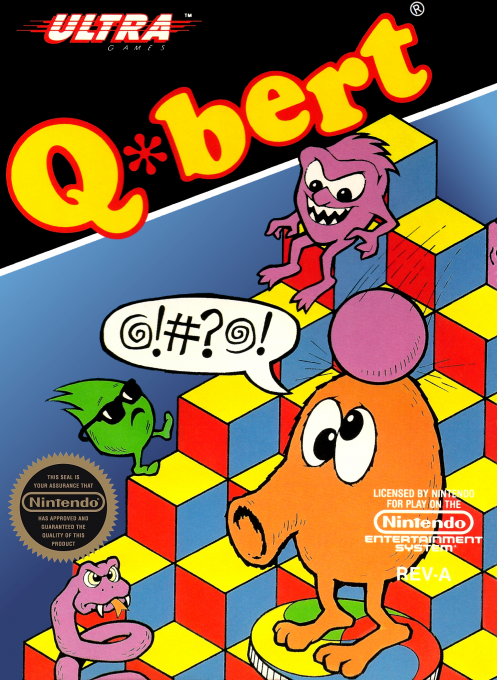
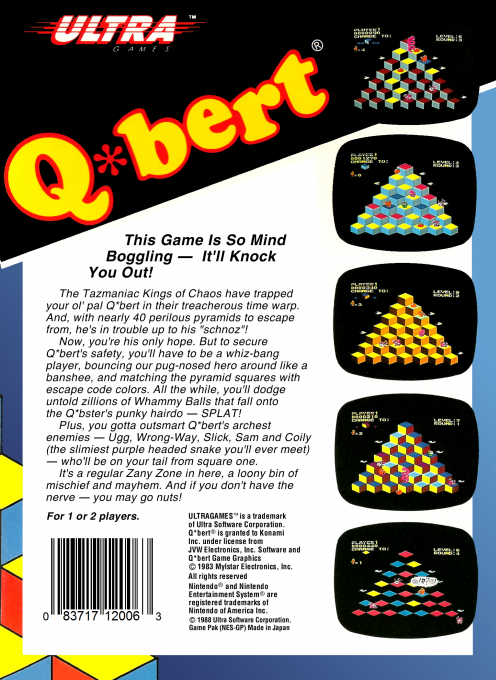
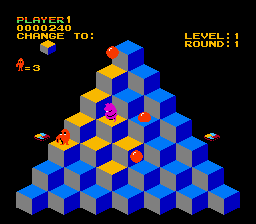
Q*bert for NES brings Gottlieb’s 1982 arcade puzzle-action game to Nintendo’s 8-bit console in a February 1989 North American release. Published by Ultra Games and ported by Konami, it stars the orange, long-nosed Q*bert on a suspended pyramid of cubes. Each screen turns simple movement into a fast planning problem: land on the right cubes, change them to the required colors, and finish the whole pyramid before its hazards close in.
The playfield is shown in an angled, three-dimensional-looking view, but Q*bert can only travel diagonally from cube top to cube top. The Control Pad sends him down-left, down-right, up-left, or up-right, so a safe route depends on reading the pyramid several moves ahead. Early rounds ask for a single visit to each cube. Later objectives become trickier as cubes may need repeated changes or may undo progress when Q*bert returns to them. Clearing the target pattern advances the game to a tougher pyramid.
A score chase becomes dangerous because the board is never empty for long. Coily begins as a bouncing egg before becoming a snake that pursues Q*bert, while Ugg and Wrong-Way move along the sides of the cube structure. Slick and Sam can reverse changed cubes, and falling balls add another moving threat or opportunity. Contact with the hostile creatures, a hazardous ball, or a leap beyond the edge costs a life, making precise directional timing as important as completing the color pattern.
Floating discs positioned at the sides of the pyramid provide Q*bert’s main escape route. Jumping onto one carries him back toward safety, and a close-following Coily can be lured into leaping after him and falling away. Green balls can temporarily stop the active enemies, while catching Slick or Sam removes those color-changing pests. These tools create short openings, but using them also means deciding whether to preserve a safer route or take a chance for more points.
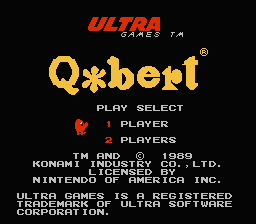
The NES edition supports one or two local players, with score displays and turns centered on the same compact cube puzzles. Its deliberately diagonal controls preserve the distinctive feel of the arcade design; the manual even suggests holding the controller at an angle to better match Q*bert’s movement. The game is a home-console version of the original Q*bert rather than the separate MSX title released under the same name, keeping the familiar pyramid format, character roster, escalating rounds, and arcade-style objective intact.
Q*bert’s appeal on NES lies in how much pressure it creates from a single fixed screen. Every hop changes both Q*bert’s position and the state of the puzzle, so a move that looks correct in isolation can block an escape or spoil a nearly completed color scheme. The 1989 cartridge arrived years after the arcade original, but it preserved a recognizable early-arcade formula: quick sessions, rising difficulty, and a character-driven puzzle challenge built around a deceptively small set of rules.
Gallery
Details
- Developer
- Konami
- Publisher
- Ultra Games
- Genre
- Logic Puzzle
- Players
- 1-2
- Release Date
- February 2, 1989
- System
- NES