About
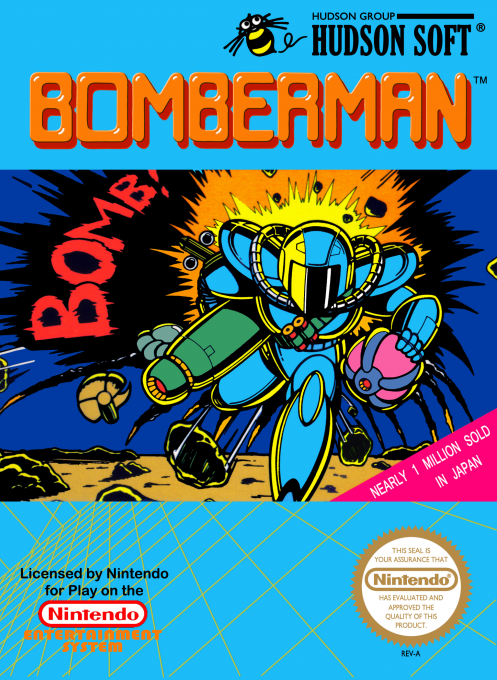
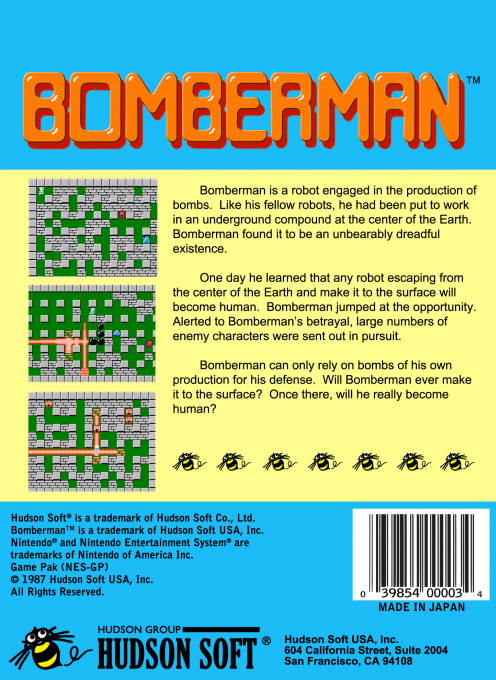
Bomberman is Hudson’s single-player maze action game for the NES, released in North America in 1989 after the original Famicom version. Hudson developed and published this edition. It presents the character as a robot working in an underground bomb factory who hears that reaching the surface will let him become human. That premise frames an escape through the factory rather than a competitive match: this is the early, solitary Bomberman, before the series became closely associated with its later multiplayer battle modes.
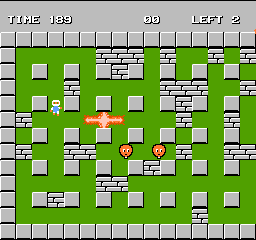
Viewed from above, each stage is a grid of fixed hard walls and breakable soft blocks. Bomberman moves in four directions and begins with the simplest possible toolset: he can place one timed bomb. A blast travels in a cross, extending outward until a wall stops it. It can destroy soft blocks and enemies, but it can also kill Bomberman, so every placement requires a route to safety. Blasts can set off other bombs, making chain reactions useful for clearing barriers or catching several enemies at once.
The basic objective is to defeat the monsters roaming a floor, uncover the exit hidden beneath a soft block, and leave through it. Stages have a 200-second limit. Taking too long does not immediately end the attempt, but it brings additional, dangerous enemies into the maze. Bombing the exposed exit or a power-up likewise releases extra enemies, so the game rewards careful excavation and treating the door as something to preserve rather than destroy. Enemy types behave differently: some follow set paths, some pursue Bomberman, and some can pass through soft blocks, changing how a maze can be used as a trap.
One item is hidden in the soft blocks of every normal stage. Fire extends the blast range, and Bomb increases the number of bombs Bomberman may have active at once. Skates increase movement speed. Other pickups change the rules more dramatically: Bomb-Walk lets him pass through his own bombs, Wall-Walker lets him move through breakable blocks, and the Detonator allows the player to trigger planted bombs manually with the B button. Flame-Proof protects him from his own explosions permanently, while the Mystery item grants a short period of invulnerability. These enhancements accumulate into a far more mobile and controllable Bomberman than the character who begins the game.
There are 50 main stages, with a short bonus round after every five. In the bonus rounds Bomberman is invulnerable and tries to destroy as many enemies as possible before the shorter timer expires, turning the usual cautious play into a scoring opportunity. Normal-stage layouts use the same maze framework but vary their block arrangement; the prescribed enemies and item for a stage give progression its structure. Extra lives and point-only bonus items are also available, although some of the latter depend on deliberately obscure conditions rather than ordinary stage completion.
A game over does not require starting the factory escape from the beginning. The NES version uses lengthy passwords to restore progress and retain much of the player’s accumulated capability, making the full run more manageable. Passwords are a feature of this release, not a save file, and the system has unusual edge cases: specially constructed codes can access unintended or challenge stages. In ordinary use, though, it serves as the bridge between a difficult early game with weak bombs and later floors built around the larger blast radius, faster movement, and special traversal abilities collected along the way.
Completing stage 50 resolves the factory story. The NES ending congratulates the player for helping Bomberman become human and points toward another Hudson game; the connection is to Lode Runner. The Japanese Famicom version states the connection more directly, while the NES text leaves it as a prompt to recognize him elsewhere in Hudson’s catalogue. After the ending, the game can be replayed with the power-ups held at the end of the previous run.
This should not be confused with Bomberman II, the later PC Engine and Super Bomberman entries, or the many games built around versus play. The 1989 NES Bomberman has no multiplayer mode: its focus is one player navigating increasingly demanding rooms, learning enemy behavior, manipulating explosive timing, and turning a sparse set of maze rules into a methodical escape game.
Gallery
Details
- Developer
- Hudson
- Publisher
- Hudson
- Genre
- Maze
- Players
- 1
- Release Date
- January 2, 1989
- System
- NES

/Chuuka_Taisen.png)