About
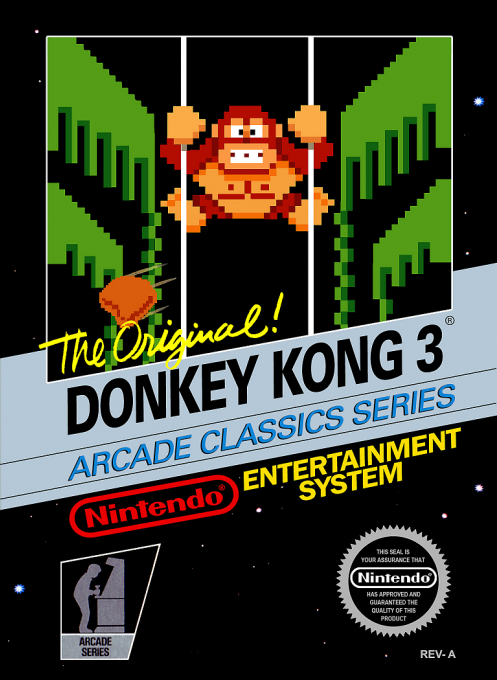
Donkey Kong 3 is Nintendo's 1986 NES adaptation of the 1983 arcade game, and it takes the long-running rivalry in a markedly different direction. Rather than casting Mario in a climbing rescue, the game puts players in control of Stanley, an exterminator trying to save the flowers in his greenhouse. Donkey Kong has settled among the rafters while waves of insects crowd the room, turning a familiar Nintendo character into the centre of a fast, score-driven shooting challenge. The North American NES release followed the 1984 Family Computer version in Japan, bringing this unusual third arcade-era Donkey Kong entry to the home console.
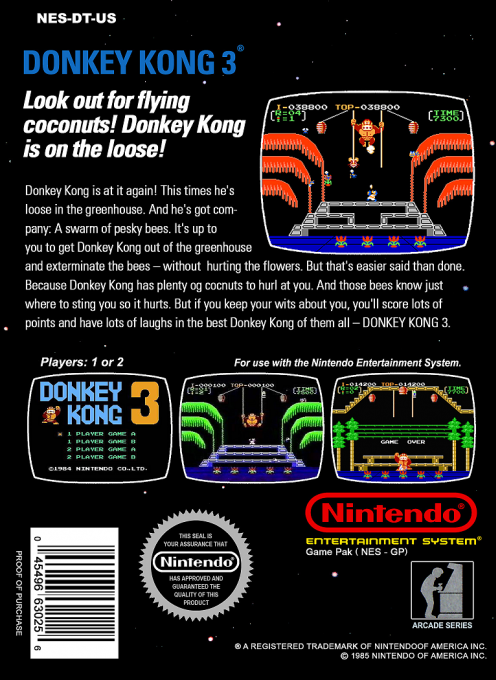
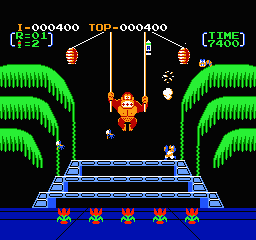
Each stage is arranged as a compact greenhouse of platforms, ladders, vines and flower beds. Stanley can run, jump and aim a can of bug spray upward or across the screen. The main objective is to repeatedly spray Donkey Kong, forcing him higher through the vines until he is pushed off the top of the playfield. Clearing every active insect is another route to completing a round, so the player must constantly decide whether to press the attack on Donkey Kong or control the immediate swarm. This gives the NES game a more reactive, arcade-style rhythm than the platforming associated with its predecessors.
The insects make the greenhouse feel busy and precarious. Bees, beetles, butterflies, inchworms and other threats approach Stanley along different paths, while some flying bugs try to carry away the flowers that determine the stage bonus. Certain enemies demand extra care: queen bees break apart when hit, leaving hazardous pieces behind, and attacks from above mean that standing beneath Donkey Kong is rarely safe for long. Timing shots, changing position and watching both sides of the screen are as important as raw speed when the stage becomes crowded.
A Super Sprayer adds another tactical wrinkle. When Stanley drives Donkey Kong past its position on the vines, the power-up drops into reach and temporarily makes the spray far more effective at pushing the ape upward. It can shorten a difficult round dramatically, but it does not remove the need to handle the insects or preserve room to move. Players build points by defeating enemies, protecting the garden and finishing efficiently, with an extra life awarded at 50,000 points before the game becomes a test of how long a run can be sustained.
Donkey Kong 3 cycles through three greenhouse layouts, but escalating enemy pressure and score chasing keep the repeated sequence demanding. The NES version preserves the direct rules and bright, readable presentation of an early Nintendo arcade design: a joystick-like sense of movement, immediate consequences for a mistimed step, and short rounds designed for repeated attempts. Its premise is playful, yet the screen management can become intense as Stanley is squeezed between airborne bugs, ground-level dangers and Donkey Kong's position above.
For retro-game fans, Donkey Kong 3 stands out because it completes the original arcade trilogy without simply repeating the formulas of Donkey Kong or Donkey Kong Jr. Stanley replaces Mario as the hero, bug spray replaces climbing as the central tool, and the action leans toward a fixed-screen shooter while retaining the series' colorful characters and high-score focus. Developed and published by Nintendo, this NES release is a distinctive snapshot of the company's arcade-to-home-console transition and an accessible challenge for players who enjoy quick reflexes, route planning and the pressure of protecting a garden one screen at a time.
Gallery
Details
- Developer
- Nintendo
- Publisher
- Nintendo
- Genre
- Platformer
- Players
- 1-2
- Release Date
- June 2, 1986
- System
- NES