About
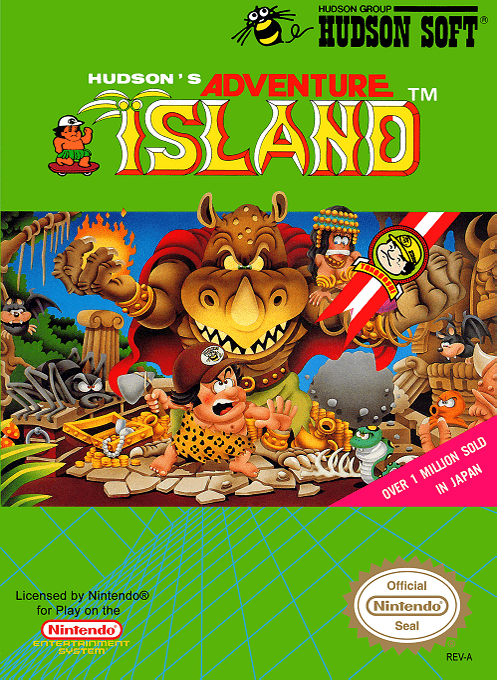
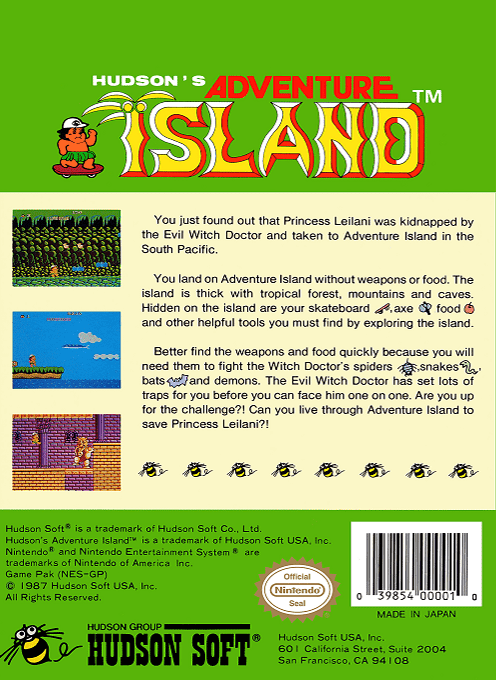
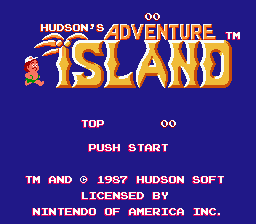
Adventure Island is Hudson Soft's brisk, punishing NES platform game, released in North America in 1988. It casts the player as Master Higgins, the western name for Hudson mascot Takahashi Meijin, on a rescue mission across a South Pacific island after the Evil Witch Doctor abducts his sweetheart, Tina. The simple premise supports an immediately readable arcade-style journey: run from left to right, jump hazards at speed, gather supplies and survive long enough to reach the next checkpoint.
The adventure spans eight areas, each divided into four stages, for a total of 32 demanding courses. Forests, beaches, caves and other island settings are packed with enemies, pits, water, rocks and projectiles. A boss encounter closes the fourth stage of every area, with the Witch Doctor returning in a different-headed form as the campaign advances. The structure makes steady progress feel significant, especially because a missed jump or careless collision can quickly erase a life.
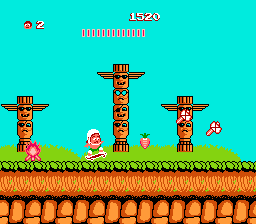
Master Higgins begins each life unarmed, so finding a stone axe is central to staying alive. Axes can dispatch many enemies and reveal the contents of oversized eggs scattered through the stages. With an axe equipped, later eggs may offer fireballs instead; these travel farther and can break obstacles that the basic weapon cannot. Eggs also conceal useful items such as skateboards, which make Higgins move faster but demand sharper reactions, as well as less welcome surprises including eggplants that drain his endurance.
A constantly falling vitality meter gives Adventure Island its distinctive pressure. Fruit and milk restore the meter, while time and certain mishaps reduce it; running out costs a life even when no enemy has landed a hit. That rule turns what looks like a conventional side-scroller into a race of route reading and resource collection. Players must judge when to grab food, when to leap for a hidden reward and when a risky detour is not worth losing momentum.
The game rewards curiosity alongside reflexes. Some eggs are hidden rather than visible, and thrown weapons can help indicate where to jump to uncover them. Other secret spots lead to bonus routes filled with fruit, while the bee-like Honey Girl grants a brief period of invincibility. End-of-stage bonuses, score thresholds and extra lives add incentives to learn stages more thoroughly instead of merely reaching the goal as quickly as possible.
Adventure Island grew from Hudson's attempt to bring the arcade game Wonder Boy to home hardware. Hudson had access to the underlying game through Escape, but Sega controlled the Wonder Boy name and character identity, so Hudson reshaped the presentation around Takahashi Meijin. That connection explains the familiar running, jumping and item-collecting foundation, while the new hero became the face of a separate series. Later Adventure Island games continued the name and core platforming lineage even as the Wonder Boy series moved in other directions.
On NES, Adventure Island remains known for direct controls, colorful 8-bit scenery and a difficulty curve that insists on practice. Its courses often require players to memorize enemy placement and platform timing, particularly in later areas where speed, limited recovery and the vitality clock combine. For players looking for a landmark Hudson platformer, it offers a compact but formidable test of timing, observation and perseverance.
Gallery
Details
- Developer
- Hudson
- Publisher
- Hudson
- Genre
- Platformer
- Players
- 1
- Release Date
- September 2, 1988
- System
- NES