About
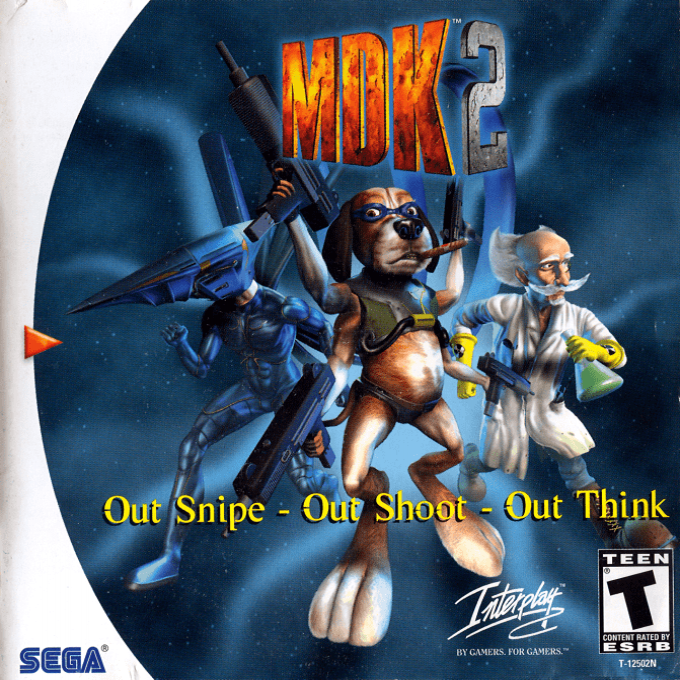
MDK 2 for Dreamcast is a science-fiction third-person action game from BioWare, published by Interplay in 2000. It continues the offbeat alien-invasion story of 1997's MDK, returning to the orbiting Jim Dandy station and its unlikely defenders: reluctant janitor Kurt Hectic, inventor Dr. Fluke Hawkins, and Max, the Doctor's four-armed robotic dog. The Dreamcast release was the game's first commercial version, arriving in North America in late March 2000 before editions for Windows and PlayStation 2. Rather than relying on one hero and one style of combat, MDK 2 builds its campaign around three very different playable characters.
The story starts after the team believes it has repelled the previous invasion of Earth. A remaining Minecrawler changes that assumption, and a new extraterrestrial threat draws Kurt, Max, and Hawkins into another fight that moves from Earth-bound danger to alien ships and worlds. Its presentation mixes a comic-book-like science-fiction premise with deliberately strange enemies, gadgets, and humor. The campaign is structured as a single-player adventure, and individual stages assign control to the character whose abilities the design is built around. That approach makes the change of protagonist part of the progression rather than a separate multiplayer-style selection.
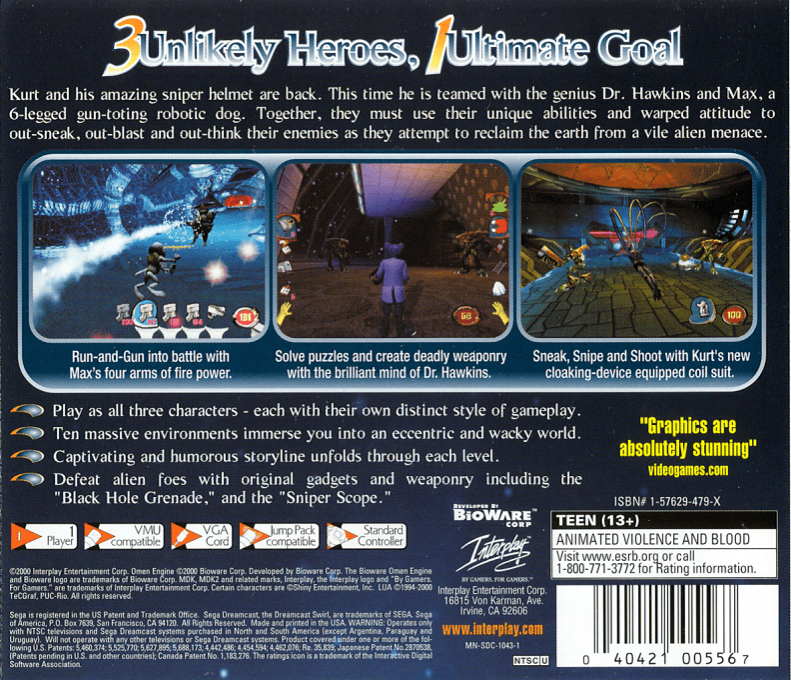
Kurt supplies the closest link to the first MDK. His Coil Suit incorporates a parachute-like ribbon chute for long drops, extended jumps, and air currents, while his arm-mounted weapon can convert into a helmet-mounted sniper system. The sniper view supports specialized ammunition, giving distance combat a different rhythm from regular firing. Kurt also has equipment such as grenades, decoys, and cloaking protection. His levels combine shooting, aerial movement, and careful positioning, with the chute allowing the Dreamcast game to make vertical spaces and gaps as important as straightforward enemy encounters.
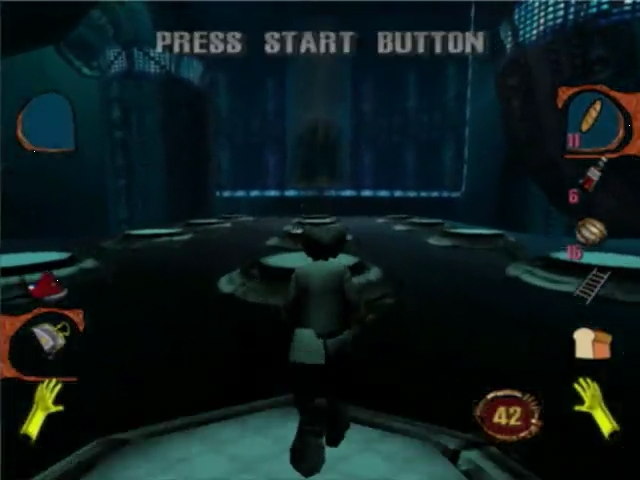
Max takes the action in a louder direction. Able to stand upright and fire multiple weapons at the same time, he is the team's most heavily armed member, with guns including handguns, shotguns, and rapid-fire weapons. Jet packs add mobility to his sections; one relies on fuel stations while another recharges when it is not being used. Dr. Hawkins, by contrast, is less resilient and is designed around puzzles and improvisation. He carries items separately in each hand and combines them to create the tools needed to proceed, with his atomic toaster serving as an especially fitting defensive invention. Moving between Kurt's precision shooting, Max's firepower, and Hawkins' item-based problem solving gives MDK 2 its central variety.
On Dreamcast, the game is a focused, linear console campaign with checkpoints and unlimited attempts, so learning a room, a jump, or a boss pattern is often part of making progress. Environments use platforming challenges, combat arenas, object puzzles, and large confrontations rather than treating every stage as a simple run-and-gun sequence. The original Dreamcast version predates later adjustments: the Windows release added selectable difficulty levels and manual saving, while the PlayStation 2 version appeared in 2001 as MDK 2: Armageddon with further level and gameplay changes. Those editions are related versions, but MDK 2 Dreamcast preserves the initial release design.
MDK 2 also occupies an interesting place in BioWare's early history. The studio followed its work on Shattered Steel and Baldur's Gate by taking over a series begun by Shiny Entertainment, using its Omen engine to make a fast 3D action sequel rather than another role-playing game. Credits for the Dreamcast version include BioWare staff Cameron Tofer and Greg Zeschuk in production and design, with Casey Hudson among the additional programmers. For Dreamcast players, MDK 2 remains a distinctive example of turn-of-the-millennium action design: a sequel that expands a sniper-led shooter into a three-character adventure of parachute descents, four-gun firefights, homemade contraptions, and an unapologetically eccentric alien war.
Gallery
Details
- Developer
- BioWare
- Publisher
- Interplay
- Genre
- Other Adventure
- Players
- 1
- Release Date
- March 31, 2000
- System
- Dreamcast