About
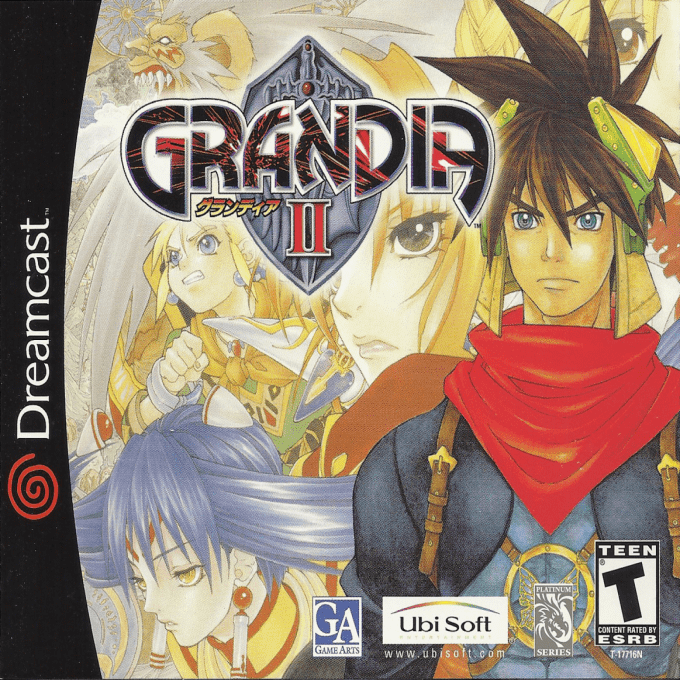
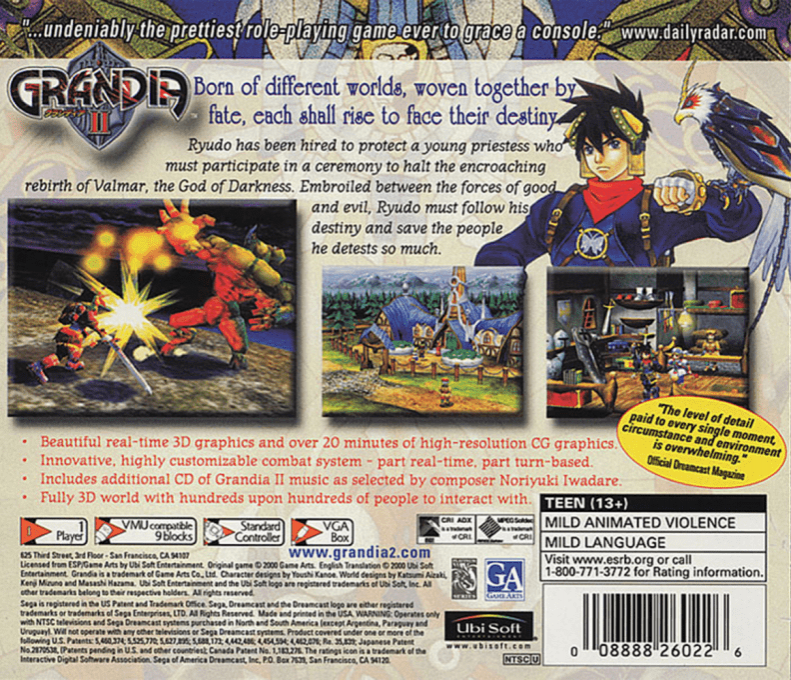
Grandia II for Sega Dreamcast is a single-player Japanese role-playing game from Game Arts, released in Japan in August 2000 and published by Ubi Soft in North America that December. It is the second numbered Grandia game, but it tells a new story with a different world and cast rather than continuing the first game's adventure. The Dreamcast edition is the original version, preceding PlayStation 2 and Windows conversions. Its fantasy journey follows Ryudo, a cynical freelance fighter known as a Geohound, and Skye, his sharp-tongued bird companion.
Ryudo is hired by the Church of Granas to escort Elena, a young Songstress, to a ceremony at Garmia Tower. The ritual goes disastrously wrong, leaving Elena connected to Millenia, a mysterious woman tied to the scattered power of Valmar, the god of darkness. Their task expands from a dangerous escort into a long search for answers about the church, the ancient conflict between Granas and Valmar, and the forces trying to bring Valmar back. Along the route, Ryudo’s party visits villages, ports, ruins, royal territory, and religious strongholds while its members confront personal histories as well as the threat facing the world.
Exploration takes place across towns, dungeons, and outdoor routes viewed in fully three-dimensional environments, a major visual change for the series after the original Grandia. Players speak with townspeople, acquire equipment and supplies, search locations, and advance through story-driven destinations. The active group grows beyond Ryudo and Elena to include the energetic young ruler Roan, the powerful beast man Mareg, and Tio, an ancient artificial being. Each brings a distinct weapon style and useful combat role, while the story frequently shifts attention between their goals, relationships, and discoveries.
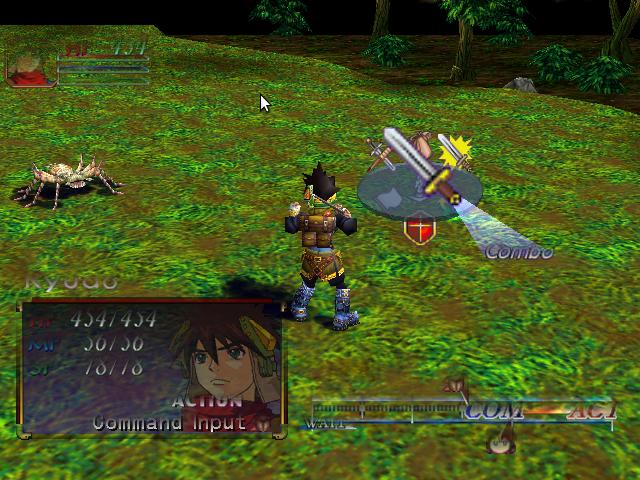
Grandia II Dreamcast uses the series’ Initiative Point battle gauge instead of a simple alternating-turn format. Icons travel along the gauge, showing when combatants can select a command and when that command will actually take effect. This timing lets players choose ordinary attacks, multi-hit combos, special techniques, items, guarding, and magic with an eye on enemy actions. A well-timed critical attack can interrupt an opponent preparing a move and push that opponent back on the gauge, so battle decisions involve both damage and disruption. Party members can also move within the combat area, making positioning part of reaching targets and responding to threats.
Character development is built around equippable Magic Eggs, skill books, and coins used to improve learned abilities. Magic consumes MP and can take time to cast, which makes the battle gauge especially important when planning healing, elemental attacks, or defensive support. Skills and special moves can be equipped to alter a character’s options and statistics, while weapon and spell choices help differentiate the party as the adventure progresses. The result is a command-based RPG system that rewards watching the timeline, choosing targets carefully, and deciding when delaying an enemy matters more than attacking immediately.
The Dreamcast release arrived as Game Arts’ first fully 3D entry in the Grandia series, with music by longtime series composer Noriyuki Iwadare. Japan received Grandia II from Game Arts in August 2000; Ubi Soft handled the December 2000 North American launch and the European release followed in February 2001. Later editions brought the game to other platforms, but this Dreamcast version is the foundation for its later ports and remasters. For players exploring Dreamcast role-playing games, Grandia II combines a self-contained fantasy story, a character-focused traveling party, and a battle system built around visible turn timing and interruption.
Gallery
Details
- Developer
- Game Arts
- Publisher
- Ubisoft
- Genre
- JRPG
- Players
- 1
- Release Date
- December 6, 2000
- System
- Dreamcast