About
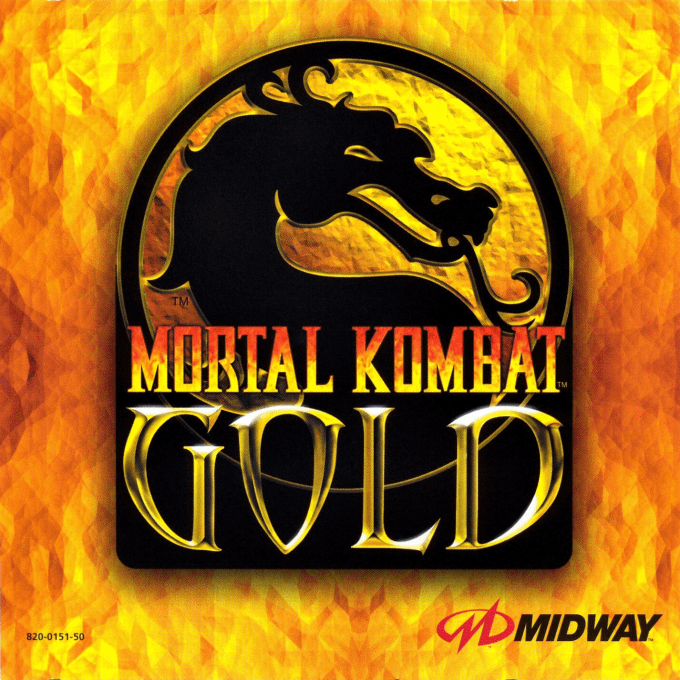
Mortal Kombat Gold is a Dreamcast fighting game released by Midway Home Entertainment in 1999 and developed by Eurocom. Built as an expanded console follow-up to Mortal Kombat 4, it arrived during the Dreamcast launch period and remains the series’ only official release for Sega’s 128-bit system. Its foundation is the one-on-one, weapon-enabled combat of Mortal Kombat 4, presented with the polygonal fighters and arenas that marked the franchise’s move into 3D.
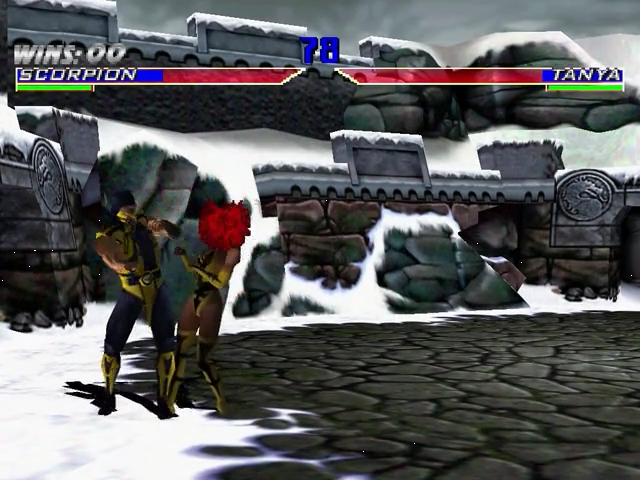
Matches revolve around reducing an opponent’s life bar with punches, kicks, throws, special moves and close-range attacks. Fighters can move around their rivals in three-dimensional arenas, while the familiar Mortal Kombat rhythm of blocking, jumping, crouching and chaining attacks still drives every exchange. Weapon pickups are part of the action: a combatant can draw a weapon during a round and use it to extend pressure or alter the range of an attack, though it can be knocked away and recovered by either fighter.
The game includes several ways to organize combat beyond a standard one-on-one bout. Players can set up two-on-two, team, endurance and tournament-style contests, challenge computer opponents through a chosen difficulty path, or use practice options to learn a character’s move set. Dreamcast controller inputs are mapped to the series’ attack buttons and directional commands, with the move index and training tools helping players work toward special attacks, combinations and finishing techniques.
Mortal Kombat Gold retains the conflict at the center of Mortal Kombat 4. The fallen Elder God Shinnok has escaped the Netherrealm and threatens Earthrealm, bringing familiar champions and villains into another supernatural tournament. Returning Mortal Kombat 4 fighters include Liu Kang, Raiden, Scorpion, Sub-Zero, Sonya Blade, Jax Briggs, Johnny Cage, Reptile, Quan Chi and Shinnok, alongside unlockable characters and the towering Goro. Each has individual moves, animation, weapons and a place in the game’s ladder-style progression.
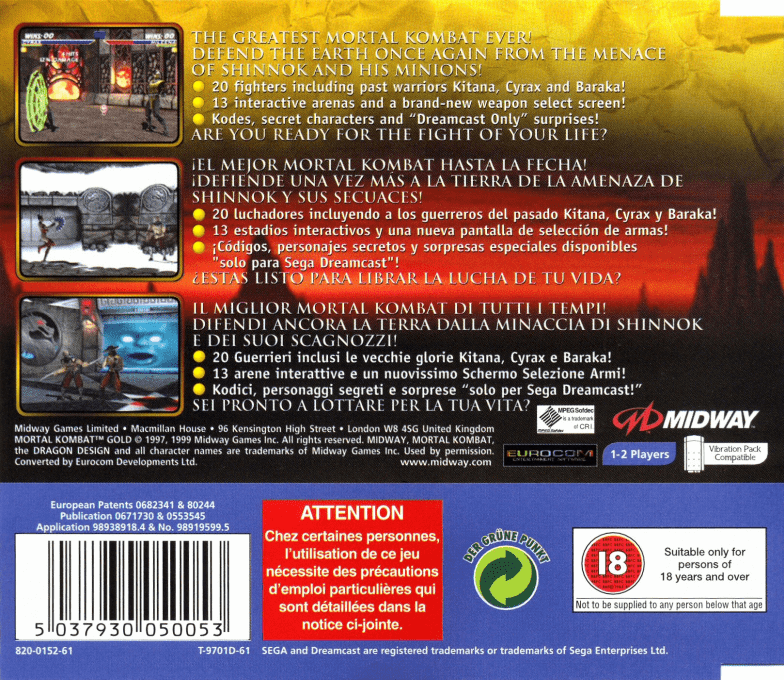
What distinguishes Gold from Mortal Kombat 4 is its enlarged selection of combatants and locations. Eurocom added returning series figures such as Kitana, Mileena, Cyrax, Kung Lao and Baraka, as well as Sektor as a secret fighter, broadening the choices beyond the original game’s roster. New arenas including the Church, Ladder, Netherrealm and Soul Chamber sit beside material drawn from Mortal Kombat 4, giving the Dreamcast version a larger stage list rather than simply reproducing the earlier arcade release.
The Dreamcast edition also carries the theatrical elements associated with the period’s Mortal Kombat games. Before and after fights, players encounter character-select presentation, arcade-style ladders, cinematic material and secret codes. Arena hazards and finishing moves preserve the series’ emphasis on decisive end-of-round moments, while alternate game modes make it possible to play against another person locally or work through longer sequences of computer-controlled opponents.
Mortal Kombat Gold occupies a specific place in the franchise’s history: it was both an updated version of the first fully 3D arcade Mortal Kombat and a launch-era showcase of an established fighting series on Dreamcast. Early copies were affected by technical problems, and Midway issued a revised retail version soon after launch; the later disc also restored functional Visual Memory Unit saving. For players exploring the Dreamcast library, it is a distinct snapshot of Mortal Kombat’s late-1990s transition between arcade roots, 3D combat and the sixth console generation.
Gallery
Details
- Developer
- Eurocom
- Publisher
- Midway
- Genre
- Fighting
- Players
- 1-2
- Release Date
- October 29, 1999
- System
- Dreamcast