About
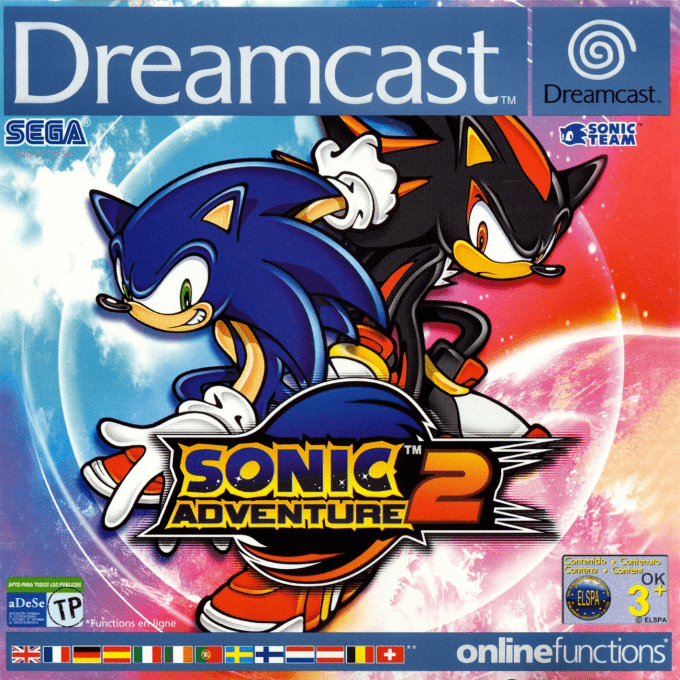
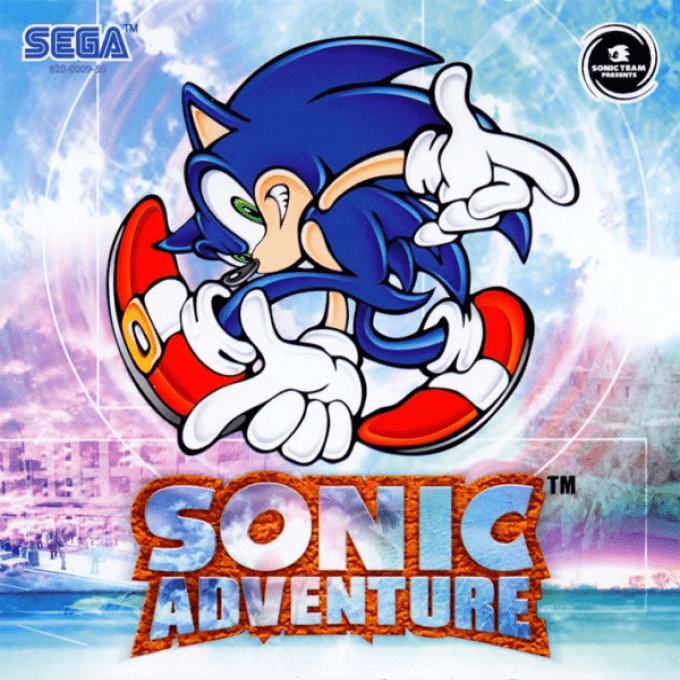
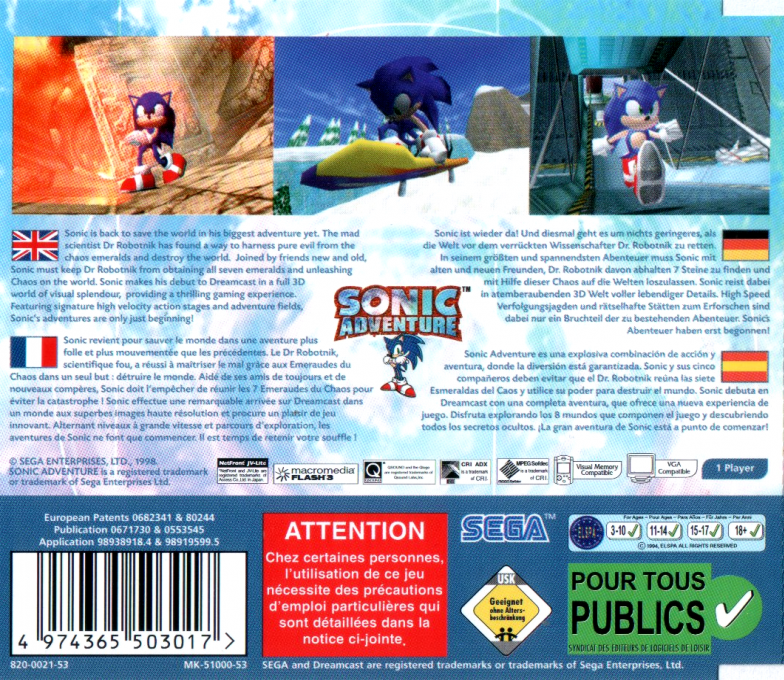
Sonic Adventure is Sonic Team’s fast-moving 3D platform adventure for Sega’s Dreamcast, published by Sega. This record represents the original European Dreamcast release of 14 October 1999, not a later port: the game first arrived in Japan on 23 December 1998 and reached North America on 9 September 1999. It was the series’ first full 3D action game and a major Dreamcast showcase, placing Sonic’s speed-driven platforming in a connected world of towns, ruins, facilities, and coastal stages.
Dr. Eggman releases Chaos, an ancient being tied to the Master Emerald and the seven Chaos Emeralds, then attempts to use its growing power for his own plans. The story is told through six intersecting campaigns: Sonic races through stages; Tails competes to reach goals before Sonic; Knuckles searches for fragments of the shattered Master Emerald; Amy evades a pursuing robot and uses her hammer; Big fishes for his missing friend Froggy; and E-102 Gamma shoots through robot-filled areas. Each route reveals pieces of the same crisis, with their combined progress leading to the final confrontation.
Between action stages, players explore three Adventure Fields—open hub areas that connect locations, characters, upgrades, and level entrances. These quieter spaces make exploration part of progression, while the action stages retain familiar Sonic ideas such as rings, power-ups, checkpoint markers, bosses, and alternate objectives. Sonic’s homing attack, Tails’s flight, Knuckles’s climbing and gliding, Amy’s hammer, Big’s fishing rod, and Gamma’s ranged fire give the six campaigns distinct controls and purposes rather than simply repeating one route with different characters.
The action-stage structure makes room for set pieces beyond a straightforward run to the finish. Sonic’s routes emphasize high-speed traversal, loops, ramps, and enemies, while other scenarios frame the same world as a race, a timed search, a chase, a shooting course, or a fishing outing. Subgames include racing, pinball, sandboarding, and rail shooting. After completion, Trial Mode lets players revisit cleared action stages and minigames, while emblems reward repeat objectives such as finishing a stage under a time limit. This balance of directed levels and explorable hubs gives the game both momentum and a sense of place.
The Dreamcast original also introduced the Chao Garden, where players hatch, name, feed, and raise Chao using small animals collected in stages. Chao can develop their abilities and enter Chao Races, making the garden a substantial companion activity rather than a brief collectible screen. With a Dreamcast Visual Memory Unit, a Chao could be transferred to Chao Adventure, a portable minigame in which it travelled and improved its skills. The original manual specifies separate VMU storage for regular saves and the A-Life data used by this feature.
The production belongs to Sonic Team, with Takashi Iizuka directing and Yuji Naka producing. Its presentation shifted the series toward voiced story scenes, a modernized character look, and a rock-led score associated with “Open Your Heart.” The game’s six protagonists include familiar faces Sonic, Tails, Knuckles, and Amy alongside Big and Gamma, both introduced here. Their different viewpoints turn Eggman’s plan, Chaos’s history, the Chao, and the Master Emerald into a single larger narrative instead of a Sonic-only quest.
Sonic Adventure’s original release was created alongside the Dreamcast and uses its hardware to present large 3D environments, character dialogue, cinematic scenes, and the VMU companion feature as parts of one package. Its world moves between Station Square, the Mystic Ruins, and the Egg Carrier, with flashbacks explaining the relationship between Tikal, Chaos, the Chao, and the ancient echidna civilization. The climax brings the routes together as Sonic uses the Chaos Emeralds to face Perfect Chaos. The result is a story-led format that broadened the series beyond its earlier 2D, stage-by-stage structure.
Sonic Adventure was later revised for Dreamcast as Sonic Adventure International, which added English voices, subtitle languages, online-ranking features, environmental and idle sounds, and an emblem list; those additions should not be mistaken for the December 1998 Japanese original. The 1999 European release represented here is the localized Dreamcast version, released as Sonic Adventure, with English and Japanese audio and multiple subtitle languages.
It is also distinct from Sonic Adventure DX: Director’s Cut, the GameCube and Windows update released in 2003. DX retains the core six-character adventure, hub fields, action stages, and Chao raising, but adds revised graphics and minigame content, a Mission Mode with 60 missions, unlockable Game Gear games, and Game Boy Advance connectivity for moving Chao between compatible games. Those DX-specific additions are not features of this original Dreamcast record.
Gallery
Details
- Developer
- Sonic Team
- Publisher
- SEGA
- Genre
- Platformer
- Players
- 1
- Release Date
- October 14, 1999
- System
- Dreamcast