About
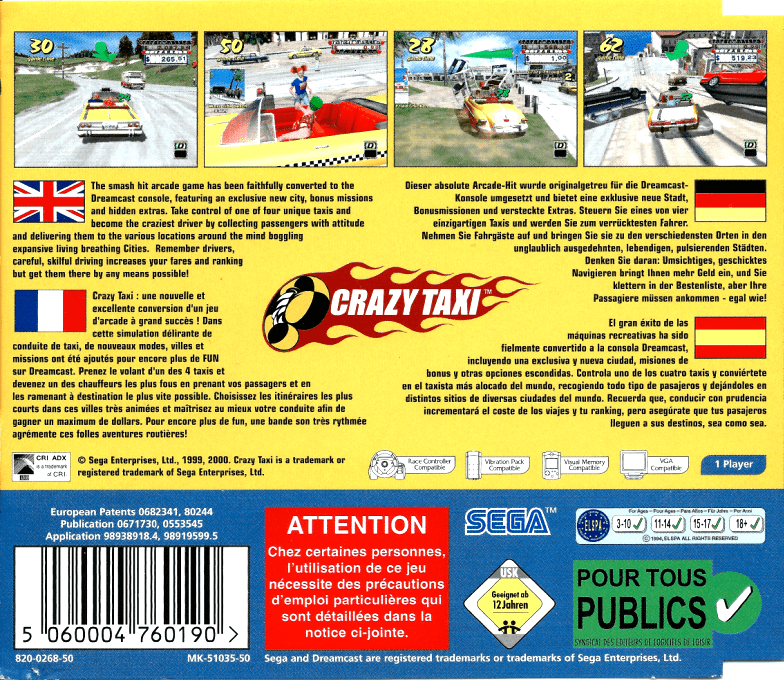
Crazy Taxi for Dreamcast is Sega’s fast, score-driven driving game, released for the console in 2000 after its 1999 arcade debut on Sega’s Naomi hardware. Developed by Sega’s arcade team, then known as AM3 and later Hitmaker, it turns a simple job—collecting fares—into a constantly moving race against the clock. Players choose one of four drivers, including Axel, B.D. Joe, Gena and Gus, and head into a bright, traffic-filled city with a passenger waiting to be picked up.
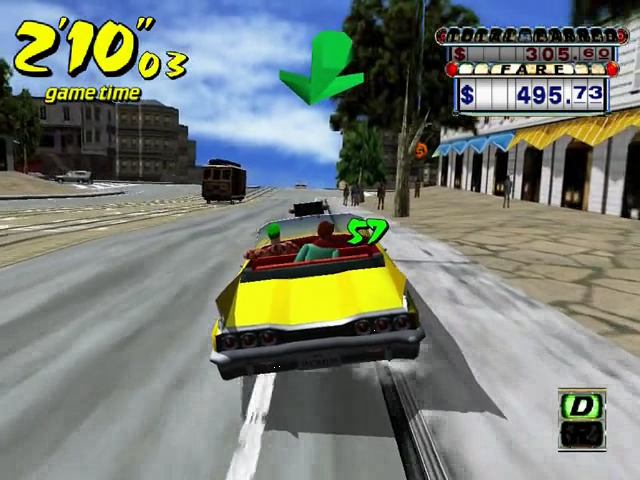
Each fare begins when a customer climbs into the cab and names a destination. A large directional arrow points toward the goal, while a visible time limit makes every route choice matter. Reaching the marked drop-off area quickly earns a better fare and can add precious time in the arcade-style ruleset; arriving too late sends the customer away without payment. The objective is not to follow a prescribed course, but to learn the streets, judge shortcuts and keep finding the next passenger before the session ends.
The Dreamcast game uses accelerator, brake and steering controls in an intentionally exaggerated style. A driver can cut through traffic, jump over changes in elevation and thread past vehicles to build a fare, while the city’s steep roads and broad junctions reward quick reactions. Near misses and daring driving contribute to the running total, so a successful trip depends on more than simply taking the shortest line. The game’s navigation arrow gives a general direction rather than a turn-by-turn route, leaving the player to turn familiarity with the map into faster deliveries.
Sega’s home version adds material beyond the coin-operated release. Arcade mode recreates the original city, while Original mode provides another urban course for exploration and route learning. Players can select timed sessions of different lengths or use the arcade rules, in which strong deliveries extend the opportunity to continue. Crazy Box supplies a separate collection of driving challenges that ask the player to apply the same handling skills in focused tasks, giving the Dreamcast edition practice-style objectives alongside its regular fare runs.
The game is set in a fictional, sunny American cityscape whose hills, waterfront roads and dense traffic create a loose West Coast atmosphere. Its passengers range from ordinary commuters to intentionally eccentric riders, and the game communicates their urgency through color-coded fare indicators and energetic animations. Rather than build a traditional story campaign, Crazy Taxi makes the city and its routes the central content: a brief run can be satisfying on its own, but repeat play reveals more efficient ways to connect landmarks, avoid congestion and preserve time.
Crazy Taxi also carries the loud arcade character of late-1990s Sega. The original Dreamcast release uses licensed punk-rock tracks from The Offspring and Bad Religion, matching its rapid starts, hard braking and deliberately unruly driving. Product-branded destinations appeared in this version as part of the city’s scenery; later releases changed some of those references because of licensing. The Dreamcast port became a key early entry in the Crazy Taxi series, later followed by sequels and versions for other platforms, but this release remains notable for combining the arcade map with its own Original mode and Crazy Box challenges.
Gallery
Details
- Developer
- SEGA
- Publisher
- SEGA
- Genre
- Arcade Racing
- Players
- 1
- Release Date
- February 18, 2000
- System
- Dreamcast